
A man’s breathing could be heard in the phone.
“Mrs. Marika, can you hear me?”
“I hear you. Where are you?”
Andrei moved toward me.
“Marika, hang up.”
For the first time I did not obey his order.
“Send me everything. Right now.”
“It has already been sent. The file is in your email. The original will be handed to a lawyer tomorrow morning.”
“Who are you?”
“David Meladze. I was an administrator at the clinic where you were brought seven years ago.”
The call ended.
Such silence fell over the house that I heard the sound of the refrigerator motor working in the kitchen.
Andrei snatched the phone from my hand.
“You do not know what you are doing.”
“Now I know what you were doing.”


Nata stood at the door and was crying. Lev appeared on the middle step of the stairs. He held a small wooden car in his hand.
“Mother, what is happening?” he asked.
He did not say the word “Mother” to me. He looked at Nata.
Nata lowered her eyes.
Andrei immediately changed his voice.
“Lev, go upstairs to your room.”
“Why is Nata crying?”
“I said go!”
The boy jumped. And I felt a strange pain that resembled neither doubt nor anger. It was mourning for the child whom I had loved for six years and had now learned had never been mine.
That same evening I called a lawyer. The woman, named Eka Kavtaradze, listened to everything and finally said to me calmly:
“Turn off the phone and sign nothing.”
“Andrei says that he did everything for me.”
“Whoever hides the truth from you and changes treatment records is not your protector.”
“Can you help me?”
“I will be at your house tomorrow morning. And one more thing: if your husband asks you to talk to him alone, refuse.”

That same night Andrei called his lawyer three times. I stood by his office and listened through the door.
“You told me that the records no longer existed,” Andrei said.
A man’s voice could be clearly heard from the other side.
“I told you that the people who knew no longer worked at the clinic. Evidence is another matter.”
“I pay you to solve this.”
“You paid me to keep silent. Now this concerns a criminal offense. I no longer represent your interests.”
The call ended.
Andrei stood motionless for several seconds. Then he took hold of the door handle and saw me.
“Were you listening?”
“For seven years you listened to me while I thought I was living only in silence.”
He rubbed his face.
“Marika, I was afraid of losing you.”
“You had already lost me on the night when you signed for the treatment of poisoning beside my bed.”
“I was only giving the medicines.”

“No. You were giving them to the person who was changing the dose.”
Everything was visible in the file sent by David. The clinic records said that the sedative prescribed for me had been replaced several times with another medication. Each change was accompanied by Andrei’s signature. On the last page it clearly said: “The patient’s husband requests that the diagnosis remain unchanged for the family.”
I read this sentence aloud.
Andrei raised his head.
“I do not remember this.”
“But you wrote it.”
“The signature may have been forged.”
“Then the police will have to find that out.”
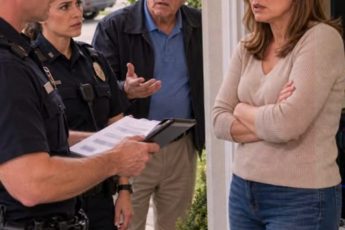
In the morning Eka came. With her there were also two investigators and a social worker. Nata hid Lev behind her.
“We do not want to take anyone away,” Eka said calmly. “We want you to answer all the questions.”
Andrei immediately picked up the phone.
“I will call my brother.”
“Your brother has been dead for seven years,” I said.
This was the first time I mentioned his name aloud and heard calmness in my own voice.

The investigator took the records.
“Mr. Andrei, we have several questions for you.”
“This is a family matter.”
“Poisoning is not a family matter.”
Nata sat down on a chair. Lev stood beside her and turned the wooden car with his finger.
Then the investigator placed a voice recorder in the room.
“Before we begin, we want you to listen yourself to the conversation recorded yesterday in your office.”
Andrei shook his head.
“It is an illegally obtained recording.”
“This device was connected to the house security system,” Eka said. “You yourself turned it on when you thought that no one could see you in the house.”
The recording started.
His own voice sounded:
“I pay you to solve this.”
Then the lawyer’s voice:
“I no longer represent your interests.”

Andrei first froze. Then he sat down on the chair.
Hearing his own words turned out to be the heaviest punishment. He covered his face with his hands, but his voice could still be heard.
“Turn it off.”
“No,” I said.
He looked at me.
“Did you want this? My destruction?”
“No. I simply wanted my life no longer to be your secret.”
That day the investigators took Andrei and Nata for questioning. Lev was taken to a temporary children’s center accompanied by a social worker, because it was no longer possible for him to remain at home.
When the door closed, I was alone in the living room for the first time.
Our family photograph was still hanging on the wall.
I took it down.
Andrei and Nata stood beside each other. Lev was between them. In the corner of the photograph my hand could be seen, which had accidentally entered the frame years before.
I did not tear up the photograph.
I simply put it in a drawer.


I entered Lev’s room. His wooden car was no longer on the bed. On the pillow there remained only a small paper crown that he had once made for me, and on it, in large uneven letters, was written: “The best mother.”
I looked at it for a long time.
Then I took the crown and put it in my suitcase.
Three weeks later I went to the doctor. My sight had not fully returned, but I had enough to see the street, distinguish faces, and choose my own path. The doctor told me that recovery would proceed slowly.
“Slowly does not frighten me,” I said. “For the first time I know where I am going.”
I moved to another city. I rented a small apartment on the fourth floor, where the smoke of bakeries could be seen from the window in the morning. I began working in a children’s library. I read fairy tales to children, while they listened to my voice longer than to my eyes.
Lev visited me once a week.
At the first meeting he sat silently for a long time.
“Are you still angry?” he asked.
“Sometimes.”

“At me?”
“No, Lev. At the people who deceived both of us.”
He put the wooden car on the table.
“I did not know then that you were not my mother.”
“I know.”
“But I still loved you.”
These words proved stronger for me than a court verdict.
“I loved you too,” I said. “Love cannot cancel the truth.”
He rested his head on my shoulder. I ran my hand over his hair, but this time the movement no longer resembled taking away someone else’s possession. It was a farewell to the lie that had raised both of us.
Four months later the court opened a case against Andrei. Nata gave evidence and admitted that the child had been hers from the beginning. Andrei partially admitted guilt, but I received a letter from him only once.
“Come back to me,” it said.
Then: “I made a mistake.”
The third message was the shortest:
“Can we start again?”
I did not write a reply.

Eka told me that silence is also an answer.
And I realized for the first time that silence had not always been darkness. Sometimes it is a door that you finally close yourself.
The first snow came at the end of November. When I left the library, white flakes were falling on the street lamps. Some could be seen clearly, while some were only small rings of light.
My dark-green wool scarf was still in my bag. In the same seam of the scarf where I had once hidden two of Lev’s hairs, I now had a small house drawn by Lev sewn in.
The house had two windows.
One for me.
One for him.
I wrapped the scarf around my neck and went down the street through the snow.
This time no one was holding my hand to show me the way.
I could see the way myself.
Missed the beginning?