
“And in the application she indicated that you had paid her debt,” Marian finished.
The phone froze in my hand.
“How much did she try to take?”
“Twenty-eight thousand. The application has not been approved yet, but she used your cadastral data.”
That night the bank called me, and the police made a second call. For the first time I felt not fear, but clarity. Belle no longer wanted my house only as a place to live. She needed my trust as a document, my property as collateral, and my silence as a signature.
In the morning Belle came to my yard.
It was raining. Her hair clung to her face, but she did not open the umbrella.
“Your mother said the application was a misunderstanding,” I told her.
“The bank itself added some of the information.”
“You signed it.”
“I only filled out a preliminary form.”
Marian pointed to the car standing nearby.
“The form says that the property owner gave verbal consent.”
Belle bit her lip.
“You were not going to help anyway.”
“I was going to help. I was not going to let you use my name.”
“You were always like this. You gave us money, but you did not let us into your life.”
Those words hurt me more than I wanted to admit. For seven years I had considered Belle my daughter. I baked cakes for her children’s birthdays, helped with bills, and spent nights at the hospital when she was ill.
But love does not give a person the key to someone else’s house.
“I had left a door open in my life for you, Belle. But you tried to tear down the wall.”

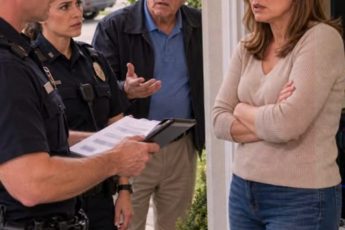
The police explained to Belle that an investigation would begin against her for attempted fraud and attempted unauthorized entry. No one was arrested that morning. I did not want a scene either. I simply watched as the officer told her that she could contact me only through an attorney.
Belle looked toward me.
“Are you really doing this?”
“No, Belle. You did it. I am only no longer covering it up.”
That same evening Caleb came alone. He held a folder of his marriage records in his hand, and his face was tired.
“I hired an attorney,” he told me.
“For Belle?”
“For me. I want to understand where I was in all this.”
He sat at the kitchen table. I put tea in front of him, but I did not drink any myself.
“Mom, do you still have that recording on your phone?”
“Yes.”
“Can I listen to it?”
I turned on the recording.
Belle’s voice sounded in the room: “Mom does not like conflict. When everything is in place, she will no longer be able to say no.”
Caleb listened with his head bowed. For the first time he heard his own wife’s words not during an argument, not against a background of explanations, but in the calm of a cold room.
His voice was heard in the recording:
“But she has already said no.”
Belle’s answer came:
“Her no will change.”
Caleb asked me to stop it.
“Was that me saying this?”
“Yes.”
He closed his eyes.
“I thought she was only asking you for help.”
“You did not want to understand, because then you would have had to make a choice.”

He sat silently for a long time.
“I am your son. Why could I not protect you?”
“Because protection is not always a loud battle. Sometimes it is hearing the truth and standing beside it.”
That week the bank canceled the application. All documents used in the loan case were handed over to the investigation. Belle wrote me an apology letter, but in the same letter she again repeated that she had “no other way.”
I did not answer.
Two days later I opened the cottage door.
Only three things remained there: a trace of dust on the floor, one broken glass, and the brass-colored lamp that Belle had been unable to take.
I placed the lamp by the window.
The room was empty, but for the first time in a long while it seemed mine again.
Within a few weeks Rosalie found another apartment. I paid the first month’s rent, as I had offered at the beginning. Vernon thanked me and lowered his head.
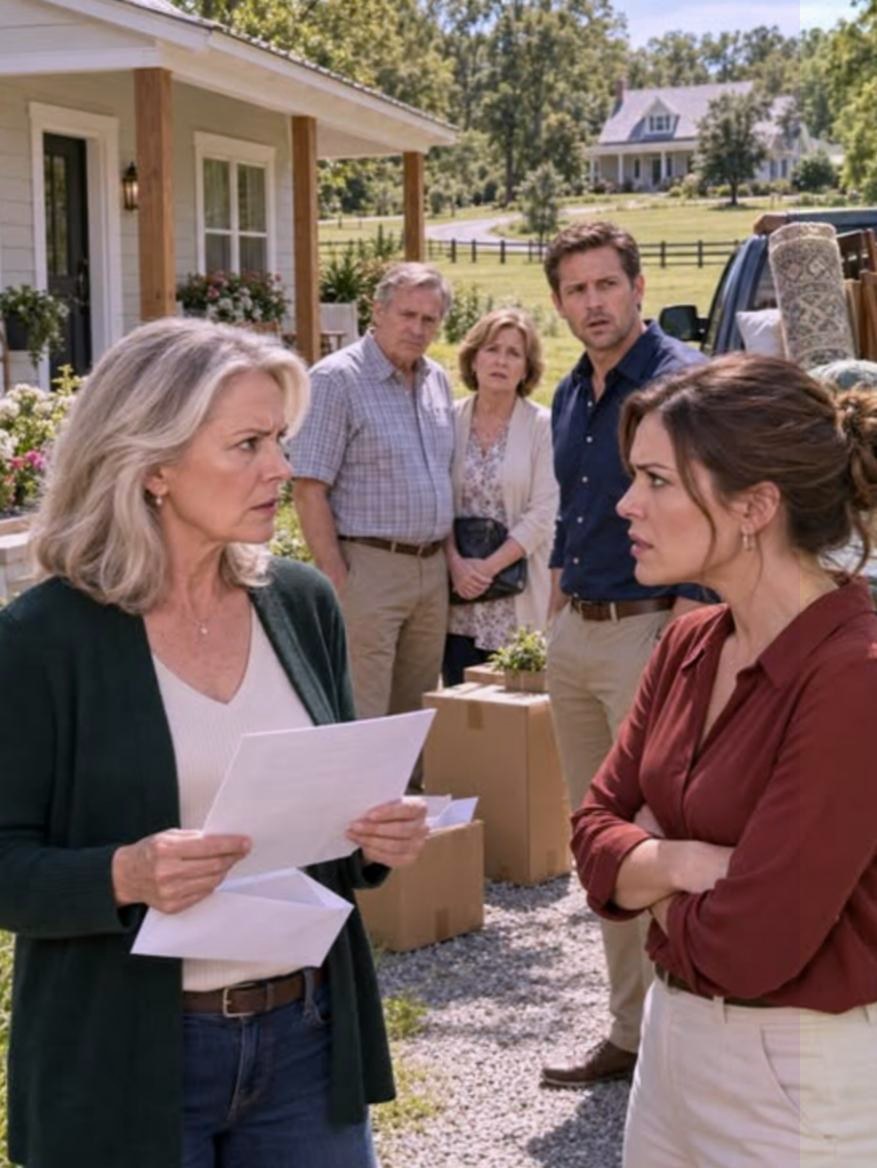
“Forgive us for leaving our things in front of your house,” he said.
“You did not leave them. You were told that permission existed.”
Rosalie wiped her eyes.
“I should have asked you too.”
“Now you know that you should never avoid asking.”
Three months later I went to court as a witness. Belle sat in the room with her attorney. Caleb stood farther away from me. He no longer lived with Belle.
The case ended with an agreement. Belle admitted using the documents, the bank suffered no loss, but she was sentenced to a fine, community service, and a ban on any direct contact with me for six months. The hardest thing for her was probably that Caleb testified.
I did not celebrate her punishment.
I simply stopped trying to protect her from the consequences she had chosen.

Six months later, on a cold November morning, my granddaughter Marisa came to the cottage. She held a colorful sheet of paper in her hand.
“Grandma, may I put my desk here?”
“If you ask me first, always.”
She laughed and spread the paper on the table. Drawn on it was a small house, and by the window stood a large brass-colored lamp.
“Is this you?” I asked.
“No. This is a house that was still waiting for its owner.”
I saw the first snow through the window.
I arranged a small workroom in the cottage. In the mornings I made wooden shelves for the neighboring children, and in the afternoons I worked in the garden. In the evenings I sewed curtains. The smell of boiled apples still filled the house, and the old floorboards answered footsteps.
One morning I received a message from Belle on my phone.
“Now I understand everything. I want to talk to you at least once. Caleb has also returned home. Maybe we can start over.”
I looked at the screen for a long time.
Then I wrote only one sentence:
“I wish you peace, but you can no longer return through my door.”
I deleted the message and put the phone on the table.
In the evening Marisa pinned her drawing to the wall. The corner of the paper moved in the wind, while the brass-colored lamp cast a warm circle on the floor.
I locked the door, put the key in my pocket, and for the first time I was not afraid that someone would mistake this for my refusal.
My house was quiet.
But this time the silence was mine.
Missed the beginning?