
At that same moment I called the hospital director.
“No one is to enter my house until the lawyer arrives,” I told him.
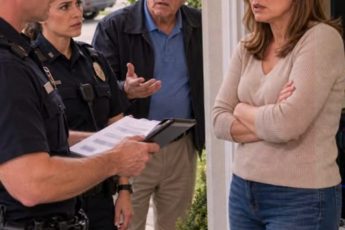
“Rowan, they have already entered. They have a police warrant.”
Mariz heard this and snatched the phone from my hand.
“You ruined everything,” she whispered.
“You almost killed Lark.”
“I was helping her!”
“Secretly poisoning a child is not called helping.”
Beckett was still standing at the door. His hands hung down, as if all strength had left his body.
His lawyer called ten minutes later.
“Beckett, don’t say anything until I arrive at the scene.”
“Mariz was poisoning my child.”
“That still has to be proven.”
“I heard the recording myself.”
The lawyer fell silent.
“Do not send the recording to anyone.”
“I have already sent it to the police.”
“Then I cannot defend you in this case if you are carried away by emotions.”
“No,” Beckett replied. “You cannot defend me because you were on her side from the beginning.”
The lawyer ended the call.


Mariz hurriedly called her brother, then a friend, then the former manager of the pharmacy. Every call ended with one phrase.
“Tell me that you did this.”
But no one answered in the way she expected.
The police sealed her bag. They found the same poison in the second bottle as well.
Then the investigator took the recorder found under Lark’s bed.
Mariz thought that it was only the child’s fear.
Until she listened to the recording again.
In the hospital’s small conference room, at eight o’clock in the evening, the investigator played the sound from the speaker.
“Open your mouth, Lark. Ten drops.”
Mariz was sitting in a chair.
Her own voice sounded in the room like the voice of a stranger.
“If you don’t drink, I’ll tell Dad that you are a bad girl.”
She raised her head.
“I did not say that.”
The investigator stopped the recording.
“This is your voice. We have already ordered an examination.”
“I was frightening the child so that she would take the medicine. Nothing else.”
“Which medicine?”
Mariz could not answer.
“The one written on the label,” she said at last.

“The label turned out to be false.”
Her lawyer, who finally came after all, stood up from his chair.
“Mariz, say nothing more.”
But she was already listening to her own words and for the first time understood that the voice which had deceived others all this time was her voice.
That night the police took several boxes from Beckett’s house. In them they found medicines prescribed in Lark’s name, altered labels, and copies of my electronic signature.
The second name indicated on the document was Mariz’s uncle, Edgar Bellamy. He worked as an administrator at a private clinic and had access to data from my hospital’s old system.
At first Edgar denied everything.
Then the investigator showed him a video.
The camera showed him entering the hospital archive on the night my password was used.
“Mariz told me that she only needed the documents prepared,” he said.
“Was poisoning the child also only preparing documents?” the investigator asked.
Edgar lowered his eyes.
Mariz’s plan turned out to be simple and terrible. She wanted Lark to become permanently ill, while Beckett remained dependent on her for help and care. After the wedding, both of them would have guardianship rights. Then Mariz would also receive Beckett’s life insurance, because he had already signed several financial documents.
But what she was hiding most of all was even more painful.
The house left in the name of Beckett’s deceased wife belonged to Lark. Mariz wanted the girl to be legally declared incapable so that she could take control of the property herself.

Lark remained in the hospital for three weeks.
The thallium slowly left her body. Her hair temporarily fell out, her hands hurt, but every day she walked for longer.
One morning she asked me:
“If I had not had the flowerpot, would I have died?”
It was difficult for me to answer.
“You were very brave.”
“No,” she told me. “I was simply helping the flower.”
It was the heaviest sentence I heard that week.
Two months later the court considered the case of Mariz and Edgar. Mariz admitted the crime so that she would not have to give additional testimony against Lark. Edgar made a deal and handed all the documents over to the investigators.
I did not go to court for revenge.
I went only because I stood beside Lark.
Mariz looked at me once in the courtroom.
“You took all this away from me,” she told me.
“No,” I answered. “You did it yourself.”
Beckett sold the house and moved with Lark to a small town by the river. I began working there at a children’s clinic, and returned to the hospital three days a week.
Lark started school for the first time at the end of November.
There was a new plant on the window of her room. This time she chose a small lemon tree herself.
“I will pour only water on this,” she said.
“Only water,” I promised.
On the day of the first snow she called me.
“Doctor Rowan, today Dad made pancakes and no medicine was hidden in any of them.”
“That is wonderful news.”
“There is another piece of news. I learned to draw.”
The next day she brought me an envelope. Inside was a drawing: two children, a large yellow sun, and a pot standing by the window. Green leaves had grown in the pot.
Below it was written: “Nothing dies here anymore.”

Several weeks later I received a letter from Mariz. It had been sent from the prison control department.
“Tell Beckett that we should start everything over. Tell Lark that I never wanted her death. You know too, don’t you, that I am not a bad person.”
I held the letter in my hands for a long time.
Then I folded it and did not send it to Beckett.
Lark no longer needed the truth from the person who had used the truth against her so many times.
I sent only one short reply to the prison address:
“We are moving forward. Please do not contact us again.”
That evening I entered Lark’s room.
The small lemon tree had produced a new leaf. Beside it stood the old, burned pot that Beckett had brought from the hospital. Black soil could still be seen along its edges. Lark did not want to throw it away.
“Why do you keep it?” I asked.
She shrugged.
“So I remember when I decided not to stay silent anymore.”
Snow was falling outside the window.
Lark put a small paper flower into the old pot.
This time nothing died there.
Missed the beginning?