
David slammed the yard gate so hard that the rusty lock fell off.
I followed behind him, but Lidia grabbed my arm.
“Don’t go alone.”
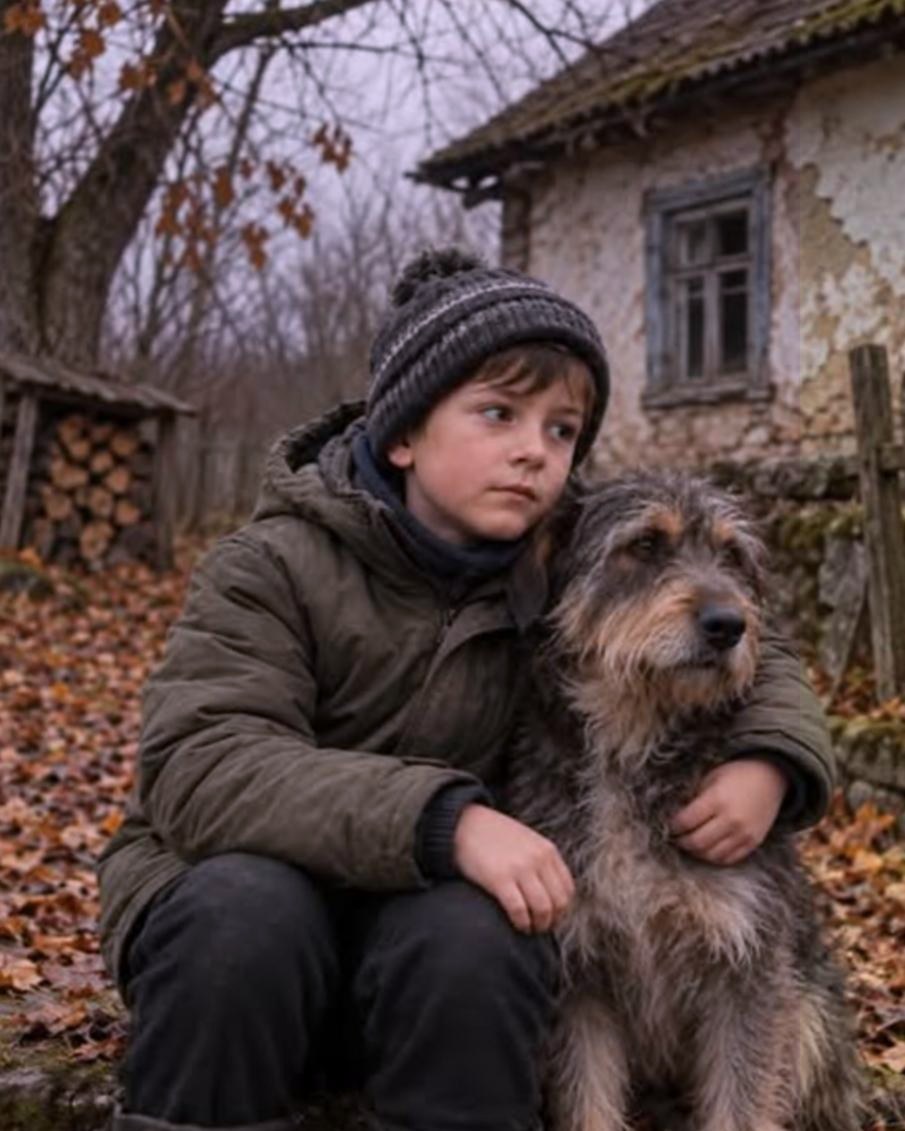
Matvey clung to Lokhmaty.
“Grandma, you have to look at that drawer at home.”
“Which drawer?”
“On Mom’s desk. She told me to hide it there if Father came back.”
We reached the house almost running. The rain struck my face, but I could no longer feel the cold. Only one thought revolved in my head: David had my key.
The door was open when we arrived.
The chairs in the kitchen were overturned. In the bedroom, the cabinet door had been torn off. Old photographs of my family lay on the floor.
David had turned everything upside down.
“Matvey, tell me what you hid!” His voice came from the other room.
The boy pressed himself against the wall.
I stepped in front of him.
“Leave this house right now.”
David smiled ironically.
“You still don’t understand whom you are fighting.”
“Now I understand very well.”

“The boy heard something he should not have heard. This recording means nothing.”
“Then why did you break into my house?”
He could not find an answer.
At that exact moment, cars stopped in the yard. Two investigators and a uniformed police officer entered. David tried to escape, but Lidia hooked a chair that had been placed by the door around his legs. The man fell to the floor.
“Don’t move!” the police officer shouted.
They put handcuffs on David. He looked first at me, then at Matvey.
“You will destroy your mother if you continue this.”
Matvey’s face turned white.
I knelt in front of him.
“You will never threaten him again.”
“You don’t know what happened that night.”
“Now everyone knows.”
The investigator opened the folder. The number on Lokhmaty’s collar, Yulia’s letter, the recording, and the veterinary certificates matched one another. The dog had indeed belonged to David. Several years earlier David had tried to steal money from the warehouse. Lokhmaty was there, while his brother got under a truck and died.
David shifted the responsibility onto someone else. Yulia learned the truth by chance and left the city after the divorce. She was afraid that David would use Matvey against her.
The hardest thing was that Matvey had heard everything.
“Mom told me to keep quiet,” the boy said. “She told me not to speak to anyone until we were safe.”

I wrapped my arms around him.
“You are no longer alone.”
The investigator played the recording for David again. The man sat on a chair, his hands bound in front of him. His own voice could be heard in the room again and again.
“If you find the boy, you won’t need the dog anymore.”
David lowered his eyes.
“I didn’t say it like that.”
The investigator switched off the recorder.
“That is your voice.”
“I was only warning him.”
“No. You were blackmailing the child.”
David fell silent for the first time.
His lawyer came too, but after seeing the materials in the folder, he did not stay long.
“I won’t be able to defend you in this case if they also obtain additional testimony,” he told David.
“You are my lawyer!”
“I was. Now I only advise you to exercise your right to remain silent.”
David leaned his head against the wall.
That night a strange silence fell over the house. It was as if even the walls had grown tired from years of fear.
Matvey went into his room. Everything there was in disorder. I found his small bag under the bed. Inside were two empty bread-wrapping papers, a broken pen, and a small cloth bag full of Lokhmaty’s fur.

I recognized that cloth. It was the pocket of my old kitchen apron, which Matvey had cut out for the dog.
The boy picked up the bag.
“I hid this in the house so Father wouldn’t find it.”
“Now you won’t need to hide it anymore.”
“He really won’t come back?”
“No.”
“Will Mom come back?”
I did not dare answer that question.
“She’ll call you,” I said at last. “And this time you’ll tell her everything yourself.”
Yulia called that same night. Her voice came from far away, but for the first time it was not trembling.
“Matvey, I’m here.”
The boy held the phone with both hands.
“Mom, I found Lokhmaty.”
“I know, dear.”
“Father came too.”
A long silence fell.
“Don’t be afraid anymore,” Yulia told him.
Matvey closed his eyes.
“I’m not afraid anymore. Grandma is with me.”

Three weeks later, a case against David was officially opened. The investigation confirmed the old theft, the threats, and the illegal entry into the house. Yulia decided to return from Poland. For the first time in years, we sat together in our kitchen.
David’s trial began, but I did not go to that hearing out of a desire for revenge. I simply wanted Matvey to see with his own eyes that the truth could not be trampled underfoot.
When David saw us, he smiled irritably.
“You ruined all of this.”
Matvey looked toward him.
“No. You ruined it yourself.”
It was the first long sentence he had said to his father.
David could not answer.
Months passed.
We treated Lokhmaty at the veterinarian’s. His leg did not recover completely, but now he walked slowly around the yard and lay in sunny places. Matvey went to him every day after school, although he no longer returned to the old abandoned house.
We replaced the windows in that house and turned it into a small workshop. Matvey made wooden birdhouses there. The first time he sold one, he spent the money on Lokhmaty’s food.
In December the first snow came. In the morning Matvey drew a dog on the window, and beside it he drew three people: himself, me, and Yulia.
“Why didn’t you draw Father?” I asked carefully.
He put down the pencil.
“Because he doesn’t live in our house.”
There was neither hatred nor triumph in these words. Only the truth.
Yulia stayed with us. She no longer needed to go abroad. She started working at a small bakery at the end of the village, and every morning I prepared sandwiches for school.
This time Matvey ate both of them.

One evening we received a letter from David. It was short.
“I want to talk to Matvey. Everything could be different.”
Yulia put the letter on the table.
“What should we answer?”
Matvey stood by the window. Lokhmaty lay at his feet.
“Tell him that we are fine now.”
“Nothing else?”
“No.”
I folded the letter and put it in the drawer.
There was no need for shouting. Nor for curses. Sometimes the strongest answer is when you no longer allow a person to return you to his fear.
In spring Matvey brought home first place in drawing from school. Instead of the old house, the picture showed a bright wooden house. Lokhmaty stood by the door, and above it hung a small sign: “No one gets lost here.”
That evening I saw again the small cloth bag sewn for the fur. Now it lay beside Matvey’s bed, but it was no longer hidden. Inside was only one burr that we had once removed from Lokhmaty’s fur.
Matvey kept that place as a talisman.
And I realized that sometimes a child’s silence is not helplessness. It may be his last attempt to keep someone.
Outside, the snow was melting. Lokhmaty lay by the door. Matvey sat beside him and read a book aloud.
This time the dog was listening too.
And for the first time I was no longer afraid that morning would take someone away from us.
The door was locked. But the house was open.
Missed the beginning?