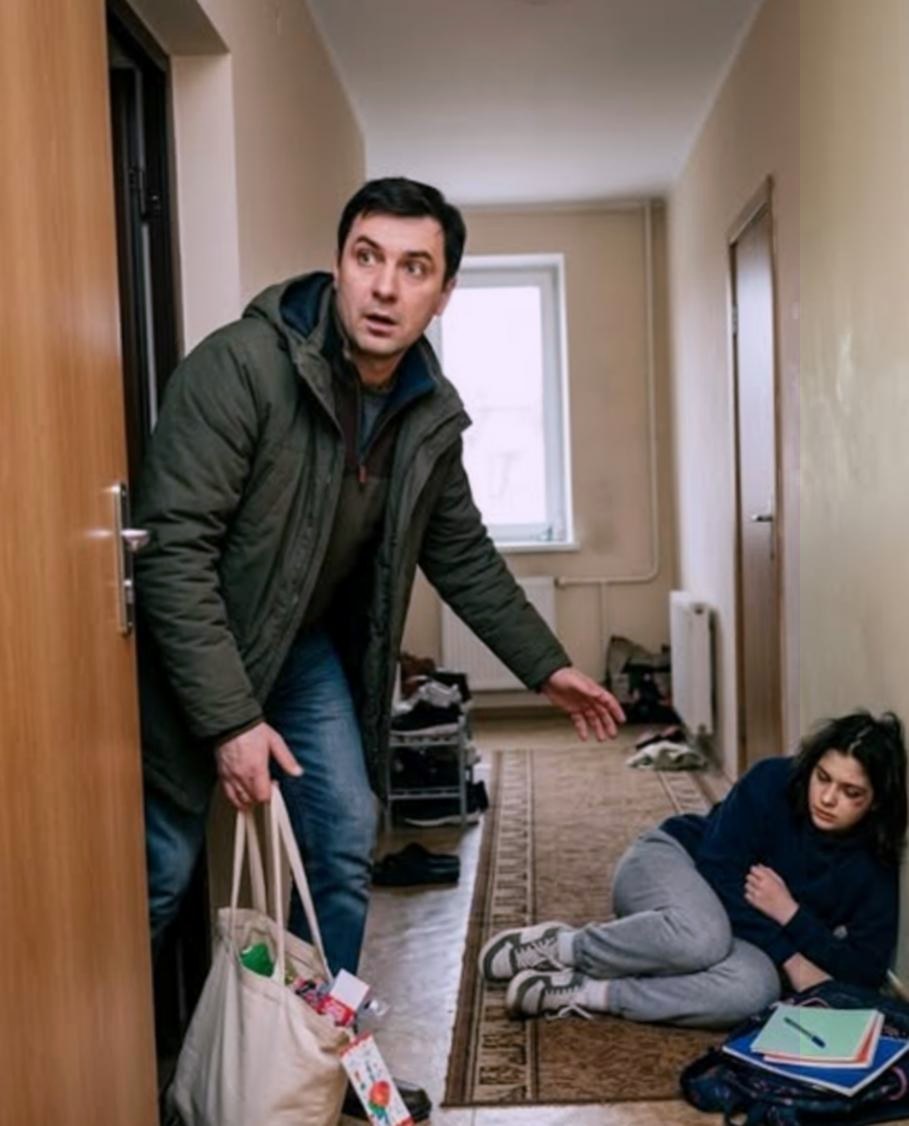

That night I sat in the hospital corridor. The wall clock ticked so loudly every second, as if someone were counting time against me.
Vika had not yet been brought out of the operating room.
Salome stood by the window and spoke quietly on the phone.
“The police have already taken Nika’s house under control,” she told me. “But he is not there.”
“Maya?”
“Nor is she.”
“The car?”
“They found it near the station. Empty.”
The phone rang immediately.
It was Nika’s lawyer.
“Mr. Giorgi, my client is ready to explain everything,” he said.
“Where is he?”
“We do not know exactly yet.”
“Then he cannot explain anything.”
“I also advise you not to give in to emotions. Perhaps your daughter heard something incorrectly.”
He said it so calmly, as if we were talking about a damaged bicycle and not a bloody child.

“The cameras recorded the attack on her,” I answered.
The lawyer fell silent.
“The cameras were turned off,” he said at last.
“One was not.”
At home, under the stairs, beside an old vacuum cleaner, I had hidden a small camera. Years earlier, when I often traveled because of work, it recorded only the movement of the door. It had no sound, but Nika’s face could be seen clearly.
He thought he had found every eye.
He failed to find one.
Salome turned on the recording on a large screen. It was five in the morning. Only the investigators, me, and Nika’s lawyer were sitting in the room.
Nika and Maya appeared in the frame. Nika was opening the door with the small key bearing the image of a red house. Maya stood behind him and had her hand on Vika’s shoulder.
Vika was stepping backward.
Nika was saying something to her.
Then the girl shook her head.
Nika swung his hand.
The blow appeared silently on the screen, but to me it still had such a sound as if bones were breaking in my chest.
The lawyer lowered his eyes.
“This may have happened for the purpose of defense,” he said.
“He struck a sixteen-year-old girl twice for the purpose of her defense?” I asked.
He could not answer.

In the second shot Maya was checking Vika’s backpack. Nika went to the wall and opened the old bookshelf. There he found the small wooden box that I had hidden years earlier.
But there was no disk in the box.
There was only an empty sheet of paper.
That was exactly why Nika became angry.
He thought that I kept the disk at home. In reality, I had sent the disk to a secure storage long before, while I had deliberately left a false clue in the bookshelf. Nika’s name was nowhere in that old case, but his father had been the main financier of that network.
For years Nika had tried to prove that his father had done nothing wrong.
And now the file stolen from the archive had turned against him.
Salome placed a second folder on the table.
“We found the main witness,” she said.
She took a photograph out of the folder.
The man was over sixty years old. I recognized him immediately.
Levan. A former accountant who had exposed the entire network twenty years ago, and then everyone thought that he had died abroad.
“He came himself this morning,” Salome said. “He knew that Nika was forcing you to return to him because of Vika.”
I could not say anything.

At that moment the operating room door opened. The doctor came out.
“Vika is alive. Her condition is serious, but stable.”
I stood up and for the first time that night breathed in fully.
The next day Nika was arrested at the bus station. He wanted to flee to another city. Maya, meanwhile, turned herself in to the police, but her first words were not about Vika, but about her own defense.
“I did not know that it would go so far,” she repeated.
Salome answered calmly:
“You opened the door.”
Against Nika there was a camera, a recording, a letter, the trace of the key, and the document stolen from the archive. At the trial he denied everything until the audio recording was played.
His own voice sounded:
“If you do not tell me, you will not wait for your father.”
Complete silence descended in the courtroom.
Nika raised his head.
For the first time he heard his own words through someone else’s ear.
His face turned pale.
Maya testified and blamed everything on Nika. However, the court also confirmed her participation. She knew why they were going to the house, she herself wrote the letter for Vika, and it was she who told them where the spare key was kept.
Both were sentenced to imprisonment.

I no longer felt hatred toward them.
Hatred is for people with whom something still connects you. I only wanted Vika to recover.
Three weeks later I tidied her room for the first time. The colorful balloons were no longer hanging by the window. Only one folded blanket and a book remained on the bed. And on the wall hung the birthday inscription I had written.
Vika took it down and carried it to the trash bin.
“Do not throw it away yet,” I told her.
“Why?”
“Because this time your good year is truly beginning.”
She smiled slightly.
Six months later we moved to a seaside city. I began working at a small investigative company, where I taught people to protect themselves and not demanded that they maintain calm because of them. Vika returned to school. Every morning she prepared tea herself and put a new notebook in her bag.
The first drawing she hung on the wall was our house. Yellow light came from the windows, and a small red house was drawn by the door.
“This is the key,” she told me. “But now it no longer frightens me.”

With the first snow of winter I received a letter from Nika.
“Giorgi, give me just one chance to explain everything.”
I folded the letter and did not show it to Vika.
I did not answer.
Maya also sent me a message that she missed her daughter.
I asked Vika whether she wanted an answer.
She thought for a long time.
“No, Dad. Now I want the person who loves me to stay with me.”
That was the only court verdict that turned out to be important to me.
That evening the kettle whistled in the kitchen. Vika stood by the window and watched the snow. And I held the old key in my hand—the enamel of the small red house had been slightly scraped off, but it could still be seen.
I no longer kept the key in the drawer.
I hung it by the door of our house, in a visible place.
This time the door would open only to the person whom we ourselves let in.
Peace returned to the house.