
After the lawyer’s final words, such silence fell in the workshop that it seemed as if all the tools had stopped at once.
Emily leaned against the wall.
“I did not sign it,” she said.
Matt’s mother quickly picked up her bag.
“All this is absurd. We came here to talk, not for an interrogation.”
“You brought the papers yourselves,” I told her.
“Noe, if you do not stop all this right now, you will regret it.”
It was the same voice that had spoken calmly and mockingly in the recording a short while earlier. Now fear was mixed into it.
The lawyer said to me through the phone:
“I have already sent copies of the documents to the police station. I have also contacted the notary so that the transfer based on that signature is stopped.”
Emily looked at Matt’s mother.
“Mother, what signature is this?”
“Nothing important.”
“It is in my name.”
“It is simply a technical formality.”
“On my house?”
Matt’s mother could not find an answer.
That same evening Matt called me. For the first time, his voice did not sound confident.
“Noe, let’s resolve all this calmly.”
“It could have been resolved calmly three days ago.”
“Mother said some things too much.”
“You were there too.”
“I did not want it to come out this way.”
“But you did not stop her.”
“We still have to save the wedding.”
“The wedding no longer exists.”
“What will people say?”
“This time tell people the truth.”
He hung up.

An hour later the hall manager confirmed to me that the reservation had been canceled. I had not lost the money completely; part of it remained as credit. The catering order was reduced, and the photographer stopped the package made in my name.
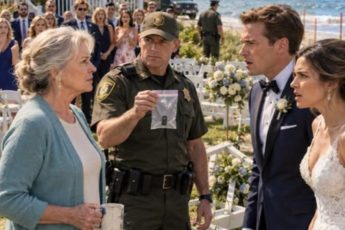
The next day Matt’s father came to me. It was nine in the morning. He held a plastic folder in his hand, its corner broken.
“I knew nothing,” he told me.
“About the house money?”
“I thought it was your gift.”
“It was a gift. But a gift does not mean that my daughter can sell it in someone else’s name.”
He lowered his eyes.
“Matt told me Emily agreed.”
“Emily said she did not.”
He sat down on the chair.
“Then my family is finished.”
“Saving your family is no longer my business.”
Saying these words did not make me happy. On the contrary, it was difficult. But for the first time I was no longer trying to protect someone from the consequences of other people’s decisions.
That same day in the evening we went to the lawyer’s office. The surface of the table smelled of lemon cleaning product. The notary brought up a copy of the signature on the screen.
Emily immediately said:
“This is not my handwriting.”
Matt’s mother exclaimed:
“Every bride gets nervous and forgets things!”
The notary shook her head.
“Madam, the electronic confirmation code used on the document was sent to your phone.”
Emily froze.
“That day only Mother had access to my phone.”
Matt’s mother’s face turned pale.
Then came another blow. The bank statement showed that the money transferred from my account for their house had been returned to Matt’s personal account that same week. They wanted the papers to show as if they had purchased their share of the house with their own savings.

Emily looked at the screen.
“Matt, did you do this?”
Matt stood at the door. He could not say anything.
“You knew that you were leaving Dad outside and at the same time using his money?”
“I just wanted everything to be arranged.”
“No,” I said. “You wanted everything to be arranged for you.”
Matt lowered his head.
Then the court process began quickly. It was not a noisy revenge. There were documents, bank statements, the telephone recording, and an expert examination of the signature.
Matt’s mother lost her lawyer when it became clear that she had asked him to hide the truth. Matt signed an agreement and ownership of the house was returned to Emily, although because of the forged document, the criminal investigation against them still continued.
I did not turn around toward Matt in court.
And Emily sat beside me at every hearing.
Once, during a break, she told me:
“Dad, you could have destroyed everything. But you only stopped what had stood on a lie from the beginning.”
“I destroyed nothing, Emily. I simply took my hands away.”
Several weeks later her room at home was almost empty. The old desk I had bought stood by the window, and one photograph remained on the wall—Emily at six years old, with dusty knees and an enormous smile.
Beside the photograph I also found the small drawing that had hung in my office. A tree house, a yellow sun, and two people holding hands for each other.
In that drawing I was still thin.
But for Emily I was still her father.
Three months later Emily moved into a small apartment in another part of the city. She began working at a children’s library. On Sundays she came to me, and together we drank cinnamon coffee that I had made for her since childhood.
One cold morning, during the first snow, she entered my workshop. She held a new drawing in her hand.
“This is for you,” she told me.
In the drawing there was a large house, but this time the door leading to it appeared open.
“It is a beautiful house,” I said.
“Now I draw what I want.”
I smiled at her.
“That is better.”

Matt contacted me twice. Once he sent me a short message: “Can we start over?” The second time he wrote that his family regretted everything and that I was being too strict.
I answered only once.
“Being away from you is not strictness. It is a boundary.”
Then I blocked the number.
Emily said nothing for a long time. At last she asked me:
“Are you angry with me?”
Outside the window, snow was slowly covering the street.
“I once was.”
“Now?”
“Now I am waiting for you to choose your life yourself.”
She rested her head on my shoulder.
“And if I get afraid again?”
“Then call me. But do not hide the truth with laughter anymore.”
She smiled too, this time awkwardly and sincerely.
Months later I used the credit from the canceled wedding hall to fund a small family center. There I taught children to make wooden objects. I hung Emily’s new drawing on the wall. I kept the old drawing at home.
One evening, when I was returning from the workshop, I found a coffee cup, new pencils, and the old drawing with the bent corner on the table.
Emily’s childhood drawing.
I straightened the sheet, but the corner still remained slightly raised. I did not try to hide it anymore.
Some things must remain as they were, so that you remember how far you have come.
I went to the window. It was snowing outside. There was silence in the house, but this silence no longer hurt me.
For the first time in years, I did not need to finance anything, prove anything, or convince anyone.
My daughter was not in the house, but I knew that she was in her own home.
The old drawing lay on the table.
This time I left the door open.
Missed the beginning?