
“The man who has supported us until now contacted me for the first time today…”
Mariam handed me the phone.
The message said: “Nino, your parents did not transfer only the land. That same night they made another decision as well. If you want Mariam to be safe, meet me alone.”
The air in the room seemed to disappear.
Father stood by the window. The phone in his pocket was vibrating, but he did not answer it.
“Who is it?” I asked.
“I don’t know,” he answered me.
Mariam shook her head.
“You do.”
Father looked at her, and for the first time I saw how the sternness with which he had frightened others all his life fell apart on his face.
Levan took out his phone.
“You will not meet anyone alone. The message has already been saved. Now I am calling the police.”
“No!” Father shouted.
“Why?” I asked. “Are you afraid that this time you will not be able to deceive someone?”
Father turned toward me.
“Nino, I only wanted to preserve the family.”
“You did not preserve the family that night. You preserved your own comfort.”
Mother was crying, but this time her tears no longer awakened the old sympathy in me.
“Your sister did nothing wrong,” she said.
“That is exactly why she must leave you.”
Mariam raised her head.
“I will go with Nino.”
Father struck the table with his fist.
“You are not going anywhere!”
At that same moment two cars stopped in the yard. Levan opened the door. Police officers and investigative service employees entered the house.

Father stepped back.
“This is my house.”
“No,” one of the investigators replied. “Today only a search is being conducted here. The ownership issue will be decided by the court.”
Father looked toward me.
“You destroyed me.”
“No,” I told him. “I simply no longer protected you from your own decisions.”
His lawyer arrived half an hour later. He folded a black umbrella at the door and left wet shoeprints in the room.
“We will settle everything,” he told Father.
But when he heard the recording, there was no color left in his face.
“I will not continue with this case,” he said.
“What are you saying?” Father jumped up from the chair.
“A forged signature, illegal waste, and a threatening message. I am a lawyer, not a magician.”
Father froze.
The next day I heard his words once again, only this time in a small investigative room. The investigator turned on the recording.
“Go outside. From today you are no longer my child.”
Father was sitting in the room too. He listened to his own voice and his face slowly changed. Finally the recording stopped.
“I did not say that,” he said quietly.
“That is your voice,” the investigator replied.
“I was angry.”
“Anger does not make a forged signature lawful.”
I looked at Father.
For the first time he had no answer.
Three days later I saw my parents’ house empty. The furniture had been moved by the expert group, and only one picture remained on the wall—my childhood photograph, in which I was holding a small wooden elephant. The glass of the frame was cracked.

Mother took the photograph down from the wall and handed it to me.
“This is yours.”
“I don’t want it anymore.”
“Why?”
“Because all your life you were abandoning me in that house, but you left the photograph as if you were good parents.”
Mother lowered her hand.
Mariam came with me.
During the first week she slept in the guest room at my house. At night she woke several times and stopped by the door, as if waiting for someone to try to expel her.
“You can leave the door open,” I told her.
“It won’t make you angry?”
“No.”
“What if I behave badly?”
“Then we will talk. No one will throw you out of the house.”
She nodded.
Within several weeks the court returned the land and the house to me. The illegal waste case continued separately. Father was not sentenced to imprisonment, but he lost most of his property, was fined, and was restricted from leaving the city. Mother stayed with him, although she no longer called me.
I did not celebrate this either, nor did I feel revenge.
I simply was no longer afraid for the first time.
Four months later Salome gave Mariam old books.
“You are starting your studies too, aren’t you?” she asked her.
“I want to study nursing,” Mariam answered.
“Then these books will be useful to you.”
They were sitting in the kitchen. Warm light came in through the window. There were three cups of tea on the table, and none of them had a teaspoon fully submerged, as my mother liked.

That evening Mariam asked me:
“Nino, did you really never want to return?”
“I wanted to,” I told her. “But returning and going back are not the same thing.”
“What do you feel now?”
I went to the window. The noise of the city came from below.
“Now I am here.”
That was enough.
Over the months our life was built through small habits. In the morning I went to the company office, where I already knew all the employees’ names. Salome studied in a course in child psychology. Mariam was doing practice at a hospital and told us a new story every evening.
One Sunday she drew a house on a sheet of paper. The house had four windows, and three people stood in front of it.
“Who is this?” I asked.
“Us.”
“Why did you draw a big door behind the house?”
Mariam shrugged.
“So that everyone knows it is possible to leave here. But also to return, if you want.”
The first snow came at the end of December. The city suddenly fell silent. I stood on the balcony and watched the white layer spread over the railing.
The phone rang.
It was Mother.
For several seconds she said nothing.
“Nino,” she said at last, “your father is ill.”
I closed my eyes.
“Take him to a doctor.”
“We don’t want a doctor. You must come.”
“I am no longer your emergency help.”
“He is still your father.”
“I know. That is exactly why he must take responsibility for his own life.”
Mother began to cry.
“Can’t you forgive us at least once?”
“Forgiveness is possible. Returning is not.”

She was silent for a long time.
“Is Mariam happy with you?”
“Yes.”
“Then perhaps we still did something right.”
“No, Mother. The right thing was what I did when I gave her the opportunity to escape from your lies.”
The call ended.
The next day Father sent me a letter. It was short. It said that he regretted it, that fear had overcome him then, and that he hoped I would someday become his daughter again.
I read the letter, folded it, and put it in a drawer.
I did not write a reply.
Not because I hated him.
Because for the first time my silence was no longer fear.
It was freedom.
Years ago, when I left the house, that little wooden elephant hung on my bag. On the way the pendant tore off, and I thought I had lost it forever. That evening, when I moved into the new house, Mariam found it in the pocket of my old bag.
“This is yours,” she told me.
I took the elephant in my hand. The wood had faded, a small crack had appeared on one ear, but it was still the same.
I placed it on the windowsill.
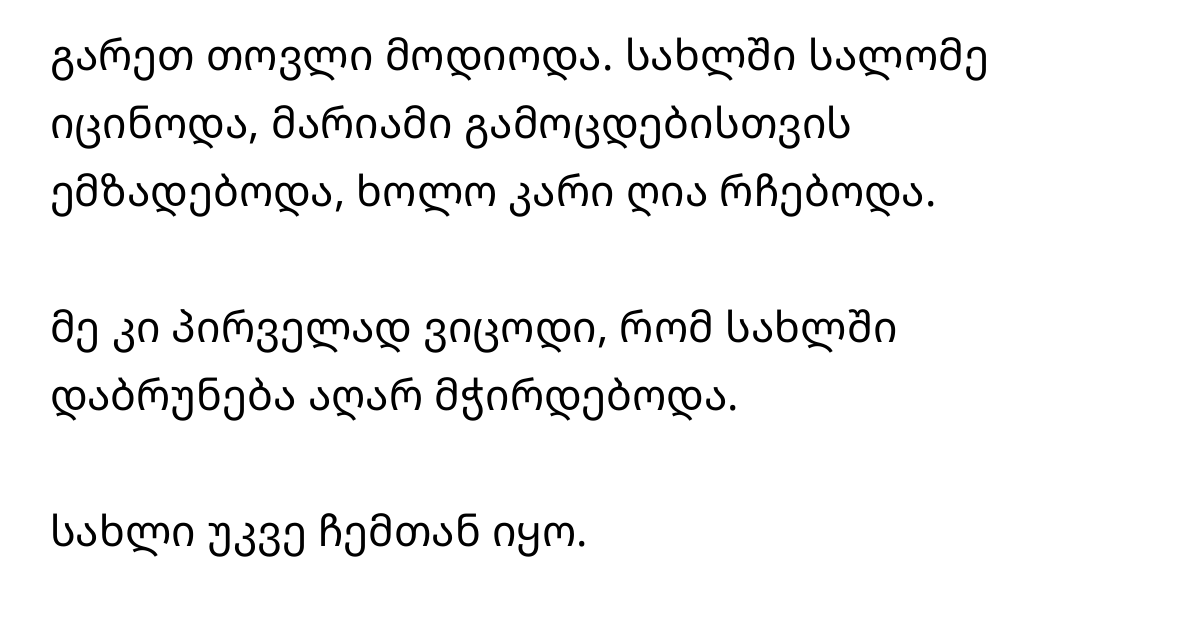
Snow was falling outside. Salome was laughing in the house, Mariam was preparing for her exams, and the door remained open.
And for the first time I knew that I no longer needed to return home.
The house was already with me.
Missed the beginning?