

I went to the clinic that same night.
Only the smell of disinfectant stood in the corridors, and the automatic lights came on at every step. I left Helen at home because she was tired. Ethan came with me.
The doctor, Maria Hall, took us into a small room.
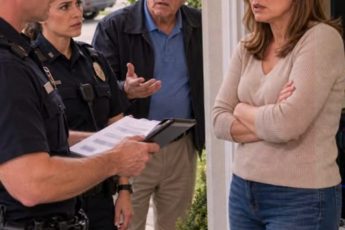
“Someone tried to obtain Helen’s treatment data,” she said. “However, we gave nothing. Security has already filed a report.”
Ethan’s face became tense.
“Did Sophie do this?”
“We do not know yet,” I answered. “But now we know that she will do anything to regain control.”
My phone rang.
It was Sophie’s lawyer.
“Mr. Mercer, my client is ready to apologize if you agree that the property-transfer document remains in force.”
“No.”
“The family conflict may cost you dearly.”
“My wife’s dignity has no price.”
The lawyer was silent for several seconds.
“Then we will meet in court.”
“Wherever you want.”
The call ended.

Ethan looked at the wall.
“Dad, I didn’t know how far she would go.”
“Because you never forced her to stop.”
“I know.”
“Now you have to understand what that means.”
The next morning Sophie called Ethan. He answered the call in front of me. He had the phone on speaker.
“Just give me one chance to explain,” Sophie said.
“You have already explained.”
“They are turning you against me.”
“No. For the first time I am hearing what you were doing.”
“You chose to live with me.”
“And now I choose not to live in your lies anymore.”
Sophie raised her voice.
“You would be nothing without your parents’ money!”
Ethan fell silent.
And for the first time I heard what she had said not as a silent husband, but as a person to whom his own words were returning. He realized that Sophie looked at him not with love, but as property.
“Tell me, did you say that yourself?” Ethan asked.
“Yes.”
“Then I have nothing more to say.”
He ended the call.

Three days later Sophie sent a letter to the management company of our building and demanded that her name be entered as the future owner. The lawyer answered that neither a signature nor any right of hers existed.
Richard paid part of his daughter’s debts only so that the creditors would not destroy the family completely. But he told Sophie clearly:
“I will no longer live in your place.”
Elaine took the key to Sophie’s house from her.
“Until you tell yourself the truth, there is no point in returning to this house.”
Sophie moved into a hotel.
On the upper floor of our house was Helen’s small workroom. Books brought from the library stood on the shelves, and a half-finished colorful scarf lay by the window. Knitting calmed her on chemotherapy days.
I entered the room and saw on her desk the light-blue dress that had still been in the bag after the wedding. The copper leaf-shaped clasp had caught in the sleeve of the dress.
Helen looked at me.
“I don’t want this day to become the biggest one in our lives.”
“It won’t.”
“Ethan is still our son.”
“I know.”
“But now he himself must come to us. We must no longer go in his place.”

One week later Ethan officially asked to separate from Sophie. This decision was not easy. They had a shared house, accounts, and wedding debts. Sophie tried to reconcile several times.
Once she came to the door of our house.
She was holding a small white box.
“I want to speak with Helen,” she said.
“Not now.”
“I want to apologize.”
“You can apologize even when you cannot receive an answer.”
She opened the box. Inside was jewelry wrapped the same way as the one Helen had worn at the wedding.
“I bought this for her.”
“Helen does not need a gift. She needs the truth.”
Sophie lowered her head for the first time.
“I was afraid that I would lose everything.”
“And so you decided to make someone else lose theirs first.”
She could not answer me.

After several months, Helen’s treatment continued. Some days were hard, some were amazingly peaceful. We still drank morning tea by the same kitchen window. Twice a week I took her to the library, because sometimes even walking was difficult for her.
Ethan began working in our commercial building, but not as an owner. He worked as the manager’s assistant and transferred part of his salary each month to Helen’s treatment fund.
One evening he asked me:
“Will you ever forgive me?”
I was watching the first snow through the window.
“Forgiveness and trust are not the same thing.”
“How do I get trust back?”
“With one right choice every day.”
He nodded.
Helen drew a small picture for him. Three people stood on a bridge, and a river flowed below. On the back of the picture was written: “A bridge is not built with words.”
Ethan held the picture in his hands for a long time.
At last Sophie sent us one letter. In the letter she wrote that because of her debts she was leaving the city, had found work in another state, and was no longer asking for the building, the money, or Ethan’s return.
At the end she added only one sentence: “If you ever can, I want to know that I am not completely lost.”
Helen read the letter and put it on the table.
“You are not obliged to save her,” she told me.
“I know.”
“Know that most of all.”
We did not send an answer.
Not because we wanted to punish her. Simply, for the first time, we gave her the right to bear the consequences of her own life herself.

At the end of winter, Helen put on the light-blue dress again. The treatment had taken her hair, but the old strength had returned to her eyes. I fastened the copper leaf-shaped clasp onto the dress.
“It still suits you,” I told her.
She looked into the mirror.
“Now I know why.”
“Why?”
“Because I chose it myself.”
Outside the window, snow was falling silently. The kettle was chiming in the kitchen. Helen held out her hand and I took it.
That night, for the first time, I no longer looked toward the pocket where that document had once lain.
There was only a small copper leaf there now.
And a door that we would never open for anyone again.
Missed the beginning?