
When the editor’s call ended, silence fell over the room again.
My mother came toward me.
“Give me the phone.”
“No.”
“Emily, this is a family matter now.”
“No, Mother. This is a threat.”
Judge Harrison raised his hand.
“No one touch anything. Mr. Carter, call the police.”
Father raised his head for the first time.
“Now?”
“Now,” he answered.
My mother looked around the room. She no longer had that old confidence with which she had silenced everyone for years.
“We can solve this within the family,” she said.
“You already tried,” I told her. “That is exactly why it has come to this.”
Ryan stood by the window. He held the engagement glass in his hand, but he was no longer drinking.
“Mother, did you tell everyone that Emily would achieve nothing?”
“I did it for you.”
“For me?”
“People would start comparing you.”
Ryan smiled bitterly.
“I did not become better because of your lies.”
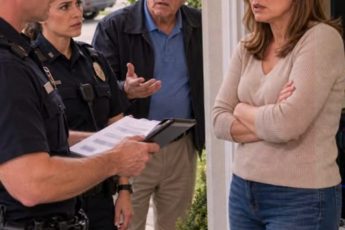
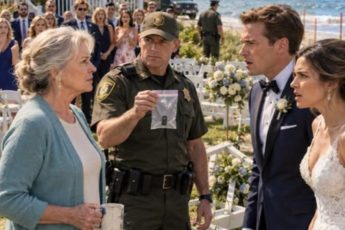
At that moment Father turned on the phone and called the security service. Ten minutes later red and blue lights came on in the yard. The police inspected the house, took the camera recordings, and attached my threatening message as a separate file.

My mother stood by the stairs.
“Tell them I didn’t know,” she whispered.
“About what?”
“About the person who took the files.”
“You don’t know?”
My mother lowered her eyes.
“A man called me. He told me that if you kept silent, Ryan’s job would not have problems.”
“Who was he?”
She could not answer.
Harrison stopped in front of her.
“Mrs. Carter, this is no longer only your daughter’s matter. You became an intermediary for a threat.”
“I did not help anyone.”
“That is exactly the problem,” he said. “You thought everywhere that silence was help.”

The next morning I went to the editorial office. Behind the door I found my editor, Nino, and a folder lying on the desk.
“Security found this last night,” she told me.
There was only one sheet of paper in the folder. In my mother’s handwriting it said: “Emily always ruins everything.”
Below it was a date—the day before my first major article was published.
Nino looked at the sheet.
“Did she send this to your workplace?”
“No. She probably kept it in her own house.”
That same evening investigators told me that the theft of the files was connected with a former employee of one of the agencies. He had made several calls to my mother.
At first my mother denied everything.
Then they let her hear her own voice.
In a room where there was only a wooden table and an extinguished lamp, the recording was played.
“If Emily stays silent, you will also get what you want,” my mother was saying. “Just do not interfere in the family.”
My mother sat in a chair and listened to her own words.
“This does not sound like me,” she said.
“That is your voice,” the investigator answered.
She lowered her eyes.
Then I realized that my mother was not trying to convince others for the first time. For the first time, she was trying to escape from herself.

Several weeks later Ryan broke off his engagement with Megan’s family. Megan did not leave him because everything was difficult; she left because Ryan finally told her the truth.
“I played the role created by my mother all my life,” he told me. “Now I do not know who I am.”
“Start by not playing anymore,” I answered.
Father did not decide to remain with Mother. Not because he wanted revenge. He simply finally understood that silence had not been neutrality.
Three months later I arranged the fireplace photographs with my own hands.
Ryan’s photographs were still there. But I did not place my photograph in the center anymore. I took it to the study of my small apartment, by the window, where the morning light fell directly on it.
I began a new investigation in Chicago. Every morning I walked to the editorial office. On the street corner an elderly neighbor walked his dog, the smell of cinnamon came from the bakery, and that old leather notebook, with its coffee-stained corner, was always on my desk.
One evening Nino told me:
“A response came about your article. People write that they heard the complete truth of this case for the first time.”
I smiled.
“The important thing is that the people I write about regain their own voice.”
Several weeks later the first snow came. My little nephew, Luka, stood by the window and drew a family on a sheet of paper. People stood beside one another, and one stood separately—with a small book in his hand.
“This is you, Aunt Emily,” he told me.
“Why am I standing separately?”
“Because you show everyone where they should go.”
I did not forget his words for a long time.

That night my mother sent me a message.
“Come home. Let us forget everything. We are still family.”
A second message followed soon.
“You are still my daughter.”
I put the phone on the table.
I looked at it for a long time.
Then I wrote:
“I was always your daughter. I am simply myself for the first time now. I can meet only to tell the truth, not to become silent again.”
No answer came.
The court announced the final decision in my mother’s case several months later. For aiding a threat, she was given a suspended sentence and community service. The former employee was imprisoned, and the complete material of my investigation became public.
I did not speak in court.
My case was already speaking for itself.

One Saturday a box was sent to me from my parents’ house. Inside were my old things: school certificates, a university card, and a childhood photograph that had been hidden in the corner of the fireplace for years.
On the back of the photograph, my mother’s handwriting said: “Emily, seven years old.”
This time I did not attach the photograph to the wall.
I placed it on my desk, beside the notebook.
Then I opened the window.
Snow was falling outside. The noise of the city rose from below, but there was peace in my room.
The brown, coffee-stained corner of the notebook shone in the light.
I had carried that object for years, as if it were proof that someday I had to prove everything.
Now I needed it only for notes.
For my own existence—I no longer did.
For the first time I did not hide my photograph.
Nor did I prove anything to anyone else.
I simply understood that the place I had been seeking all my life had finally been inside me.
Missed the beginning?