
Emma did not answer the call even on the fourth attempt.
I knew the laboratory’s address. Nika took the car keys, while my mother leaned against the wall.
“I’m coming,” she said.
“No,” I answered. “Stay home and tell the police everything.”
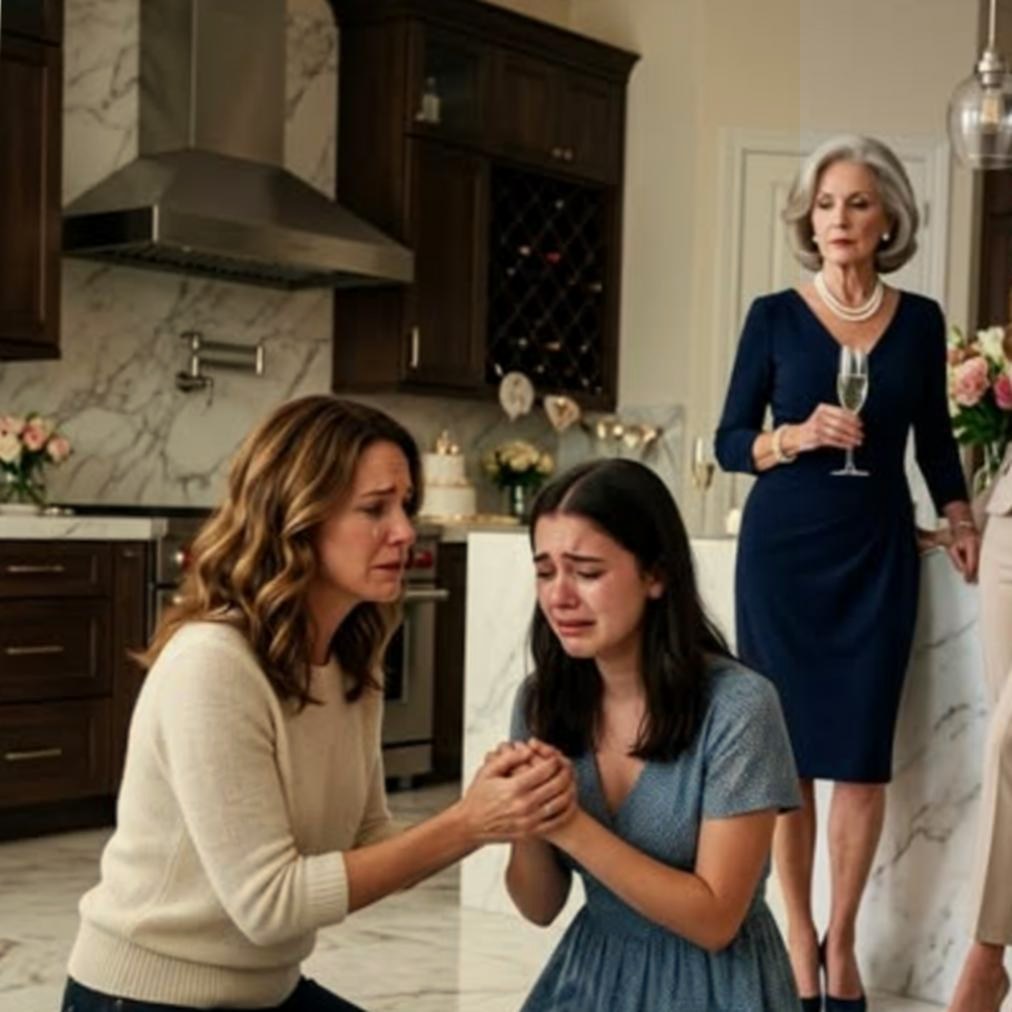
Lauren was crying.
“Ana, please, don’t destroy Adrian. Maybe he was simply afraid.”
Nika looked at her sternly.
“He used your daughter’s address for a threat. This is no longer fear.”
He had already given the police a copy of the message. Adrian’s voice on the phone had been recorded as a separate file. My mother, trembling, also handed over all the bank statements and the forged application.
Lauren froze.
“Mom, you betrayed him.”
For the first time my mother looked at her daughter as though she were a stranger.
“No. For the first time I stopped protecting him.”

We arrived at the laboratory in twenty minutes.
The sharp smell of disinfectant stood in the corridor. Blue plastic boxes were arranged along the walls. Emma was waiting for me by the glass door, in a white coat, with fear stamped on her face.
“Mom, he called me,” she told me. “He said that you would pay his debt, or else he would tell my supervisor everything.”
“Did you tell him anything?”
“No. I recorded the conversation.”
She held out her phone to me.
Adrian’s voice could be heard in the recording. Calm, almost polite.
“Your mother will not deny you money. You simply need to remind her who can stop your career.”
Then Emma answered:
“You cannot touch my career.”
“Everyone has a price.”
The recording ended.
I closed my eyes. I was still afraid, but something firmer had appeared beneath it.
“Is this enough?” I asked Nika.
“This is no longer only a civil dispute.”
That same evening the police established Adrian’s location. He was hiding in a small hotel room on the outskirts of the city. When the officers opened the door, they found there only a suitcase, several phones, and a folder full of forged signatures.
Adrian was arrested.
I could not perceive this story as a victory. I simply knew that at last he would no longer escape the consequences.

The next day the bank froze my mother’s new loan. The lawyer explained to Lauren that she too bore responsibility for the transfers from the wedding fund.
“I can no longer protect you,” she told Lauren. “You signed.”
Lauren stood up from the chair.
“But Mom will pay.”
“No,” my mother said.
That one word fell into the room like a heavy object.
The same week Adrian’s first hearing took place. I did not enter the courtroom. Emma sat beside me in the corridor and held the same small silver pendant in her hand.
The main witness was not Adrian’s partner.
The main witness became his own voice.
The prosecutor played the recording. Everyone in the courtroom heard how he said he intended to intimidate me by stopping Emma’s career. At first Adrian looked at the floor. Then he raised his head and looked at his lawyer.
“Turn it off,” he said.
The lawyer shook his head.
“That is your voice.”
“I did not say it like that.”
The recording continued.
“Everyone has a price.”
Adrian heard his own words through someone else’s mouth. His face slowly collapsed.
I did not look at him.
Within a few weeks my mother sold the house. Most of the debts were covered, but preserving the old life became impossible. Lauren rented a small apartment and looked for a job for the first time. My mother no longer came to me to ask for money.

One evening I went to her house to take some things.
The marble kitchen was empty. Instead of lilies, only a circle of dust remained on the island. All the expensive paintings had been removed from the walls.
The old room intended for Emma, however, was unchanged. On the bed lay the cream-colored invitation, the one that had first shown me that money had never been the problem.
My mother quietly closed the door.
“I want you to know that I was wrong then,” she told me.
“I know.”
“Can you forgive me?”
I looked at the empty garden through the window.
“I can forgive. But I can no longer return to the old life.”
She nodded. This time she did not start an argument.

Four months later, on the first snowy morning of November, Emma and I left a small apartment in a new city. My company had opened a new office there. Emma worked in a research group and every morning went with a backpack, a thermos, and a pencil stuck in her hair.
Our kitchen was one-tenth the size of my mother’s kitchen, but laughter fit freely inside it.
Emma’s drawing hung on the refrigerator. It showed two people: one in a white laboratory coat, and the other beside her; both held a small sun in their hands.
“Who is this?” I asked.
“You,” Emma answered. “Because when everything was dark, you still gave light.”
I smiled.
“Then you are the one who followed the light.”
That same week my mother sent me a short letter. She wrote that Adrian’s case was continuing in court, Lauren was feeling better, and she herself was learning to make a budget for the first time.
At the end there was one sentence: “If I ever need your help again, may I call you?”
I looked at the screen for a long time.
Then I wrote: “You can call me when you want to see me. But I can no longer promise to solve your problems.”
This was not cruelty.
It was a boundary.
That evening Emma took off the pendant and put it on the table.
“Mom, do you remember when I told you that I had been expensive?”
“I remember.”
“Now I know that I was simply important.”
I took her hand.
Snow was falling outside the window. The small silver pendant glittered under the lamp, exactly as it had that night when my family first promised me that Emma and I were worth nothing.
But now this object reminded me of something else.
Sometimes the greatest help is leaving a person alone with their own decisions.
I turned the pendant over in my palm.
And I no longer opened the door for anyone.
Missed the beginning?