
I did not go alone to the old station.
My father tried to object, but this time the decision had already been made.
“If this is a trap, being alone will change nothing,” I told him. “They simply want me to do that.”
At seven in the evening, I stood on the abandoned platform of the station together with the head of security. Drops fell from the iron roof. In my pocket was the small golden clasp I had seen on Natalie’s bag and quietly removed on the courthouse steps. An inconspicuous mark from the store was engraved on it.
The clasp’s number changed everything.
The head of security called the same store. It turned out that the bag had been delivered not to Natalie’s address, but to a law firm, and paid for with the company card. Henry Cole’s assistant was listed as the recipient on the receipt.
I called my father.
“Cole is not only Dominic’s lawyer,” I told him. “He is the conduit for the money.”
“We already know that. The tax service has frozen his accounts.”
“Does Dominic know?”
“Not yet.”
At that moment my phone rang. It was Henry Cole.
“Ms. Audrey, let’s talk.”
“Why do you want to talk now?”
“Because your former husband can no longer protect me.”
“Protect yourself.”
Silence fell on the other end of the line.
“You don’t understand how far this has gone,” he said. “Dominic thought you were only a beloved wife. Victoria thought the board would remain in her hands forever.”
“And what did you think?”
“That money would silence everyone.”

He asked for a meeting. I agreed, but on one condition: the conversation would take place in the company’s lower conference room, in front of the cameras.
An hour later Cole was sitting there. In front of him lay my mother’s old silver pen, which I had never brought to court. Then I realized that he had taken it from my office.
“Where did you find this?” I asked.
“You left it in the archive yourself.”
“No. You left it there.”
Cole lowered his eyes.
My father played all the recordings on the screen. The footage showed a woman who dressed like me and went to the archive doors. But when she turned her face toward the camera, it was clearly Natalie.
Natalie was sitting on the other side of the room and crying.
“I did it only once,” she said. “I was told that Dominic would give me everything after the divorce.”
“Who told you?” I asked.
She looked toward Dominic.
“His mother. Then Cole. Dominic told me that you were planning to flee the country and that he needed copies of the documents.”
Dominic jumped up from his chair.
“She’s lying!”
“Then why did you pay for her bag with the company’s money?” I asked.
He had no answer.
Cole covered his face with his hands.
“I only drew up the contract.”
“You submitted forged evidence to the court,” my father said. “That is no longer called ‘only.’”

There was a knock on the door.
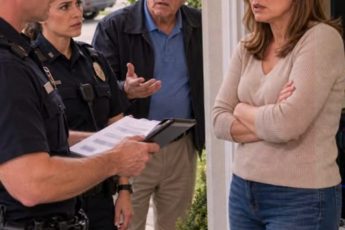
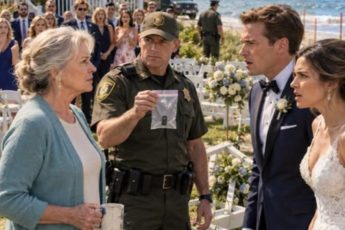
Investigators, representatives of the tax service, and a special administrator appointed by the court entered. Victoria stood behind them, pale and silent.
“All of Crestwood’s accounts have been frozen,” one of the investigators said. “Mr. Vens, you are under arrest on charges of fraud, money laundering, and falsifying evidence.”
Dominic looked toward me.
“Audrey, tell them this is a mistake.”
For the first time, there was no command in his voice.
Only fear.
“You yourself told me that I was no longer worthy of interfering in adults’ affairs,” I answered. “And now I will no longer protect you from your decisions.”
They put handcuffs on him.
Victoria came to me.
“Your father left you everything,” she told me. “But you still cannot run this company.”
“I am not running the company today to prove anything to anyone. I am running it because I did not allow you to destroy it.”

The next day Dominic’s lawyer refused to defend him. Within several hours, Victoria resigned from her position as a board member. Marcus’s companies collapsed, while an independent audit established the names and responsibility of every employee who had taken part in the fraud.
And in the very first week I created new rules: no corporate card would have the right to be used by one person alone. Every expense would require two signatures. Every employee could report a violation anonymously.
Some people told me that I was excessively strict.
I only answered:
“Trust is not blindness.”
Three weeks later I returned to my old house. Dominic’s closet was empty. Only one frame hung on the wall, with a photograph from our wedding. I took the photograph down and put in its place a small map I had received from my father, on which Crestwood’s first warehouse was marked.
But I stayed longest in his office.
There, on the floor, I found the small golden clasp from Natalie’s bag, the one that had been in my pocket at the station. I picked it up. It was heavy, but it no longer hurt.

Four months later I moved to another part of the city. In the mornings I walked to the office. At noon I ate together with the employees in a small cafeteria. On Fridays my father came, and we drew up plans for new projects in the old warehouses.
One evening my seven-year-old niece, Elene, ran into the office. She was holding a drawing.
“Is this you?” I asked.
“Yes. Here is your company, and here is a door that is open to everyone.”
“Where am I standing?”
“At the door. So that you don’t lose anyone.”
Her words struck me more powerfully than any court decision.
Several weeks later I received a letter from Dominic. It was not from prison. He was still awaiting the final hearing and was trying to return to me through a lawyer.
“Give me one chance. Everything can start over.”
I looked at this sentence for a long time.
Then I answered:
“You have already started over. Simply without me.”
I tore up the letter and put it in the trash.

On the first snow of winter, I stood by the office window. Below, employees were walking, the elevators were still working, and the city was breathing with its usual noise.
I took the small golden clasp out of the desk drawer. Now I had attached a new thin chain to it. I hung it beside Elene’s drawing, on the wall where our wedding photograph had once been.
It was no longer a sign of loss.
It was the key to a door I had never opened for anyone else.
And for the first time in my life, I closed the door myself.
Missed the beginning?