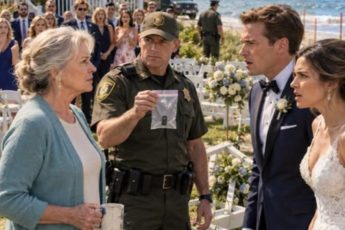


The next morning at nine o’clock, Derek did not appear at the police station.
An attorney came instead.
Dad called me at nine twelve in the morning. His voice was trembling so much that I could barely understand the words.
“Derek is no longer at home. Ashley said he left by car.”
“Running away cannot solve the problem,” I answered.
“Claire, please tell them that this is a family matter.”
I stood by the window and turned the little copper house keychain in my hand. The chipped corner of the red enamel pricked my thumb.
“Dad, this was a family matter when I was paying your bills. Now it is a legal case.”
Silence fell.
“Are you really going to go against him?”
“I’m not going against him. I’m simply stepping back and no longer covering his trail.”


That same day, the bank confirmed my attorney status in writing. It turned out that Derek had also used an electronic signature in my name. In one document submitted to the bank, he had stated that I had reviewed the company’s financial accounts and considered all the transfers legal.
Fortunately, I had not signed any final review conclusion.
But the document existed.
That evening Dad, Mom, and I met again in the bank’s room. The clock on the wall ticked loudly. On the table stood a computer, on whose screen Derek’s voice was supposed to be played.
It was a recorded telephone conversation that the company’s accountant had given us. Derek thought he was reassuring Martin. In reality, he left his own words behind.
His laughter sounded in the recording.
“Claire will put everything in order anyway. If something happens, we’ll say Dad knew. He loves his family and won’t make a fuss.”
Then his voice became quieter.
“I need the money for that boat now. When the loan is approved, I’ll pay it back.”
The recording ended.
No one moved in the room.


Dad looked at the screen. It was as if he was hearing for the first time how his son spoke when he was sure no one would hear.
“Is that his voice?” Mom asked.
“Yes,” Martin said. “He sent me the recording himself because he was afraid they would accuse him too.”
Dad buried his head in his hands.
“I didn’t notice.”
“You noticed, but you did not want to see it,” I said.
Mom looked toward me.
“And us? What did we do?”
I did not have an answer immediately. For years I had solved their problems because I believed that love sometimes resembled a burden carried silently. Now I understood that they saw my silence not as love, but as constant availability.
Two days later, the police found Derek at a friend’s house on the outskirts of the city. He was charged with financial fraud, using false documents, and misappropriating company funds. Ashley handed the boat documents to the investigation and stated that she did not know the source of the money.
Derek called me that very evening.
“Claire, you can stop everything.”
“No.”
“I’m your brother.”
“You should have remembered that word when you used my name.”
“Dad will lose everything.”
“No, Derek. Dad is losing what was never based on the truth in the first place.”


He breathed into the phone for a long time.
“You are still my family.”
I closed my eyes.
“Family is not the place where a person is called only when money is needed.”
The trial lasted several months. Derek admitted guilt in order to lessen his sentence. The company barely avoided bankruptcy because the bank appointed an independent manager. Dad sold the house, paid part of the debts, and for the first time in his life asked specialists for help, not me.
Mom apologized to me. Not once, but many times. I believed her remorse, although I could no longer return to the old house.
I took only one thing from Derek’s room—the photograph of our childhood hanging on the wall. In it, we were both little. I was holding a red plastic shovel, and he was standing beside me and smiling. The photograph remained in the empty room; the bed had been removed, and only a rectangle of dust was visible on the windowsill.
Three months later I moved to a seaside town. I started working at a small law firm where no one knew my family name and no one needed me to save my salary. In the morning I walked to work, bought bread at the same bakery on the way, and read on the balcony in the evening.
Mom and Dad called me once a week. Now they asked me how I was, not how much I could transfer.


One evening Mom told me:
“Your father is trying to start over with small repair jobs.”
“That’s good.”
“He wants you to come back home.”
I looked at the sea through the window. The first snow of November was falling lightly onto the balcony railing.
“Maybe I’ll visit you someday,” I said. “But I won’t return to my old life.”
A few weeks later, my little niece, Nini, sent me a drawing by mail. A small house was drawn on the paper, its roof colored red, and three people stood beside it. Beneath it, in childish letters, it said: “Home is where they do not ask you to prove yourself.”
I attached the drawing to the refrigerator.
Derek sent his last letter one day before the final court hearing. He wrote that he had changed, that the family had fallen apart without him, and that I should come to visit him at least once.
I read the letter to the end.
Then I replied:
“I hope you truly change someday. But I will no longer be part of your change.”
That was my last answer.
For years I thought that, to preserve a family, I had to humiliate myself. Now I knew that sometimes closing a door is not betrayal, but survival.
That night I put the keychain on the table. The little copper house gleamed in the lamplight. The chipped corner of the red enamel was still there, like an old wound that no longer hurt me.
For the first time, I chose the home myself.
Missed the beginning?