

When I heard Nino’s last words, the weakness remaining in my body disappeared in one second.
“Where are they taking Leo?” I asked.
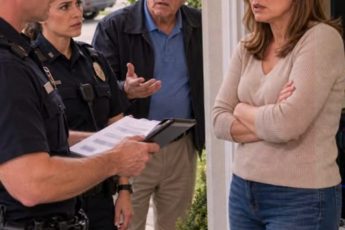
“To the central hospital. Two cars are already on the way.”
David jumped to his feet.
“Don’t call Elene.”
Nino looked at him sternly.
“Now you no longer give anyone orders.”
Another car stopped outside. The paramedics transferred Leo onto a stretcher. They fastened a plastic bracelet onto his small hand. I touched his fingers and repeated that Mom was here.
They put handcuffs on David.
“Sarah, please listen to me,” he told me.
“I listened to you all evening.”
“Elene forced me.”
“Your voice is in the recording.”
He opened his mouth, but could not find a word.
Nino picked up the telephone receiver from the kitchen floor. Its ivory-colored plastic had yellowed over the years, and a small crack ran across the call button. David always said that this object made the house look like an abandoned office.
That night it was precisely what left us the only way to stay alive.

At the hospital, the corridor was filled with a sharp disinfectant smell. It was two o’clock at night. The doctor told me that they were slowly removing the substance from Leo’s body and that he had a chance to survive.
I sat down against the wall.
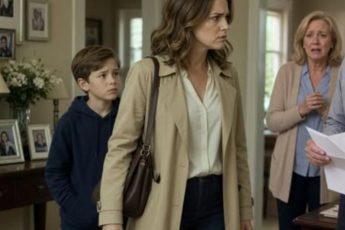
“Mom, will he die?” Leo’s friend asked quietly, waiting in the corridor.
“No,” I told him. “Not this time.”
At four in the morning Nino called me.
They found Elene at the bus station. In her suitcase they had found copies of the accounts, insurance documents, and forged samples of my signature.
“Did David confess everything?” I asked.
“Not yet. But he recorded himself.”
That same day the court ordered pretrial detention. I stood in the courtroom, while Leo remained in the hospital. David did not even look toward me.
The judge said that the case concerned premeditated poisoning, fraud, and attempted murder for the purpose of life insurance.
David’s lawyer stood up.
“My client acted under emotional pressure.”
The lawyer stopped speaking himself when the prosecutor played the recording.
David’s voice sounded in the courtroom.
“This will be easier for everyone.”
His own words returned from the walls.
David buried his head in his hands. For the first time he saw how his calm sounded to someone else.
I was no longer crying.

Three weeks later I returned home. Everything in the kitchen stood as it had that night, but David’s things had already been taken away. Only one photograph remained on the shelf — our wedding day, where he was smiling, while I did not understand how little I knew about him.
Leo’s bed was empty in his room. He was still undergoing rehabilitation at the hospital. His small wooden train lay on the pillow, and one wheel was broken.
I picked up the photograph and looked at it for several seconds.
Then I put it in the drawer.
I did not tear it up.
I simply no longer needed to see it every day.
David sent his first letter from prison a month later.
“Sarah, Elene planned everything. I was only trying to get out of debt. If you say in court that I noticed remorse, my sentence will be reduced.”
I read the letter to the end.
Then I handed it to Nino.
“Do you want an answer?” she asked me.
“No.”
“Are you sure?”
“For the first time I am.”
Elene confessed to the crime. She said that David needed my accounts, while David needed her help because he was buried in debt. They thought that my death would be declared an accident and that Leo, as a minor, would not be able to control them.
The hardest thing was that they saw Leo not as a person, but as an obstacle.

Six months later we moved to a small town near the coast. There, the smell of the sea came through the windows in the morning, and the neighbors knew one another by name.
I began working at a library. Every day I arranged books, read aloud to children, and for the first time in a long while I no longer needed to look back when finishing work.
Leo slowly recovered. He returned to school and spoke enthusiastically during physics lessons.
One evening he drew a house on a sheet of paper. A large yellow sun was on the roof, and four strips of light came from the windows.
“How many people live here?” I asked.
“Two,” he answered. “Me and you.”
“Then why are there four windows?”
Leo shrugged.
“Because every room should have its own light.”
After his answer I remained silent for a long time.

On the morning of the first winter, snow began to fall. I was standing by the library window when an unknown number lit up on my phone.
It was David.
“Just five minutes,” he said.
“No.”
“I want to see Leo.”
“He does not want to see you.”
“You are turning him against me.”
Snowflakes fell against the window. Leo was arranging pencils in the next room.
“David, I will no longer protect you from the consequences of your own choices.”
Silence fell on the other side of the line.
“Will you ever forgive me?” he asked.
I knew the answer immediately.
“Forgiveness and returning are not the same thing. I am not going back.”
The call ended.

Leo entered the room, holding an old object in his hand.
It was the yellowed landline telephone that I had also brought from the new house. Its crack was still visible, but now we had replaced the call button and the device shone white on the wall.
“Mom, will someone call us on this again?” Leo asked.
I ran my hand over the telephone.
“If someone calls, this time we will decide whether to answer.”
Leo nodded and stood by the window. Outside, the snow quietly covered the tracks.
And for the first time I realized that survival does not mean only escaping death.
Sometimes survival is when you are no longer afraid of the silence of your own home.
The telephone remained silent.
And so did we.
Missed the beginning?