
When the call ended, such silence fell over the house that it was as if all the clocks had stopped at the same time.
David immediately took the phone from me.
“I’m calling the police right now.”
“He said he knows where they are.”
“That is why I am calling.”
Lily stood by the window. The glass blurred by the rain trembled in front of her.
“Mom, if they were somewhere, why didn’t they come back?”
There was no answer to that question.
But for the first time in seven years, I had a direction.
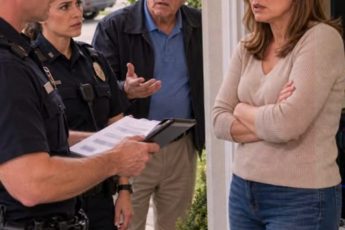
Investigator Maria Carter and two police officers arrived half an hour later. They took the memory card, the letter, and the photographs. David, meanwhile, copied Ryan’s old recording onto several different devices.
“Paul may try to take the card,” he said. “But now he can no longer erase what exists elsewhere too.”

At ten, Paul called again.
This time we turned on the speaker.
“Anna, come alone,” he said. “To the old boat shed.”
“I am no longer the woman you lied to for seven years.”
“You do not understand what happened.”
“Then explain it to me.”
He backed down.
“Ryan helped me himself.”
David shook his head.
“Do not answer.”
But I already knew that I had to go. Not only to Paul. To the place where the greatest lie of my entire life had begun.
The police hid cars near the shed beforehand. Lily and I sat in David’s car until Paul’s truck slowly entered.
Paul got out.
He looked the same as seven years ago, only his face was gaunt and his eyes kept darting toward the door.

“Where are they?” I asked.
“They were alive that night.”
Lily’s breath caught.
“Was Dad alive?”
Paul looked toward her and immediately lowered his head.
“Ryan knew they were planning to kill him. He told me that he would take the boys out of the city and then hand over the evidence.”
“Who was trying to kill him?” I asked.
Paul bit his lips.
“Me.”
Lily made a sound as if something in her heart had cracked.
“Did you kill Dad?”
“I damaged the boat. I wanted everyone to believe that the lake had taken them. But at the last minute Ryan got the boys off the boat. He transferred them to a small boat hidden on the northern shore.”
“Then what?”
Paul closed his eyes.
“I took them along the old mountain road. Ryan tried to escape. The car went over a ravine.”
My knees gave way.
“Did they die?”
“Ryan did. The boys did not.”

The world stopped for a moment.
“What are you saying?”
“Jack and Caleb got out of the truck before the car went over. They were alive. I left them in a children’s shelter under other names. I was afraid they would find Ryan’s documents and come after me.”
Lily opened the door and went outside.
“Where were they for seven years?”
“With different families. I kept watch over them.”
“And why didn’t you tell us?”
Paul could not answer.
Then Investigator Carter stepped forward.
“Paul, everything has now been recorded. Where are the children?”
He took a folded sheet of paper from his pocket.
“In the coastal town of Elmore. One family is raising Jack. Caleb is with another family.”
“Do they know their real names?”
“No.”
The police arrested him right there. No one shouted. Neither Lily nor I.
For the first time his hands lost their strength.

The next day, at the radio station, they listened to the recording of Paul’s interrogation. The investigator played the section where he says: “I wanted everyone to believe that the lake had taken them.”
Paul listened to his own voice and hid his face in his hands.
“I did not say that,” he whispered.
The investigator calmly answered:
“That is your voice.”
It was then that Paul understood that a person is most destroyed by his own lie when they make him hear it through someone else’s voice.
That same evening we left for Elmore.
A woman met us at the door of the first house. Behind her stood a fifteen-year-old boy. He was tall and thin, and had a small scar near his left eyebrow.
Ryan had a scar in exactly the same place.
“Jack?” I said.
The boy looked at the woman.
“Who is this?”
I took one step forward.
“I am your mother.”
His face changed, but he did not step back.

We found Caleb at the second house. He was holding a small wooden boat. When I saw him, he was touching the boat’s bow with his fingers in the same way Ryan used to.
The first meeting did not resemble a fairy tale.
The boys did not hug me immediately.
First they asked questions.
“Why didn’t you come here before?”
“Why did we think we were orphans?”
“Did Dad really love us?”
Every answer hurt me.
But I did not add another lie.
“Your father loved nothing more than you. He fought until the last moment to save you. And for seven years I thought I had lost everything.”
Jack looked at the floor.
“We were losing things too,” he said.
“I know.”
That word was not enough.
But it was a beginning.


Years later, the court sentenced Paul to a long prison term. The boat club’s money was returned, his property was given to the affected families, and in the official record of Ryan’s case it was written for the first time that he had not been a victim of an accident.
I did not meet this news with joy.
Justice could not bring Ryan back to me.
But at last I no longer had to repeat to myself that perhaps I was mistaken.
Three months later Jack and Caleb moved in with me. At first they slept in one room and listened to each other’s breathing at night. I put two new toothbrushes in the house. In the kitchen I bought two mugs for them.
Lily formed a special bond with them. She was the only one who had seen Dad in the last video and told the boys about his voice.
One evening Caleb asked me:
“Mom, what was Dad like?”
I placed an old photograph on the kitchen table.
“He laughed loudly. He sang badly. He always forgot about his coffee.”
Jack smiled.
“We forget too.”
“Then he really left you something.”

Months later I began working at the town’s small library. In the mornings I arranged books, at noon I read fairy tales to children, and in the evenings, when I returned home, I saw the boys’ shoes by the door.
My life was no longer the old one.
But for the first time it was mine.
One day, with the first snow of winter, Lily stuck a drawing on the refrigerator. Four figures were drawn, and a fifth in the sky, in the form of a small bright point.
“This is Dad,” she told me.
“I know.”
“Are you not afraid anymore?”
I looked at the snow through the window.
“Not every day.”
That same evening Paul’s lawyer sent me a letter. Paul was asking for a meeting. He said that he wanted to explain everything and needed forgiveness.
I read the letter to the end.
Then I folded it.
In reply I sent only one sentence:
“I may carry forgiveness in my heart, but I am no longer obliged to let you return to my life.”

The next morning I played Ryan’s old video again. His voice was still hoarse, and the corner of the frame was still cracked.
“If you are watching this, you are probably already a big girl.”
Lily sat beside me. Jack and Caleb were arguing in the other room about who would take the fishing rod.
Ryan’s face faded from the screen.
I took the glass jar in my hand. Seven years earlier I had put the copper-colored key into it. Now the key lay on the windowsill in our new house—not because I was opening anything, but because I no longer needed to hide it.
The first snow was falling outside.
This time I left the door open.
Missed the beginning?