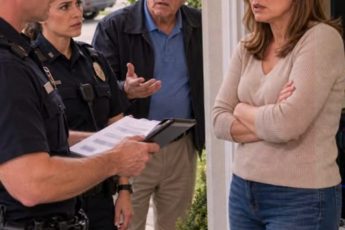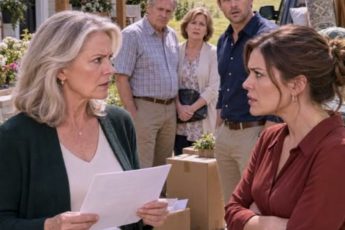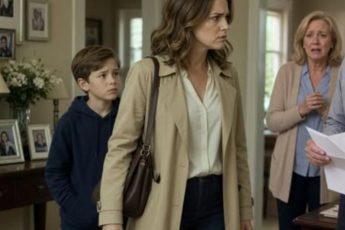

The woman stood motionless in the yard for several seconds, and then walked toward the house.
Carmine closed the curtains.
“Who is she?” I asked.
“Elena Carter,” she answered. “Your father’s second wife.”
That name made the room colder than the wind coming through the open window.
Leo was already sitting on the floor, his hands in handcuffs. His people ran away, but Carmine had locked the gate beforehand. Below, several minutes later, the flashing lights of police cars illuminated the walls red and blue.
Leo raised his head.
“Dominic, listen. All of this was Elena’s plan. I was only carrying out orders.”
“You stood in my room for six months,” I said. “You threatened my doctors and told me that I had no hope.”
“If I did not do it, she would kill my son.”
Carmine laughed coldly.
“Your son had her protection. You sold Dominic for money.”
This time Leo looked me in the eyes.
“You created this world yourself. Everyone thought that no one would dare betray you.”
These words struck me more powerfully than any of his threats.
When the police officers entered the room, one of them played the recording. It was Leo’s voice, recorded on the night when he threatened the doctor.
“You must not tell him that he has a chance of walking. If he begins rehabilitation, he will regain everything.”
In my own room, my own past was speaking.
Leo recognized the voice.
For the first time I saw how a man listened to himself from the side.
His face collapsed.
“I… did not say that.”
Carmine put the voice recorder in front of him.
“You said it yourself.”
Leo lowered his eyes.
Elena appeared on the stairs, but a police officer stopped her there.
“I have a share in this house,” she said.
“A share in the money that was transferred this morning?” I asked.
She fell silent.
Carmine opened a second folder. Inside were bank statements, forged signatures, and a letter in which Elena asked Leo to stop the rehabilitation. Her goal was simple: while I could not get out of bed, she would ask the court for control of the company.

“You did not want to kill me,” I said to Elena. “You simply wanted me to be alive, but powerless.”
“Your father should have left everything to me.”
“Father left everything to me.”
“You destroyed this family.”
“Maybe. But you bought my body.”
Elena found no answer.
That night both of them were taken away. Carmine called a lawyer, but he refused to defend Elena when he saw the documents. The company’s accounts were frozen. A case was opened against Leo for the attack, bribery, and threats. Elena was charged with forgery and fraud.
And I was alone in the room for the first time in a long while.
Faith stood at the door.
“Are you all right?”
“No,” I said honestly. “But for the first time I know why.”
She picked up my small object from the table. It was an old copper whistle that my father had given me in childhood and told me that if I ever found myself in danger, I should give three short sounds. It had lain in the drawer for six months, because I no longer believed that anyone would hear my voice.
“Will you keep this?” Faith asked.
“No,” I answered. “From now on I will carry it with me.”
The next morning they transferred me to a clinic.
Rehabilitation was merciless. In the first week I could move only my fingers. Then a slight sensation appeared in my knee. Every time I fell, Faith helped me rise from the floor, but she never pitied me.
“One more time,” she would tell me.
“I can’t anymore.”
“You have already said this sentence too many times.”
“And it is still true.”
“Then try one more time.”

In three weeks I stood on my feet for two seconds for the first time.
Two seconds.
For me, it was a victory greater than the whole city.
Carmine came every day and managed the company like a temporary director. She closed part of my illegal business, transferred the employees to legal contracts, and told me that if I truly wanted a new life, I could not try to preserve my old power.
“I lost all of this,” I said.
“No,” she answered. “You lost what was also making you lose yourself.”
Two months later the trial began. I did not attend every hearing. Some things had to be entrusted to the state. Leo confessed to the crime and received his sentence. Elena denied everything to the end, but her own letters and accounts spoke against her.
I did not attend the revenge.
It was enough that the truth was no longer hidden.
Four months later I sold the mansion.
My room remained almost empty. I removed the curtains, the iron bars were taken away, and the coffee stain was still visible on the wall, because I threw away the expensive carpet and decided to repaint the wall. I left only one thing in that room—the old wheelchair, on whose handle the traces of my fingers were still visible.
Faith asked me why I was not selling it.
“Sometimes you have to remember where you came out of,” I told her.

Six months later I bought a small house by Lake Michigan, far from the noise of the city. In the mornings I opened the window, made coffee myself, and exercised at a small wooden table in the kitchen.
Faith no longer worked there.
She became my friend.
On Sundays we went together to the clinic, where we established a free rehabilitation fund in her brother’s name. She taught children to draw, and I financed hospital expenses with the money that legally remained to me.
One morning Faith put a drawing on my table. It showed two people standing by the lake. One of them held a small copper whistle in his hand.
“Is this me?” I asked.
“No,” she told me. “This is the man who no longer waits for someone to shout in his place.”
The first snow came in December.
That day I was already going out into the yard with a cane. My leg hurt, but it obeyed me. I found a letter in the mailbox.
It was from Elena.
“You can get everything back if you change your testimony against me. We are family.”
I read the letter twice.
Then I called Carmine.
“What should I answer?”
“Nothing,” she told me. “Sometimes silence is the most precise answer.”
I tore up the letter and threw it into the trash bin.

In the evening Faith came. In her hands she held a new, small wooden box.
“I made this for you.”
Inside the box lay the old copper whistle. Three small marks had been carved on its side—three short sounds with which my father had once promised me that he would certainly find me.
I hung the whistle around my neck.
Outside, snow was falling silently on the lake. For the first time in my life, my house no longer looked like a prison. The doors were locked, but I had a free way out.
Faith closed the window.
“Where shall we go now?”
I leaned on the cane, and then took one step without it.
“Forward,” I answered.
And the copper whistle on my chest rang quietly.
Missed the beginning?