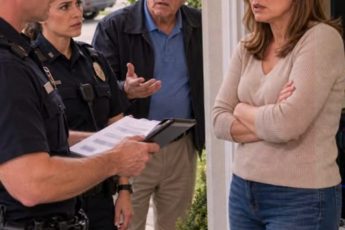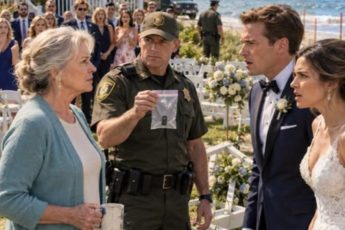


After Nora’s words, the room became so silent that it seemed even the rain had stopped striking the windows.
“What disappeared?” I asked.
Nora looked at my father.
“The company’s main seal and several signed blank forms.”
My father immediately stood up.
“Maren took them.”
“I was in my own apartment all night,” I answered.
“The cameras show something else,” Landon said.
Nora put the phone on the table.
“That is exactly why we must go to the company. Right now.”
Twenty minutes later we were standing in front of Caldwell’s warehouse. It was six in the evening. Rainwater ran in small rivers over the asphalt, while the wind shook the building’s iron door.
Inside, the employees stood silently. Some held empty salary envelopes in their hands.
My father walked toward them.
“This is all a temporary delay.”
A woman named Diana raised her head.
“You have been telling us this for three months.”
“Maren will fix everything,” my father said.
I stepped forward.
“No. This time I am not fixing anything in your name.”
Landon grabbed me by the arm.
“Do not humiliate us in front of the people.”
“You already did this matter yourselves in front of the people.”

Nora took us into the director’s office. She turned on the camera recording on the table. On the screen Landon could be seen entering the safe room at three o’clock at night. He was holding his father’s key.
The color drained from Landon’s face.
“I only wanted to verify the documents.”
“Why did you take the seal from the safe?” I asked.
“Dad told me that we should file a complaint against you. We had to get the money back and make you sign as if you had transferred it illegally.”
My father turned toward him.
“Be quiet.”
For the first time Landon did not listen.
“You told me everything would be mine if we removed Maren from the company.”
My mother gripped the chair.
“What are you saying?”
“I am saying what we all know,” Landon answered, and his voice broke. “Dad has been convincing us for years that Maren was worth nothing.”
Nora called the police. I did not want anyone to be arrested. I simply wanted everything to stop. But what a person has done to someone behind their back sometimes is no longer dependent on that person’s wishes.
The police seized Landon’s recording, the safe’s fingerprints, and the forged forms. My father tried to call his lawyer, but his lawyer did not answer the call.
“This cannot be,” my father repeated. “I ran this company for twenty years.”
“You controlled people,” I told him. “I was the one keeping the company afloat.”

A week later, the first hearing took place in court. My father and Landon were charged with financial fraud, using forged documents, and hiding information from employees. A temporary manager was appointed to the company, while the report my father had filed against me was canceled because its basis had been disproved by his own son.
After court I returned home alone. I found the door of the old house half open. I went inside.
On the walls of my childhood room there still hung the photograph in which all the family members could be seen, while I stood at the back, half behind the curtain.
I took the photograph down.
Then I took a small wooden box from the upper shelf. Only one thing remained there for me—the ivory-colored brooch that I had carried on my bag years before.
The house was empty. Not of things, but of the expectation that one day they would see me.
Three weeks later we opened Verity Draft’s new office in Durham. It was small, had white walls, and smelled of coffee in the morning. For the first time, the employees met me not as the silent financier, but as a person who remembered their names.
I hung a small sign on the door.
“No one hides here.”


Diana started working with us. She took charge of the finance department and on the day she received her first salary, she stood by my door for a long time.
“May I come in?”
“This is your office too.”
She smiled.
“For the first time someone has told me that.”
Months later, on a cold December morning, my little niece Emma came to the office. She held a colored sheet of paper in her hand. On it was drawn a woman whose dark mark on her face looked like a large red sun.
“This is you,” she told me.
“Why do I have such a big sun?”
“Because it will show everyone where you are.”
I pinned the sheet to the wall.
That evening my father wrote to me for the first time. It was only one sentence: “Can we start over?”
I looked at the screen for a long time. Earlier, I would have run immediately after receiving such a message. But now a small wooden box stood before me, and inside it the ivory-colored brooch gleamed.
I wrote a short reply.
“You can start your life over. My return is no longer necessary.”
I sent it and put the phone aside.

I was not happy about his downfall.
Nor did I want Landon to go to prison.
Simply, for the first time I no longer felt that saving someone from other people’s mistakes was my duty.
The next morning the first snow came to the office. The employees went to the windows. Emma was drawing another woman on the sheet in the corner, this time standing by open doors.
I sat down at my desk, opened the wooden box, and attached the brooch to my bag again.
For years it reminded me that once I had been invisible.
But now it meant only one thing.
I went outside.
Missed the beginning?