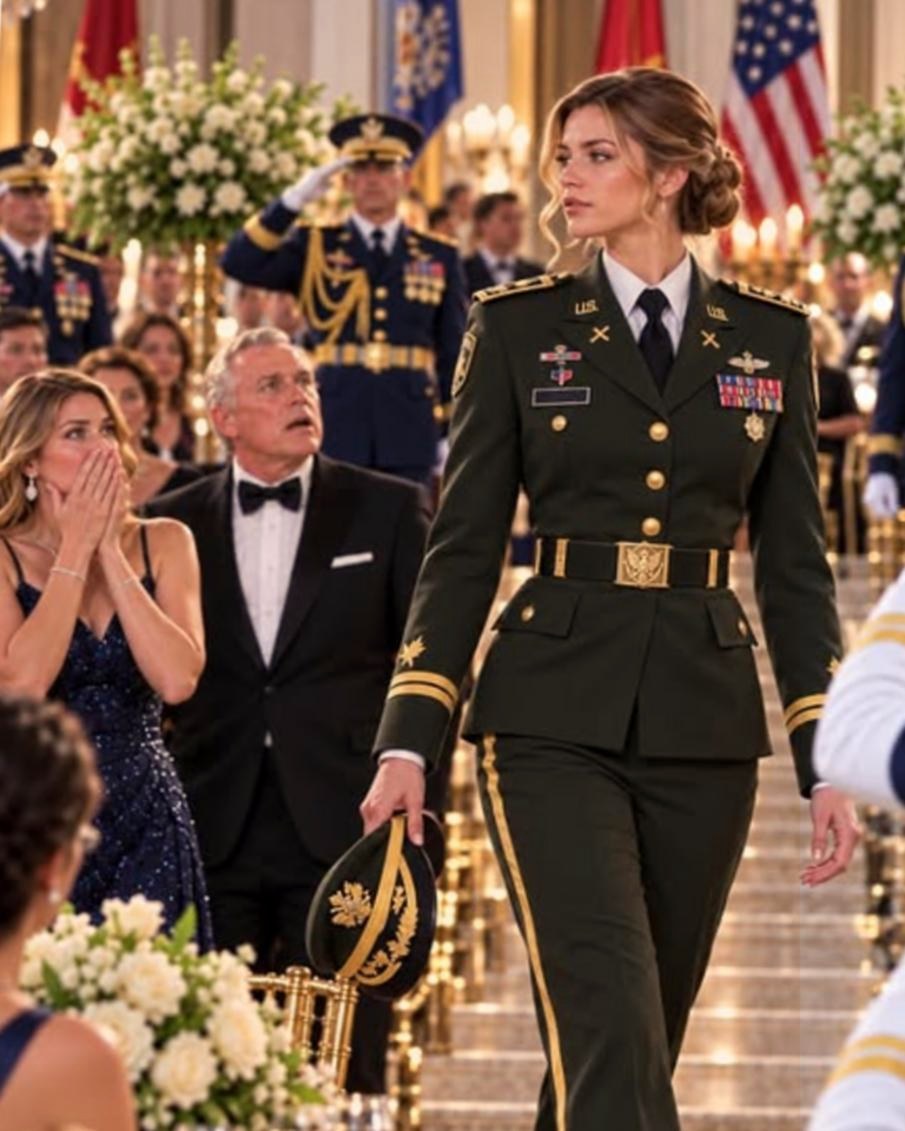

The phone froze in my hand.
“What happened?” the general asked me.
“I don’t know,” I answered. “But someone wants me to think that way.”
Elena stood beside me and looked at the message.
“I do not recognize this number.”
“I recognize it,” my father said.
Everyone looked at him.
Richard stood pale. For the first time there was neither anger nor arrogance on his face. Only fear.
“This number belongs to an employee of the old foundation,” he said. “To a person who disappeared after that operation.”
“How do you know?” I asked.
My father could not answer.
That night the police allowed him to leave the hall, but the general quietly said in my ear:
“Do not go alone in the morning.”
I was not going to.

At six in the morning I arrived at the old military warehouse. General Harrington, Elena, and two investigators were waiting for me there. The snow had not yet come, but the air smelled of iron and wet earth.
The warehouse door was half open.
“The message was sent from here,” the investigator said.
Inside there was only one table. An old voice recorder and a small key had been placed on it.
My father’s voice sounded from the recorder.
“Claire must not learn about this. If she finds out, we will lose everything.”
Then another man asked:
“But her name remained in the report. How will we erase it?”
My father answered:
“With money. Money always works.”
I froze on the spot.
It was his voice.
Not a rumor. Not an edit. Not someone else’s account.
His own words.
The recorder continued.
“The award ceremony will not take place until we find out who owns the contract. If Claire is declared a hero, people will ask questions.”

The general lowered his eyes.
“That is exactly why the official recognition failed then,” he said. “An investigation was underway, but your father, through the influence of the foundation, obstructed everything.”
“Why?” I asked.
Elena picked up the key.
“Because during that operation you saved not only people. You discovered that money allocated for military procurement was going to a private company. And your father’s friends ran that company.”
I remembered my father’s old exhibition in the living room, where Ethan’s photographs hung together with the medals. For years I went to that wall and realized that my silence was convenient for them.
“That is why he called me a disappointment,” I whispered.
“Because you were not controllable for them,” the general said.
That same morning the investigators searched my father’s foundation office. There they found transfers, hidden accounts, and statements forged with my signature. Elena’s recording gave the investigation the final evidence.

My father called me at noon.
“Claire, everything will be fixed,” he told me. “Just say that the recording was taken out of context.”
“No.”
“I am your father.”
“And that is exactly why I believed you longer than I should have.”
“Family does not act like this.”
“Family does not force a child to hide their own name.”
Silence fell on the other side.
Then for the first time he told me what I had been waiting for all those years.
“I am proud of you.”
I closed my eyes.
Those words had once meant everything. That day they sounded only like a delayed voice.
“You do not need to say that anymore,” I answered.
Three weeks later his foundation was closed. The investigation went to court. My father was charged with fraud and misappropriation of state funds. Ethan wrote me a letter and said that for the first time he understood how easily he had believed our father’s words.
I did not answer immediately.
Sometimes forgiveness does not mean giving an answer.

When I returned home, my childhood room was empty. They had left a place on the wall for Ethan’s photograph, but none of my pictures had ever been there.
In the desk drawer I found only the old golden pen. The one my father had handed me years ago and told me was “too expensive a thing for an office girl.”
I picked up the pen in my hand.
The small eagle on its top was still shining.
Four months later I moved to another city. I took a new position at a military academy and taught young officers how to make a decision when all communication is cut off.
In my office I placed a small wooden board by the window. On it lay a drawing by my nine-year-old niece—three people in the mountains, and above them a large yellow sun.
“Is this you?” I asked her.
“Yes,” she told me. “You are going ahead because the others do not know the way.”
When the first snow came, I looked at that drawing and, for the first time, did not want to prove anything to the past.

My father wrote to me once again.
“If you are ever ready, I want to talk to you in person.”
I looked at the message for a long time.
Then I wrote calmly:
“You have already told me everything. Now I am continuing my life.”
I put the phone down.
I went to the window and took the old golden pen in my hand. Outside, snow was quietly falling, while the noise of the city was slowly fading.
That evening I understood for the first time what peace sounds like.
The eagle was still shining.
Missed the beginning?