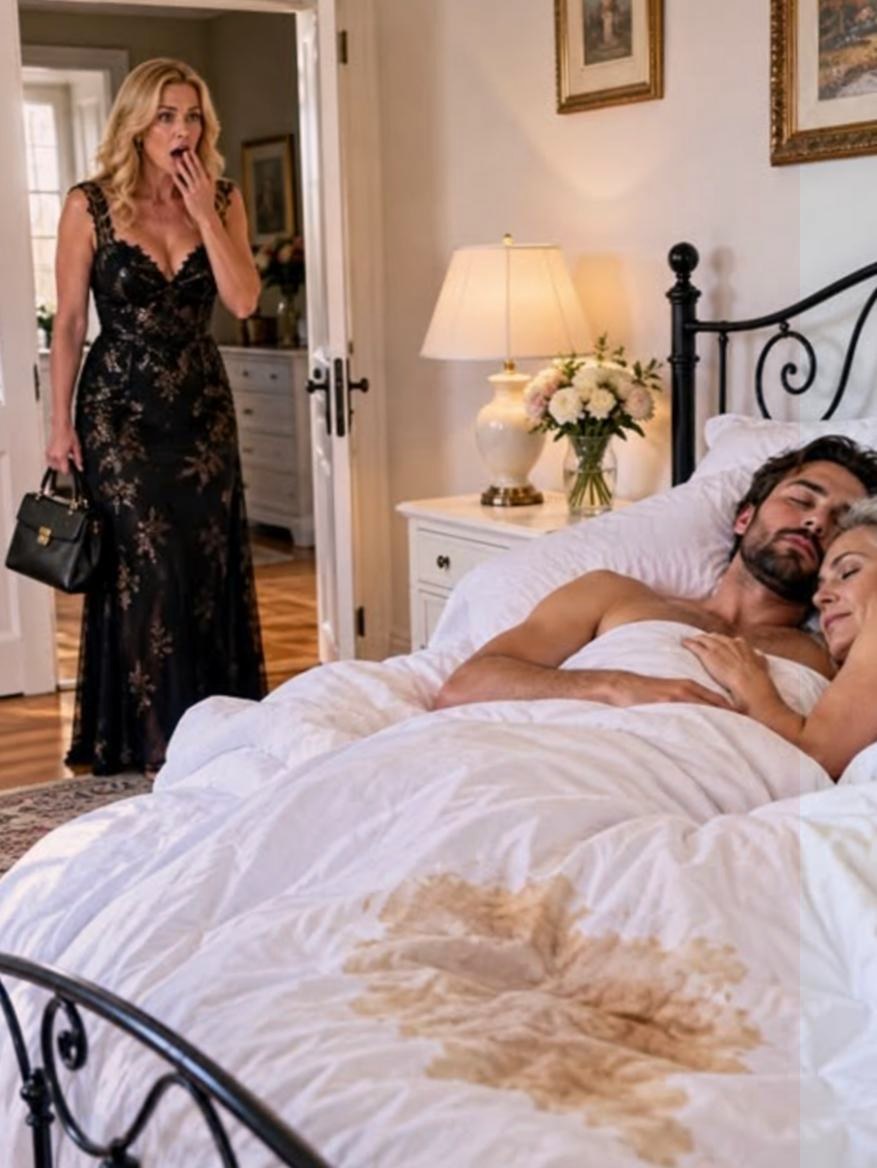

There was another knock at the door, this time so hard that the wooden headboard shook.
Margaret jumped up.
“Let no one come in,” she said.
Aaron placed his hand on the handle.
“This is my house too.”
“No,” Margaret replied. “You only live here.”
He opened the door. Two people stood on the threshold — a young woman with a folder of documents and an elderly man holding a camera. Behind them stood the notary, Elene, with stern calmness on her face.
“I am Elene Kavtaradze,” she said. “The person authorized by trust to manage your father’s will and property.”

Margaret stepped back.
“You have no right to come here.”
“On the contrary, I have exactly that right. Especially after I found out that an attempt to sell the house was made without your son’s consent.”
Aaron looked at his mother.
“Were you trying to sell the house?”
Margaret answered quickly:
“I was doing it for you. We needed money.”
“Who needed it?”
She could not answer.
Elene opened the folder and took out a sheet.
“Your father owned this property until his death. The will clearly says that the house will pass to Aaron only if he makes the decisions about his residence himself. Margaret had a temporary right of use, but not the right to sell, rent, or transfer it into another person’s name.”

I looked at Margaret. Her face aged in one moment.
“Why did you tell me that I could not live here without your permission?” Aaron asked.
“Because you did nothing until I told you.”
“And therefore you decided to arrange a test on the night of my wedding too?”
Margaret’s gaze moved to me.
“I had to find out whether she would obey you.”
Everyone in the room fell silent.
Aaron picked up the little letter from the bed. The edge of the paper was already slightly crumpled by my fingers.
“Did you write this?”
“Yes,” she said at last. “But you understood the words incorrectly.”
“It says here that if Nino gave up the room once, she would give up everything afterward.”
“I was simply testing her character.”
“No, Mother. You were testing whether I could still carry out your orders.”


Margaret shook her head.
“She turned you against me.”
“No,” I said. “You wrote all of this yourself.”
Elene took the recording.
“An audio recording of your conversation has already been saved, if you need to prove this. A camera had been installed in the hallway because of the property inspection. Last night Margaret herself said that she was forcing Nino to give in.”
Margaret lunged toward her.
“You cannot use this!”
“We have already used it,” Elene said calmly. “It is precisely because of this recording that we stopped the sale process.”
The key fell from Margaret’s hand. It fell onto the floor and rang sharply against the marble.
Aaron watched it for a long time.
Then his phone rang. He answered.
“Sir, I am your lawyer,” a voice said. “Your mother asked me to get you to sign the documents. I have now learned that she concealed the main facts. I can no longer take part in this case.”
Margaret looked at the phone.
“No. Do not hang up.”
But the call had already ended.

That same day she tried several times to regain control. First she told me that everything was my fault. Then she cried. Next she promised Aaron that if I left the house, she would never again interfere in our life.
Aaron no longer believed her.
“This house will no longer be a bargaining weapon,” he told her.
Margaret struck the table with her hand.
“You are leaving your mother because of her?”
“No. I am leaving the rule according to which love meant obedience.”
Several hours later, Elene played the recording installed in the hallway. We were all sitting in a small room. First my voice came from the phone’s speaker — tired, but restrained.
“Fine,” I was saying in the recording.
Then Margaret’s voice could be heard.
“One night on the sofa will not hurt you.”
The silence that had been in my voice then could be seen, although silence has no voice in a recording.
Margaret lowered her head.

Then her own phrase was heard:
“If spending one night on the sofa is a tragedy for her, she will not endure your life.”
Margaret covered her ears with her hands.
“Turn it off.”
Aaron did not move.
For the first time he was listening to himself from the outside too — at the moment when he told me not to quarrel, at the moment when he took my silence for agreement.
“I really said that,” he sighed quietly.
“Yes,” I answered. “But the fact that you hear it now means we have not lost everything yet.”
That evening Margaret left the house. She had one small suitcase and the key that had fallen onto the floor, but now she was no longer holding it. She stopped at the door.
“Do not think this is over.”
“What we will not repeat is over,” Aaron told her.
His mother did not answer again.

I entered the bedroom alone. The bed was still made, but for the first time the room no longer resembled our wedding night. On the pillow lay my white hair clip — a small silver moon that I had worn all day and removed only when I lay down on the sofa.
I picked it up.
It was the only thing that stayed with me that night.
Several weeks later Margaret moved into another apartment. The house documents were legally оформed in Aaron’s name, the attempt to sell was canceled, and Elene gave us a copy of all the rules as well. Aaron and I installed a new lock.
But the most important lock was not on the door.
One Sunday morning we were sitting in the kitchen. The first snow was falling outside. Our little nephew, Luka, was drawing on the floor with pencils. He drew a house on the sheet, and on the roof two yellow windows.
“Whose house is this?” I asked.
“Yours and Aaron’s,” he answered. “Whoever lives here decides for themselves who comes in.”
Aaron smiled, but his eyes became wet.

I attached Luka’s drawing to the refrigerator.
I began working at a small publishing house in the city center. In the morning I walked, bought coffee at the same café, and when I returned home in the evening, I always checked whether I truly had time to remain with myself.
Aaron changed too.
He no longer said, “Let us not anger Mother.”
He said, “What do we decide?”
These two sentences sound almost the same, but an entire marriage stood between them.
A month later Margaret sent us a letter. It was short. She wrote that she had made a mistake, that she was afraid of being left alone, and that she wanted everything to return to the way it had been.
Aaron read the letter for a long time.
“Do you want us to answer?” he asked me.
I stood by the window. Outside, snow was already gathering on the balcony.

“You can answer,” I told him. “But only if the answer is about regret and not about the conditions for returning.”
He nodded.
That same night Margaret called me.
“Nino, you destroyed everything,” she told me.
I listened silently.
“You may truly think so,” I answered. “But I will no longer destroy myself to restore the old peace for you.”
Silence fell on the other side of the line.
“You took my son away from me.”
“No. I did not take Aaron from you. He simply chose for the first time what kind of person he wanted to be.”
Margaret said nothing.
I calmly ended the call.

Several months passed. We hung new curtains in the house. We put our engagement photograph back at the head of the bed, but beside it we also attached Luka’s drawing. Every evening, before sleep, we locked the door together.
One evening Aaron handed me a small box.
Inside lay my silver moon-shaped hair clip. I had thrown it into a drawer after the wedding night and forgotten it.
“Why did you keep it?” I asked.
“Because that night began badly, but that object showed me what I had made you lose.”
I put the clip in my hair.
Then I opened the window. Cold air entered, but this time no one told me where I should sit or where I should lie down. The room was ours.
The silver moon shone lightly in my hair.
And that night I slept for the first time as if the house truly were mine.
Missed the beginning?