
The message did not repeat a second time.
But it was enough.
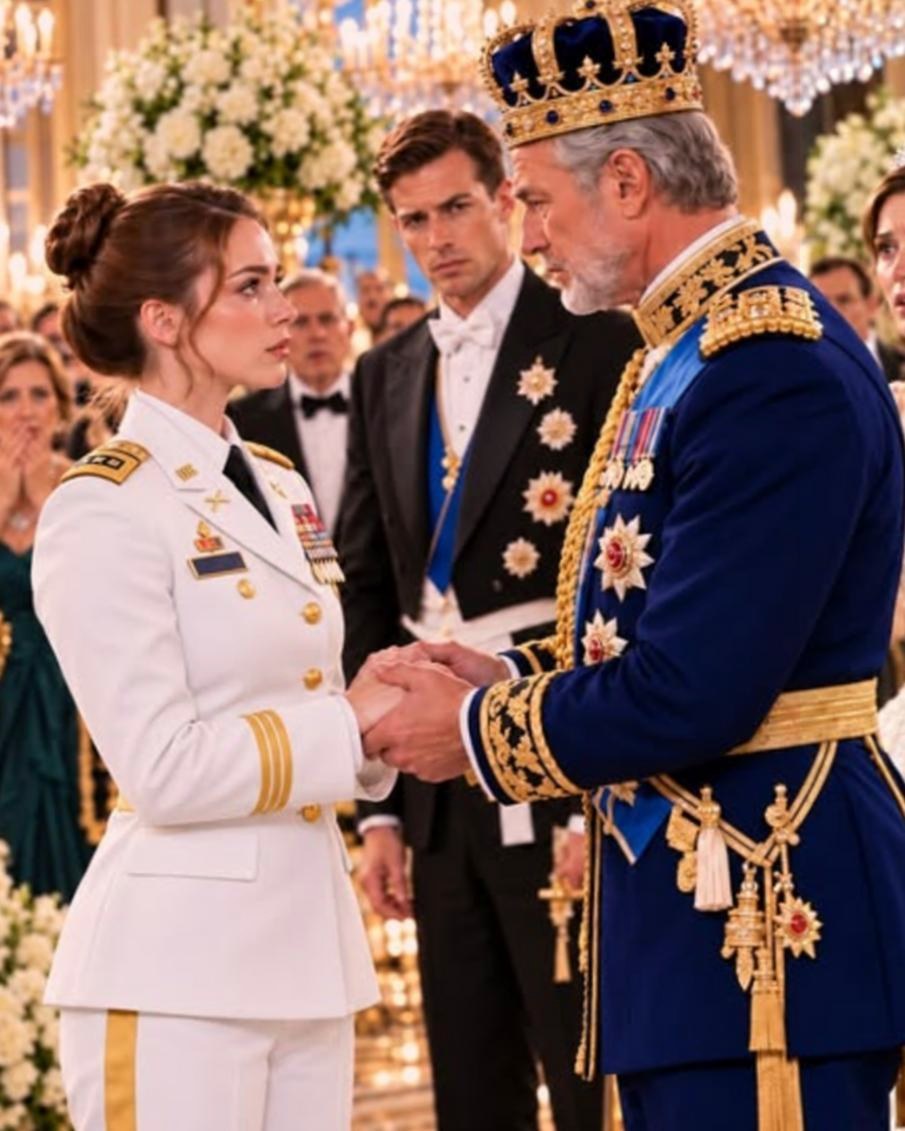
The king raised his hand, and all the doors in the hall locked at the same time. The guests’ phones were taken away. The children were moved to the back room. The music stopped, while the champagne glasses remained on the tables as if the celebration had simply been deprived of breath.
“No one leaves,” said the colonel.
Rachel came toward me.
“Emily, please listen to me.”
“I have listened to you my whole life.”
“I did not want to kill anyone.”
“But you wanted me to be silent.”
She bit her lips.
“I thought that if Alexander found out about you, he would reject me.”
Alexander exhaled heavily.
“Rachel, I married a person who did not let me know her life.”
“I love you.”
“Love is not called protecting lies.”
The king signaled to the guard, but Rachel tried to fall to her knees before him. Mother helped her. Father stood by the wall, still holding the wedding program in his hand. He had crumpled the edge of the paper as if that small sheet could return everything.

The king’s lawyer brought a video recording into the room. It was from the hotel kitchen. It showed Rachel handing a guest list and copies of security cards to a man dressed in a black coat.
“I only gave him the list,” Rachel said. “I did not know what he intended to do.”
In the video her voice could be heard clearly:
“Emily cannot enter here. If she enters, stop her. It does not matter how.”
The screen in the hall went dark.
Rachel was looking at her own face and seemed to be seeing it for the first time.
“I do not speak like that,” she whispered.
The lawyer answered calmly:
“You do speak. The recording is certified.”
Rachel closed her eyes.
And for the first time I felt not victory, but exhaustion. For eight years I had proved to everyone that I had done the right thing that night. Now I no longer needed proof.
The colonel then told me that the man dressed in a black coat had been the former head of security for Alexander’s uncle, Leopold. Leopold wanted to remove the king and place Alexander on the throne, whom he would then control himself. In that old operation I had discovered Leopold’s secret meeting, although at the time I did not know against whom he was working.
I had saved not the king, but his most dangerous witness.
The next day Rachel’s wedding was canceled. The official statement concerned only three matters: a security breach, the illegal transfer of state documents, and participation in a conspiracy.
Rachel was arrested in the hotel’s underground parking lot. I did not go there.
Her lawyer contacted me in the evening.
“She wants to speak with you.”
“I am no longer her rescuer.”
“Perhaps your testimony could help.”
“The truth will help. Not me.”

The second call was made by Mother.
“My child, she is your sister.”
“I know.”
“Perhaps you could forgive her at least once?”
“Forgiveness is possible. Going back is not.”
Three days later I heard my own words for the first time. The colonel asked me to be present in the interrogation room. They played the recording for Rachel.
“If Emily comes here, everything will fall apart.”
Her voice was cold. Confident. Familiar.
Rachel sat on the chair and scratched the edge of the table with her fingers.
“Enough,” she said.
“You said it yourself,” the investigator replied.
“That is what I thought then.”
“What do you think now?”
She was silent for a long time.
“Now I understand that I was not living in her shadow all my life… I was living in her kindness.”
That was the first truthful sentence I heard from her that day.
One week later I returned home.
I found the bedroom closet open. The naval uniform was no longer hanging there; the king had asked for it for the royal archive. In its place only one small metal object remained—the old brass whistle.
The fourth scratch was still on it.
Rachel’s room was empty. A childhood photograph hung on the wall: two girls, one embracing the other by the window before a great thunderstorm. I took the photograph down, but I did not tear it. I put it in a drawer.
Some things must be kept not because you want a return, but because you want to remember where you came out of.

Six weeks later the king officially offered me the position of royal security adviser. I did not refuse.
The new job was in a small port city. Every morning I woke at six o’clock, opened the window, and let the salty sea air into the house. During the day I checked security plans. In the evenings I taught the neighbor’s boy, Nicholas, to ride a bicycle.
One day he brought me a drawing.
On the sheet were drawn black cars, a tall house, and a small woman. The woman held a golden whistle in her hand.
“Is this you?” I asked.
“Yes. You protect everyone.”
“Sometimes it is necessary to protect yourself too.”
“Then draw this for you too.”
In the corner of the sheet he added a small house whose door was locked from the inside.
The first snow came in December. The roofs of the port turned white, while the sea fell silent like dark glass. That evening I received a letter from Rachel.
“Emily, now I know that you were never my enemy. If you are ever able, I want to speak with you for only five minutes.”
I placed the letter on the kitchen table.
The next day her lawyer called me again.
“She has remorse.”
“Remorse is good.”
“Will you not agree to a meeting?”
Outside the window, snow was falling slowly.
“No.”
“Why?”
“Because her remorse is no longer my obligation.”

I did not say another word.
Several months later the court sentenced Rachel for the illegal transfer of state documents and aiding a conspiracy. Leopold was arrested before he could flee the country. The king retained the throne, while Alexander held a small, quiet government meeting instead of a ceremony.
Rachel did not have a wedding.
And for the first time I had a life that did not begin in someone else’s shadow.
Mother called me every week. At first the words between us moved carefully, like steps taken on ice.
“Are you well?” she would ask me.
“Now I am.”
“Father wants to see you.”
“When I am ready, I will meet him.”
This time no one was hurrying me.
Neither the king.
Nor the family.
Nor the past.
One evening I stood at the door and was hanging Nicholas’s drawing on the wall. I took the brass whistle out of the drawer. Its surface was warm because it had been in my pocket all day.
I hung it by the window.
Outside, the city lights swayed in the water. Far away a ship set off and gave a low signal.
I wrapped my fingers around the whistle.
That night, for the first time, I no longer remembered who had not invited me to the wedding.
I remembered only that in the end I had opened the door myself.
And this time I let no one inside who wanted to make me smaller.
Missed the beginning?