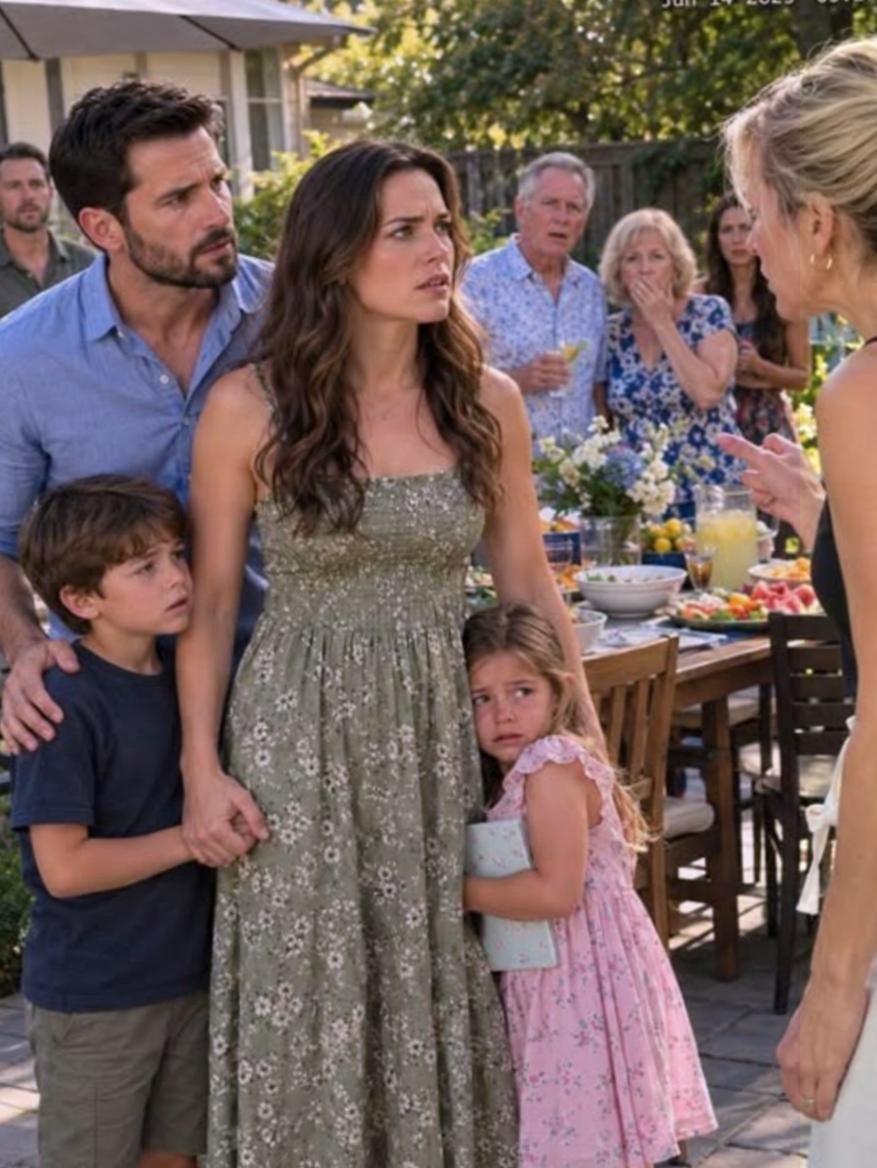

“What video?” I asked.
Every sound in the yard disappeared.
Sam’s breathing could be heard on the phone.
“A camera recording from the Child Protective Services office. Brooke claims that you threatened her there and forced her to sign the documents.”
Brooke raised her head. That old confidence appeared in her eyes again, as though the last word still belonged to her.
“You see?” she said quietly. “In the end they will believe me after all.”
“Did you watch the recording in full?” I asked Sam.
“Not yet. I only saw the description in the case materials. But there is something strange. The time of the video and the time indicated on the document do not match.”
The copper medallion jingled again in my hand.
“Then tomorrow we will listen to the video in full,” I told him.
“No, Claire. We have to go to the office today. If the recording is falsified or is an excerpt, by morning it may already be too late.”
Daniel took the children by the hand.
“I’ll take them home.”
“No,” I said. “We are all going together.”
Brooke stood up.
“I am not going with you.”
Nora answered calmly:
“You are already a participant in this case. It would be better if you stayed.”

Brooke lost control for the first time. She picked up her bag and ran toward the gate, but her father blocked her way.
“Step aside, Father.”
“This time I cannot let you go,” he told her. “Enough.”
We drove almost in silence. Lily sat on my shoulder, while Ethan looked out the window. The city lights spread across the glass in long strips.
“Mom, will we still be with you tomorrow?” Lily asked me.
There was such fear in her question that my chest tightened.
“Tomorrow too, the day after tomorrow too, and every morning when you wake up,” I told her.
It was ten o’clock at night at Sam’s office. The hands of the clock on the wall moved noisily. He turned on the computer and opened the recording.
In the first minutes only a hallway was visible. Then Brooke appeared. She was not alone. Standing beside her was her former husband, Mark, whose name no one had mentioned for years.
“You told me Claire would be there,” Mark said.
“She will be,” Brooke answered. “She will have to give up the children.”
The door opened on the screen and I entered. I was holding Lily’s small pink bag because that day I was bringing her favorite toy for the social worker.
My voice could be heard clearly in the recording.
“Brooke, I came here only to confirm the documents.”
“If you do not sign, the children cannot stay with you,” she answered.
“Is that a threat?”
“It is a choice.”

Mark put something on the table. It was money.
I stepped backward.
“Do you want to sell the children?” I asked.
Brooke shook her head.
“It is simply help. Sign, and we will tell everyone that you saved them.”
I took the documents and turned toward the camera.
“Now it is clear why you wanted to hide this recording,” Sam said.
In the last minutes Mark told Brooke that he did not want responsibility for the children, but Brooke convinced him that if I left the family, both of them would gain control over them. Then Brooke signed the relinquishment of custody. Of her own free will. In her own words.
The video ended.
Brooke was sitting on the chair, her head buried in her hands.
“I just wanted everything to be fixed,” she said.
“No,” I answered. “You wanted someone else to be blamed for what you could not accomplish.”
The next morning in court, her lawyer left in the middle of the meeting.
“I cannot defend a position that my own client herself denies,” he told Brooke.
The judge heard the video, the documents, and the social services report. Brooke’s request was canceled. She was allowed to contact the children only under supervision, but Brooke did not use a single meeting to apologize. She continued saying that she had a case against everyone.

A few days later the prosecutor’s office began an investigation against Mark and Brooke for a falsified statement and an attempt to mislead the court. I was not asking for them to be punished. I was simply no longer trying to save them from the consequences of their decisions.
The hardest moment came after the court hearing.
Sam played the telephone conversation recorded by Brooke. This time she was sitting in another room and heard her own voice from the outside for the first time.
“Claire will give the children back to me herself. If I humiliate her in front of people, Daniel will break.”
Brooke raised her head.
“I did not say it like that.”
“You said it,” Sam replied.
“I was angry.”
“But it was your voice.”
Brooke lowered her eyes. For the first time she could not blame anyone for her own words.

A week later we emptied the children’s rooms in our old house. Not because we wanted to leave, but because every corner there reminded us of Brooke’s threats. A small wooden car had remained under Ethan’s bed. And by Lily’s window hung her drawing, in which four people stood holding hands.
I took down the drawing and gave it a new place on the wall.
I put the dark green folder on the top shelf of the closet. On the same shelf I placed the copper medallion.
Months passed.
We moved to another neighborhood. Daniel opened a small workshop, and I began working as an administrator at a school. In the mornings I woke the children myself. Ethan drew robots in his notebook, while Lily chose a new hair clip every Friday.
One morning, when the first snow began falling outside the window, Ethan asked me:
“Mom, can I add your surname to my surname too?”
The spoon fell from my hand.
“Why do you want to?”
“Because when someone asks me who my family is, I want to say both names.”
Lily put her drawing on the table. Four figures stood on it, and a large yellow sun was drawn above them.
“Brooke is not here,” she said.
I sat down beside her.
“The drawing has only the people who stand beside you.”
Several weeks later I received a letter from Brooke. At first I did not open it. Then I read it anyway.
“I want you to speak to me at least once. Now I have lost everything.”
I held the sheet in my hand for a long time.
Then I wrote a reply.
“I am not the enemy of your pain. But I can no longer be the person who fixes your choices. The children need peace. Please respect this boundary.”

I sent the letter and turned off the phone.
That evening Ethan picked up the medallion.
“Are you still wearing it?”
“Always.”
“Why don’t you need to hide it anymore?”
I placed the medallion on my palm. The two names shone in the winter light.
“Because it was never proof for other people,” I told him. “It is our story.”
Lily ran her finger over the medallion.
“Then don’t hide it anymore.”
Outside the window the snow began falling harder. A warm light was burning in the house, the smell of cinnamon floated through the kitchen, and the children’s laughter filled the walls.
I hung the medallion by the door, where we could see it every day.
This time it no longer meant that someone had to prove that she was a mother.
It was simply returning home.
Missed the beginning?