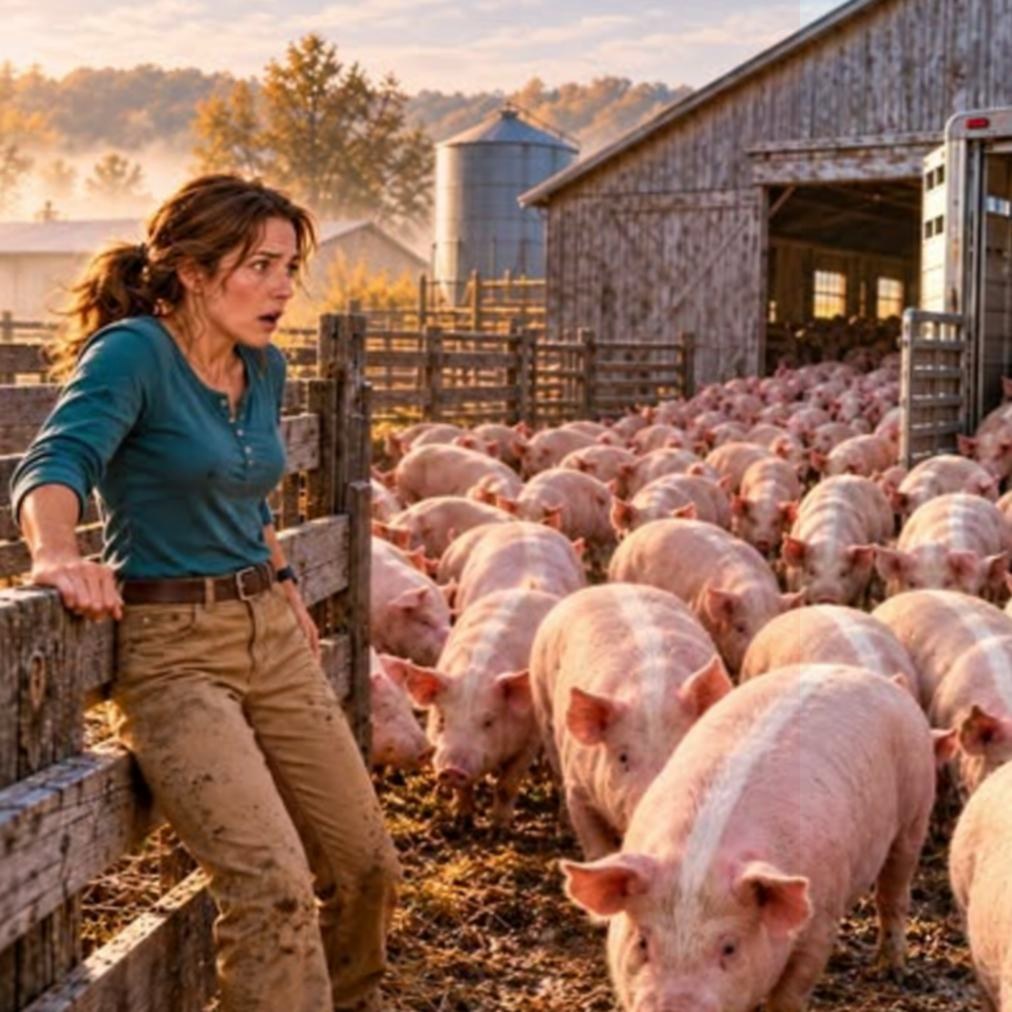

Lika’s teacher’s voice message remained in the phone.
“Mara, do not return alone. The police are on the way. I wrote down the black car’s number.”
Father put his hand against the wall.
“Now they no longer have time.”
“Neither do we,” I told him.
Elliot turned off the generator. Darkness covered us in the underground room in one second. Only the beam of my small flashlight remained.
The sound of an engine came from above.
Blaine had returned to the farm.
We came up through another exit, through the old grain pit. The wind struck my face and the smell of earth clung to my clothes. Two police cars stood by the pen, and between them Blaine stood with his hands raised.
“This is a misunderstanding,” he was saying. “The woman has a psychological problem. Her father has been missing for years.”
The policeman looked at him.
“Where are your employees?”
“I do not know whom you mean.”
At that moment Elliot switched on the flashlight and played the recording aloud.
Blaine’s own voice sounded throughout the yard.
“If Mara resists us, we will use her loan. If necessary, we will take the child too.”
Blaine froze.
His lawyer, who had just got out of the car, immediately called him.
“They cannot use this conversation,” he told him.
“You yourself told me that everything was legal,” Blaine hissed through his teeth.
“I told you not to call about the child.”
Blaine heard his own words for the first time through someone else’s mouth. His face slowly turned pale. He stepped back, as if the voice had physical force.
The policeman put handcuffs on his wrists.
“Blaine Wycliffe, you are under arrest on suspicion of threats, forgery of documents, and organizing illegal research.”
Two investigators got out of the second car. They already knew the location of the underground door. Lika’s teacher’s recording changed everything.

The pigs were making noise in the pen. Their white stripes shone identically in the flashlight beams.
“Where is Father?” the policeman asked me.
I looked toward the forest.
But he was no longer standing there.
Only his hat lay beside the old well.
I picked it up. A second memory card was hidden inside.
The policeman looked at the screen.
“What is on this?”
I put the card into the laptop. A land-sale contract appeared, my father’s signature, and beside it a doctor’s conclusion that on the day of the signing he had been given a strong sedative.
The second file contained the names of the people who worked at this center. Among them was one of my childhood neighbors, a man who was standing at the farm with the policemen that night.
“He is with them too,” I said.
The policeman immediately called the second investigator.
The neighbor tried to escape, but the way was already blocked.
The court trial began months later. Almost every day I had to repeat the same words, but this time the walls were no longer underground and no one was threatening me silently.
Blaine’s company had its license suspended. The state confiscated the land. The records taken from the underground center also helped other affected families.
Father was found three days later, near a small church located by the river. He was alive, but very weak. When I went to the hospital, his eyes were closed.
“I thought I would lose you again,” I told him.
“This time you found me,” he answered.
I was angry with him. For seven years I had lived thinking that he had left me alone.
“Why did you not tell me the truth?”
“Because I believed that being far away would protect you.”
“But you left me alone.”
He looked at me for a long time.
“I know.”
This word from him was heavier than an apology.

Blaine tried to contact me several times from prison. The first time his lawyer called me.
“Mr. Wycliffe is ready to compensate you if you change your testimony.”
“No.”
“Mrs. Whitlock, the amount will fully cover your debts.”
“My life is no longer for sale.”
The second letter Blaine sent himself.
“You do not know how many people you will destroy with all this.”
I folded the letter and put it in the trash bin.
I had destroyed no one.
I simply no longer protected a person who was assigning his own decisions to me.
Four weeks later we completely cleaned the farm’s pen. Of those sixty-eight pigs, thirty-six were transferred to rescue farms. Veterinarians observed the others and distributed them to safe places.
For the first time in a long while, peace returned to our yard.
Lika decided to return to school. Every morning she prepared her bag herself and left a small drawing on the kitchen table. In one drawing there was our house, above it the sun and sixty-eight small white stripes.
“This no longer frightens me,” she told me.
“Why?”
“Because now I know what it means.”
“What does it mean?”
She put the pencil aside.
“That sometimes strange things open the door to the truth.”
After recovering, Father moved in with us. In the first days we did not talk much. In the mornings he checked the fence, while I worked in the old workshop.
There I found the copper bell from my childhood. Its handle was still burned, but its sound was still clear.
Several days before the first snow, I hung it at the farm’s gate.
Now every morning, when the wind moved it, the sound of the bell scattered throughout the yard.

One morning I received a new message on my phone.
“If you ever want to forget everything, I can start a new life for you.”
It was Blaine.
At the sight of his name, my heart no longer quickened. I felt no fear either.
I simply deleted the message.
Then I opened the window.
Snow was falling. Lika was running in the yard, and Father stood beside the fence listening to her voice.
I took the bell in my hand and struck it once.
Only once.
Its sound went toward the forest, but this time nothing returned from there.
And for the first time I understood that peace is not silence.
Peace is when you no longer wait for anyone.
The bell was still ringing.
Missed the beginning?