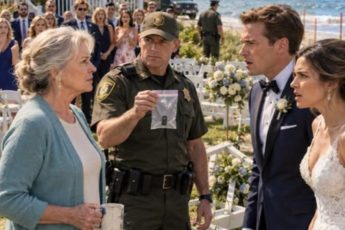

Real fear appeared on his face for the first time.
Matt dialed a number.
“Contact the bank. Now. Stop everything.”
He heard the answer and his jaw tightened.
“What do you mean, there is a restriction on the account?”
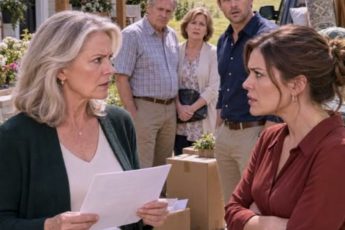
Salome calmly took the phone.
“It means it is too late.”
Jessica looked at her.
“Did you arrange this?”
“No,” Salome said. “This is the result of your signatures and your words.”
Matt walked around the room. He kept touching the door lock with his fingers, as if searching for an exit that no longer existed there.
“Rachel, let’s talk,” he said to me.
“I have been doing exactly that for six years.”
“We only wanted to help Noah.”
“It is not called helping a child when you make him cry and force him to lie to his own mother.”

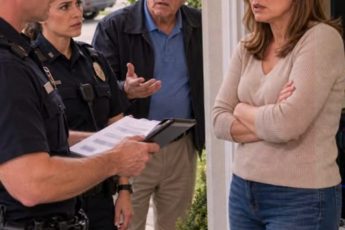
The police arrived fifteen minutes later.
It began to rain in the yard. Water ran down from the windowsill and formed a small puddle near Jessica’s shoes. One police officer asked Matt for the documents, while another took the folder from Jessica.
“This is a forged document,” Matt said.
“Then why was your signature at the bottom?” the police officer asked.
Matt could not say a word.
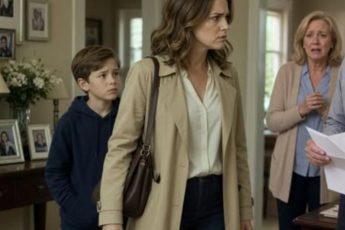
They took the recording, the papers, and Noah’s phone that remained in the house. Jessica was still trying to maintain her composure.
“I only wanted to protect the child.”
Noma, the school psychologist, looked directly at her.
“Protecting a child does not mean frightening him.”
Then Salome turned on a small speaker.
Jessica’s own voice sounded in the room.
“If you do not sign, Noah will say that he is afraid of his mother.”
Jessica lowered her eyes.
Matt seemed to freeze.
He heard his own words from someone else for the first time. I could see how his face changed with every sentence. When his laughter sounded in the recording, that laughter affected him more heavily than the police officer’s gaze.

“I do not speak like that,” he whispered.
“But that is your voice,” I said.
Matt buried his head in his hands.
“I did not know the amount was so large.”
“But you knew that Noah was afraid.”
“Jessica told me everything was legal.”
Jessica immediately shouted.
“Do not blame everything on me!”
“You told me that his mother was the problem!”
“Because she was getting in our way!”
The police officer stood between them.
“Enough.”
That night I took Noah home. We hardly spoke in the car. His bag lay on the back seat, and above it I could see the small wooden compass I had given him in childhood. That compass always showed exactly north. That night Noah clutched it in his hand so tightly, as if he were clinging not to a direction, but to himself.

When we arrived home, I turned on the light in his room.
Everything was still standing as it had been: the new notebooks, the sports shoes, the photograph of us hanging on the wall, in which both of us had our eyes closed because the sunbeam was hitting us directly in the face.
Noah sat down on the bed.
“Mom, if they call again, I do not want to go back to them.”
“No one will force you again.”
“Are you angry?”
“At you? Never.”
“Then whom are you angry at?”
I went to the window. Outside, the streetlight spread across the wet asphalt.
“At the people who thought your fear could be used.”
Noah was silent for a long time.
“If there had been no money, would they still have taken me?”
This question hurt me the most.
“I don’t know,” I told him honestly. “But I know that you are not money. You never have been.”
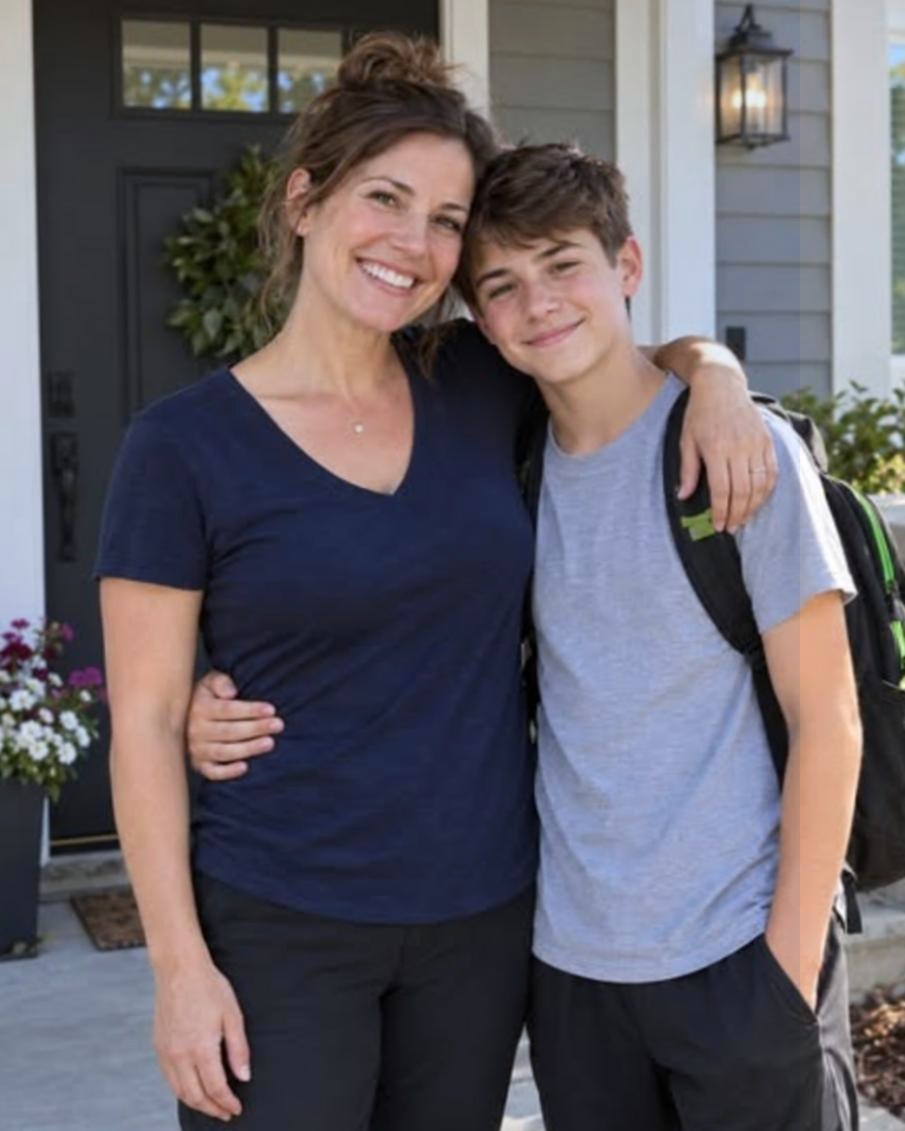
The next morning we went to school. We did not forget to take the photograph. Noah stood tense at first, but when I raised the camera, he rested his head on my shoulder.
“This time I will not close my eyes,” he told me.
“Neither will I.”
In the following weeks everything changed slowly, but clearly.
The bank froze Noah’s account until a new guardian was appointed. The court prohibited Matt and Jessica from meeting Noah alone. The investigation confirmed the forged signature, the threats, and the attempted transfer of money. Matt confessed to the crime, while Jessica denied everything to the end.

At the court hearing I was not watching his punishment.
I was watching Noah.
He was sitting beside me and drawing a small house on a sheet of paper with a pencil. The house had two doors, but only one path led to it.
The judge announced the final decision. Matt was deprived of guardianship. The case against Jessica continued separately. An independent supervisor was appointed for Noah’s account until he became an adult.
When we came outside, Matt called to me.
“Rachel, please. Just five minutes.”
I did not want to stop, but Noah was holding my hand.
Matt took his phone out of his pocket.
“I deleted everything. I also broke up with Jessica. I can be a good father.”
“Fatherhood is not a promise, Matt.”
“Give me at least one chance.”
“You already had a chance. Six years. Noah’s entire childhood.”
“Then what do I have left?”
For the first time there was no confidence in his voice.
I answered calmly:
“There remains the possibility of taking responsibility for your own decisions.”
Noah stepped forward.
“Dad, I was afraid of you when I said I was afraid of Mom.”
Matt lowered his eyes.
We left.

Three months later we moved to a new neighborhood. The house was small, but in the morning the sun came in through the kitchen window. I started working at a library. Noah joined the drama club at school and every Tuesday repeated his lines loudly at home until both of us lost our places laughing.
His wall filled with drawings. In one, I was depicted holding a large umbrella, and Noah stood beside me. Above it was written: “Home is the place where the truth can be told.”
One evening, when the first snow fell, Noah stood by the window.
“Mom, do you know what I learned?”
“What?”
“The person who truly loves you does not force you to choose through fear.”
I stood beside him.
“That is a very big thing for a twelve-year-old.”
“A lot happened.”
“Yes.”
“But now we are fine.”
“Now we are home.”
That night Matt wrote to me once again. It was a short message: “I miss him. Maybe I could come at least once.”
I looked at the screen for a long time. Then I locked the phone and did not answer.
It was not cruelty.
It was a boundary.
Noah’s small wooden compass lay in the kitchen, the one he had taken from his pocket that night. He had carried it for years, so the wooden edges had worn down. I picked it up and placed it on the windowsill.
It was still pointing north.
This time we chose the path ourselves.
And no one gave the house away anymore.
Missed the beginning?