
Patricia saved the call recording in three different places that same night.
One copy remained on my phone.
We sent the second to David.
The third went directly to the sheriff’s office.
Karen tried to regain control immediately. In the morning she sent a letter to the county council in which she declared me an “enemy of public safety.” Then she gave an interview to the local newspaper and said that one ranch owner was stopping a multimillion-dollar project out of personal stubbornness.
But this time the words worked against her.
Patricia put every letter, every plan, and every photograph into one folder. The folder had a new copper clasp. The same shape as the one on my grandfather’s old leather folder.
“Do not speak to anyone alone anymore,” she told me.
“And what if Karen comes again?”
“Do not open the door.”
Karen came anyway.
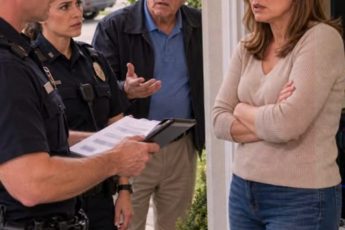
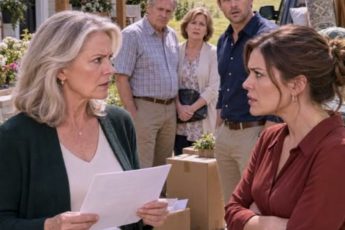
On Tuesday, at six in the evening, she stood in my yard with her lawyer, Gerald Pritt. The wind struck the barn roof, while the iron gate made a sharp sound with every sway.
“Daniel,” Gerald began, “we have an agreement.”
“What kind?”
“You will sign a temporary land-use permit. In return you will receive substantial compensation.”
“What do you call substantial?”
Karen said with a cold smile:
“Enough for you to end this misunderstanding peacefully.”
“And if I do not sign?”
Gerald opened his bag.
“Then the matter will continue for years. Court costs, experts, counterclaims. You may even be right and still lose everything.”
Laura stood beside me. Her fingers touched my wrist.
I opened the door wider.
“Leave.”
Karen lost her patience for the first time.
“You do not understand how many people you are hurting!”
“I do. That is why I will not let your mistake save my family.”
They left.

But that night Karen heard her own voice from someone else for the first time.
At the sheriff’s office they played her the call recording.
“If you want your family to remain safe, drop this matter.”
Karen sat motionless.
“I did not say that,” she whispered.
The sheriff played the recording again.
The same voice.
The same pause.
The same threat.
“It was made from your number,” the sheriff told her.
Gerald lowered his head.
“Karen, at this point I can no longer represent you.”
“What does that mean?”
“Conflict of interest and criminal risk. You will need another lawyer.”
Karen struck the table with her hand.
“Are you leaving me now?”
“I am distancing myself from you before the matter becomes worse.”
It was the first moment when she faced her own decisions alone.
The following week the county officially corrected the digital map. The investigation established that no one had deliberately moved the old boundary, but several people knew that the old records existed and still used the simple, incorrect line.
This distinction was important to them.
To me—less so.
Because the foundation had already been poured.

The court issued a temporary decision: Northridge was ordered to stop construction, while the county and the developer were required to remove the old structure and restore the land. A separate case was opened against Karen for the threat. She was not sent to prison, but the court issued a protective order and she was also removed from her position.
When I signed the final document, I did not feel victory.
I felt exhaustion.
As if for months I had been holding the land with my hands so that someone would not take it away, and now for the first time I could relax my fingers.
In a few days the heavy equipment returned, but this time for another purpose. They removed the foundation concrete. They dismantled the steel frame. The trucks slowly carried away what only a short time earlier had been called a twelve-million-dollar project.
The earth beneath the foundation was dark and damp.
In the place where the parking lot was supposed to be, they found one rotten post from my grandfather’s old fence.
Laura brought it home.
“Shall we throw this away?” she asked.
“No.”
“Then where should we put it?”
“Where we will need to remember.”

But the hardest room was still my grandfather’s workshop.
A month later I went inside. The leather folder still lay on the workbench, although now it had a new clasp. The room smelled of oil, dust, and old wood. Through the window the eastern pasture could be seen.
The sign was no longer there.
The concrete fence was no longer there.
The yellow excavator no longer stood there.
Only the marked-up earth remained and, in the middle, by the oak, a small pink ribbon.
That day I understood that the land does not return to you only when the others leave. It returns when you can look at it again without being reminded of other people’s voices.
Three months passed.
The county found another place for the new fire station, across the road, on Northridge’s own land. Construction began again. This time three independent surveyors checked the boundary.
Meanwhile I no longer used foreign words, because they did not belong to me here. Every morning I walked around my ranch, checked the water reservoirs, and began keeping records of land-survey matters in the small office. David told me to help organize the old maps.
“People notice late how many problems begin with one wrong line,” he told me.
“At least now they will notice.”

Laura planted a garden in the yard. For the first time in years, in the evenings only our own voices could be heard in the house. The unknown number no longer called. We no longer found a black car at the gate.
One morning I brought my seven-year-old granddaughter, Emma, to the oak. She held a sheet drawn with pencils.
“This is you, Grandpa,” she told me.
On the sheet she had drawn a large tree, a small house, and a long line.
“What is this line?”
“The one that must not be moved.”
I laughed, but my eyes filled with tears.
“Sometimes people try to move it.”
“And does the land agree?”
“No.”
Emma drew a tree and added a small iron circle beneath it.
“Then the land is smart.”
A few weeks later I received a letter from Karen. My address was written by hand on the envelope. Inside was a short text.
“Could we ever talk? I only wanted to protect my people.”
I held the letter in my hand for a long time.
Earlier I probably would have replied. I would have tried to explain, calm her, and convince her that everything was over.
But now I knew: the weight of her crime was no longer my responsibility.
In reply I sent only one sentence.
“You must bear the consequences of your decisions yourself. I remain on my land.”
After that I wrote nothing more.

The first snow came at the beginning of December. It was rare in Texas, so Emma stood in front of the door from morning and stretched her hands toward the sky. I entered my grandfather’s workshop, took the leather folder, and went to the oak.
The copper clasp gleamed in the cold snow.
I put the folder on the ground beside the old iron marker. Snow slowly fell on its worn leather, and for the first time in a long while I was no longer afraid that someone would take it from me.
Laura called to me from a distance:
“Daniel, the tea will get cold!”
I ran my hand over the folder.
I could still hear my grandfather’s voice.
“Never let anyone tell you that the land has changed.”
I returned home.
The boundary remained in place.
Missed the beginning?