
We did not stay at home that night.
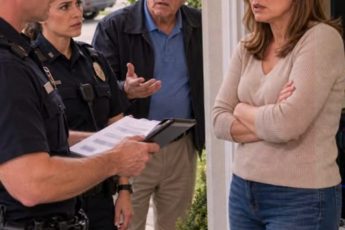
Sandra took the children to her apartment, and I went to the police station together with lawyer Irakli. The city streets were wet. Raindrops collided with one another on the taxi window, while I spun Mateo’s small wooden car in my hand.
That object had always been in his pocket.
Now I was holding it.
“Are you afraid?” Irakli asked me.
“For the children, yes.”
“Then you must remember that you already have enough to protect them.”
At the station I called Arthur.
He did not answer on the first ring.
On the second, his voice cracked.
“Mariana, let’s forget all this.”
“You have to come to the police.”
“Mother said some things, but this is a family conversation.”
“A forged signature is no longer a family conversation.”
He remained silent on the other side of the line.
“You don’t want the children to lose their father, do you?”
For years this phrase had been his strongest weapon. This time, for the first time, I was no longer afraid.
“The children are not losing their father, Arthur. They are finding out for the first time what you are.”
I ended the call.

Teresa called me immediately.
“Mariana, please withdraw the complaint. Arthur was simply confused.”
“He forged my signature.”
“He was in a bad condition.”
“I worked for eight months, raised the children, and paid for everything. No one remembered my condition then.”
“Do you want a family or revenge?”
I closed my eyes.
“I want peace. I no longer need revenge.”
The next morning, a social worker came to Sandra’s apartment. Mateo told everything himself. Lucia showed a drawing made with her colored pencils.
There were four people standing in the drawing.
Me, Mateo, Lucia, and Sandra.
Arthur was in the corner, in a small square around which Lucia had drawn a black line.
“Why is Dad standing here?” the woman asked.
Lucia shrugged.
“Because when he is at home, Mom’s heart hurts.”
That evening Arthur was brought by the lawyer. His face was tired and gray. Teresa came too, but this time she did not sit beside her son.
Irakli arranged the papers on the table.
“Here is the job offer Arthur rejected. Here are the messages in which he writes about the plan to drive Mariana from the house. And here is a copy of the false application and the preliminary conclusion of the signature examination.”
Arthur raised his head.
“I only wanted to bring the family back.”
“No,” I said. “You wanted the family to revolve around you again.”

Irakli turned on the recording.
My own voice sounded in the room.
“Mariana will pay my bills anyway.”
Arthur seemed to hear these words for the first time. The color disappeared from his face.
“I did not mean it that way.”
“But that is what you said,” Sandra answered.
Teresa’s voice sounded in the recording too.
“People will believe that she is a bad wife.”
Teresa covered her face with her hands.
“God… did I say this?”
No one answered.
Sometimes the heaviest punishment is when a person hears himself through someone else’s ears.
Arthur leaned toward me.
“Mariana, I will take the job. I will change everything. Just withdraw the complaint.”
“Change does not begin with fear of a complaint.”
“The children need a father.”
“Yes. But children need a father who will not deceive their mother.”
Irakli calmly explained that because of the false document, the case would continue, while contact with the children would be possible only under the supervision of a specialist.
Arthur signed the agreement.
And Teresa said for the first time:
“I have justified everything for him for years. Now I understand that by doing this I was helping neither him nor you.”
I nodded.
“Time will show us that now.”

That night I entered our old apartment alone to take my things.
The living room was unusually empty. The family photograph no longer hung on the wall. Behind the photograph only a small dusty mark remained.
In Mateo’s room I found his bed, books, and the empty box of the wooden car.
I had the car with me.
In the kitchen, on the shelf, stood one glass. The one Arthur always left by the sink and I washed every morning.
This time I did not touch it.
Three weeks later we moved into a new apartment, on the other side of the city, close to the clinic. The apartment was small, but in the morning sunlight from the window fell directly on the kitchen table.
I was still working at the clinic, although now I no longer took an additional evening shift. Once a week I went to the park with the children. On Saturdays I watched Mateo’s football practice, while Lucia stuck colorful stickers on my bag.
One evening Mateo asked me:
“Mom, will Dad come again?”
“He may visit. But living with us will be different now.”
“Do you still love him?”
The first snow was beginning outside the window. Flakes slowly swirled in the light of the streetlamps.
“I once loved him very much,” I said. “But love does not mean that a person has the right to hurt you.”
Mateo thought for a long time.
“Then are you free now?”
I looked toward him.
“For the first time in a long time.”
Lucia brought me her new drawing. This time all four people stood on one line, but she had drawn a door beside Arthur.
“This door is open,” she told me. “If Dad really becomes good, he may come in.”
“This is not your choice, Lucia. It is the adults’ responsibility.”
“But you won’t lock it forever, will you?”
“I am not locking anyone outside. It is just that now truth will be needed to enter my home.”

Two months later I received a message from Arthur.
“I started working. I no longer live with Mother. I know I did a lot wrong. Could we go somewhere with the children on Sunday?”
I looked at the screen for a long time.
Then I wrote:
“You will see the children according to the agreed rules. Do not try to return to me. I am not going back.”
An answer did not come immediately.
Only several hours later did one word appear.
“I understand.”
I did not know whether he really understood. But for the first time I no longer felt that understanding him was my duty.
That evening Mateo put the wooden car on the table.
“You won’t need it anymore, will you?”
I took the car and placed it on the windowsill, beside Lucia’s drawing.
Outside, snow was already covering the entire street.
And for the first time I was no longer waiting for someone to return.
I remained at home.
And silence no longer frightened me.
Missed the beginning?