
The call from the medical center ended that same night, at ten eleven.
I slowly put the phone down on the table.
Diego was standing in front of me. Paulina stood beside him, but she was no longer touching him.
“Mariana, that call means nothing,” Diego said.
“Then why are you trembling?”
“Because you are not well and some people are taking advantage of this.”
Gabriel closed the folder.
“From now on you will not be alone with her.”
Diego looked at the lawyer.
“You are interfering in a family matter.”
“No,” Gabriel answered. “I am carrying out the protection of my client’s life and property.”
Paulina suddenly took out her phone.
“Diego, we have to go.”
“Not yet.”
“It is already all over.”
It was the first time Paulina had said aloud what both of them had been hiding for months.

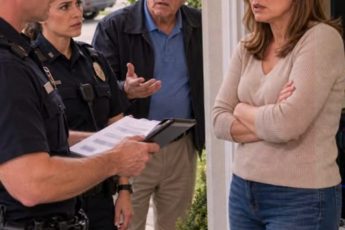
Police officers entered the hall.
They did not shout. They did not threaten anyone. They simply requested the documents and asked both of them to remain in the building.
Diego took a step toward me.
“Mariana, think. If you take this all the way, we will both lose everything.”
“I have already lost six years. Now I am only deciding how many more I will lose.”
The police officer placed a hand on his wrist.
“Mr. Diego, you must come with us for questioning.”
Paulina immediately called her own lawyer. In a few seconds she lost color.
“He is not coming,” she said quietly.
“What does ‘not coming’ mean?” Diego asked her.
“He said he has a conflict of interest. He has already seen the sales contract.”
For the first time Diego looked at Paulina as if she were a strange woman.

The next morning Claudia gave me another piece of evidence. A recording had been extracted from the hotel security cameras in which Diego and Paulina entered the room on the morning when I was lying at home because of my “memory problems.”
But the most serious recording was audio.
In Gabriel’s office, beneath the blinds lowered over the windows, the three of us listened to it.
First Paulina’s voice was heard.
“If she cannot work for another week, the buyer will back out.”
Diego chuckled.
“He will not. We will show everyone that she can no longer make decisions.”
“And what if the doctor suspects something?”
“We will bring the doctor ourselves. It already says in her record that she is confused from stress.”
Then Paulina asked:
“Are you sure she will drink it in the morning?”
“She has been my wife for six years. If I tell her that it is good for her, she will drink it.”
The voice stopped in the room.
I was sitting on the chair and listening to myself hold my breath.
Diego’s words stood before me, alive and most cruel.
“If I tell her that it is good for her, she will drink it.”
I lowered my eyes.
Gabriel said nothing. It was not necessary either.

That same week the investigators established that the medicine blister had been bought in Diego’s name. The pharmacy camera showed his face, the date, and the payment card. On Paulina’s computer they found altered calendars, hidden messages, and letters sent to the buyer.
The case reached court.
Diego denied everything until he heard the audio recording.
In the courtroom he lowered his head.
The judge asked:
“Is that your voice?”
He was silent for a long time.
“Yes,” he said at last. “But I did not mean it that way.”
I did not look toward him.
Paulina accepted responsibility for attempting the deal, forging documents, and property fraud. Against Diego, the investigation confirmed charges of intentionally causing harm to health, forging documents, and misappropriating funds.
The court froze my company’s accounts until the audit was completed. For two months everything was difficult. I had to convince the clients that I was still running the business. I had to explain to the employees why Paulina had disappeared. Some cried. Some apologized to me.
I did not blame them for a single minute.
They too had believed the lie that was repeated every day.
The most painful moment came when I returned home.
Diego’s things had already been removed from his office. Only an empty shelf and one sheet of paper rolled under the desk remained in the room.
And in the kitchen stood the jar in which my mornings had been locked.
I put on a glove and threw it in the trash.
But I did not throw away the sleeve stained with gold paint. That shirt remained even after washing. The stain was small, but clear — the sign of the day when my body still seemed to belong to me, while my life had already been sold to others.

Three months later I opened a small studio in another neighborhood of Monterrey. I worked there in the mornings, and from the window I could see a row of old trees. I kept the same name — “Jacaranda.”
The brand was now in my hands. The building too.
Every morning I drank water first, then made coffee. I washed the cup myself. This insignificant habit became a sign of freedom for me.
One morning my little niece, Lucía, came to the studio. She sat at the table and drew me a picture with colored pencils.
There was a large house in the picture, and a woman stood in front of it. The woman had a golden stain drawn on her sleeve.
“Is this you?” I asked.
Lucía nodded.
“You are protecting the house.”
“From whom?”
“From everyone who comes in without knocking on the door.”
I laughed. For the first time in a long while, that laugh came out without fear.
Several weeks later I received a letter from Diego. It had been sent through a lawyer.
“I want to talk to you. Everything began differently. Paulina confused me. I never wanted anything bad for you.”
I read the letter to the end.
Then I wrote a reply.
“Your intention is no longer my responsibility. I am not going to return to your life. Please do not contact me again.”
Gabriel asked me whether I really wanted it sent.
“Yes,” I answered. “For the first time I want my answer to be only mine.”

On the first morning of winter I saw white flakes from the studio window. It rarely snowed in Monterrey, so the employees went outside and looked at the sky like children.
I opened the wardrobe.
There, on a small wooden hanger, hung that old shirt. The golden paint stain was still visible on the sleeve.
I put it on that day.
I looked at myself in the mirror and no longer saw a woman who waited for tea prepared by someone else, trusted someone else’s explanation, or lived with someone else’s permission.
I saw a person who had reclaimed her own home.
Lucía’s drawing hung by the window outside. The wind fluttered the paper slightly, but the golden woman remained in place.
I locked the door, put the key in my pocket, and turned on the studio lights.
That morning, for the first time, I drank nothing that someone else had prepared for me.
The golden stain shone in the sun.
Missed the beginning?