
Grant looked toward the house, but this time there was no longer a person there who could carry out his orders.
Natalie stood at the door, holding the phone as if she were looking for an answer on the screen.
“The plane is ready,” she said quietly.
“Then go and bring the car,” Grant ordered.
For the first time, Natalie did not obey his order.
“What will happen to my apartment?”
Grant looked at her angrily.
“Are we discussing this now?”
“We are discussing it exactly now. You told me the money was legal.”
“And you believed me.”
Natalie fell silent.
This short sentence turned out to be heavier for her than any shouting.
Dana Reyes put the phone to her ear.
“The bank has frozen all the accounts. Airport security has also been informed.”
Grant immediately called Marcus.
Marcus looked at the screen and ended the call.
“Answer!” Grant shouted.
“We have already said what we had to say.”

Grant called a second time.
This time Marcus turned on the phone’s speaker.
“Marcus, all this can be settled,” Grant said. “Elena is ruled by her emotions. You are her brother. At least do something for the family.”
Marcus looked toward me.
“Elena, do you want me to settle it?”
“No,” I said. “For the first time I want him to receive the consequences himself.”
Marcus ended the call.
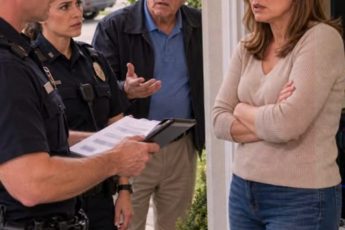
A few minutes later, the police officers entered the yard. One officer asked Grant for his first and last name. Grant first tried to laugh, then mentioned the name of a lawyer, then looked at his mother.
No one moved to help him.
Clarissa stood at the door and looked at the champagne fragments scattered in the water.
“Grant,” she said in a hoarse voice, “you told me everything was under control.”
Grant turned his head toward her.
“Mother, not now.”
“No, now is exactly the time.”
The officer put handcuffs on Grant.
He did not resist. Only then did he see that for years he had left others in exactly this state—placed against a wall, confused, unable to defend their own name.

Marcus played the recording again.
Grant’s voice sounded in the yard.
“If Elena resists us, we will say that she is emotionally unstable.”
Grant froze.
These words now sounded as if they had come from someone else’s mouth, although he himself had said them.
“She will sign where we tell her.”
He lowered his eyes.
“Turn it off,” he whispered.
“Why?” I asked. “Are you hearing what you were saying for the first time?”
He could not answer me.
I no longer wanted to return to the house, but my documents and several personal belongings were there. I entered together with the officer.
In the hallway, my old mirror still stood, whose lower corner Grant had once broken with his fist. Family photographs hung on the walls. In one of them, the two of us were on the seashore, holding paper cups and squinting from the sun.
I took the photograph down.
I left only myself in the frame.
Natalie’s suitcase stood in the bedroom. Half of my clothes were no longer in my closet. And the green silk robe lay on the bed, as if the house still could not decide whom it belonged to.
I did not take it.
From the kitchen drawer I took only my mother’s knitted sweater and my bent ring.
I put the ring into my palm.
The broken edge still cut me, but now the pain reminded me of my own choice, not Grant’s power.

Three weeks later, the court transferred temporary management of Grant’s property to the bank. His companies’ accounts were examined. Natalie gave testimony and accepted responsibility for her own crime as well. Clarissa tried to contact me through a lawyer, but I did not answer.
I did not want revenge.
I wanted no one to convince me again that I needed permission to prove my own truth.
Two months later, I rented a small apartment in a seaside town. Fishermen’s boats could be seen from the window in the morning. The kitchen smelled of lemon, because I always added lemon peel to my coffee.
I reclaimed my old profession.
I began working at a firm directed against financial fraud. In the very first week, a young employee asked me whether I really could read hundreds of pages without missing even one inconsistent number.
“I can,” I answered. “I simply did not want to see what I was seeing before.”
One morning, four months later, a child knocked on my door. It was the neighbor’s seven-year-old boy, to whom I sometimes read books.
He was holding a drawing.
On the sheet, a small house was drawn, and in front of it stood a woman. The woman had one hand placed on her heart, and in the other she held a yellow circle like the sun.
“This is you,” the boy told me. “When the sun comes out after the rain.”
I stuck the drawing on the refrigerator.
That evening I received a message from Grant.
“Elena, everything is over. The lawyers say that if you change your statements, my sentence may possibly be reduced. We went through a lot together. Come, let us speak at least once as husband and wife.”
I looked at the screen for a long time.
Then I sent only one reply.
“Our conversation ended on the day when you used your words against me in our own home. The law will say the rest.”

I turned off the phone.
The first snow fell outside. My mother’s sweater lay on the windowsill, and beside it was my bent wedding ring.
I did not wear it anymore.
Nor did I throw it away.
I simply managed, for the first time, to look at it without remembering Grant’s face.
The ring was no longer a sign of my defeat.
It was proof that, after everything, I reclaimed myself.
Snow fell silently over the city.
And I locked the door and turned on the light.
This time, I was the one deciding who would enter the house.
Missed the beginning?