
“Who filed the complaint?” I asked.
Salgado stood silently for several seconds.
“Your husband’s treating doctor. He said that Ernesto told him something important about Daniel one day before his death.”
Outside, the rain did not stop. The red and blue lights of a police car flashed on the wall by the rear entrance.
Salgado handed me my coat.
“Now we are going home.”
“Is Daniel there?”
“Yes. And he is trying to convince the buyer that you are mentally unstable.”
I stood up.
For the first time in several days, I was no longer afraid.
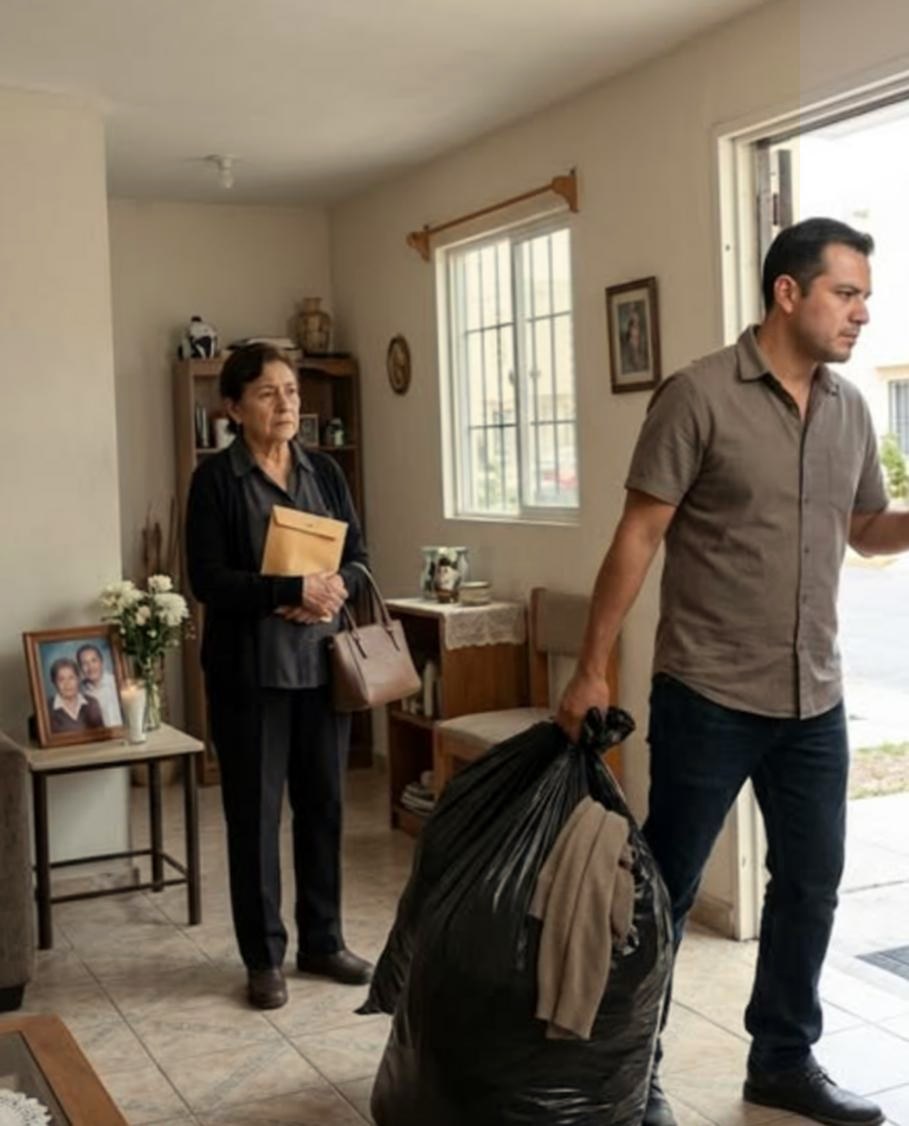
When we arrived at the house, I found the gate open. There was an unfamiliar car in the yard. Daniel was walking nervously by the entrance, while Monica was talking to someone on the phone.
As soon as he saw me, his expression changed.

“Mother, why did you come here?”
“I came to my house.”
“You need rest now. We have taken care of everything.”
Salgado stood in front of him.
“Mr. Daniel, you have already been warned that you do not have the right to sell this property.”
“You do not understand, my mother is confused.”
“Your mother is speaking very clearly,” said the police officer who was standing behind us.
Monica lowered the phone.
“This is a family matter.”
“No,” I said. “This is a matter of forged signatures and fraud.”
Daniel came toward me.
“Mother, please, don’t destroy me. I have debts. You only had to sign.”
“Is that why you took me to the nursing home?”
He could not find an answer.
“I lost your father, and you made me lose the house too.”
“I was doing this for you.”


Salgado placed the phone on the table and played the recording.
Daniel’s own voice sounded in the room.
“A few weeks in a nursing home and she will sign everything.”
Daniel froze.
Monica leaned against the wall.
“This… this recording cannot be used,” she whispered.
“Why?” the police officer asked.
Daniel could not speak. For the first time he heard his own words through someone else’s ears. His face slowly went pale.
“I did not say it like that,” he said.
“You did,” I answered.
“Mother…”
“Do not call me that anymore to justify your actions.”
The police read him the charges of forged documents, coercion, and financial fraud. An investigation was also begun against Monica. Their lawyer came the very next day, but after speaking with Salgado, he closed the folder.
“I cannot participate in this case,” he told Daniel. “You admitted everything yourself.”
Daniel struck the table with his hand.
“Everyone is against me!”
“No,” Salgado said calmly. “You have simply been left face-to-face with your own words for the first time.”

That night Daniel was taken from the house in handcuffs. Monica stood at the door and cried, but I no longer followed her with my gaze.
I entered the house alone.
Ernesto’s funeral vase was still standing in the living room. The white flowers had wilted, and the water smelled sweet and heavy. The copper key with the crescent-moon mark was no longer hanging on the wall.
I went into the hallway. Daniel’s room door was open. One photograph had been left on the bed—Daniel at six years old, holding a red balloon, while I stood behind him and laughed.
I picked up the photograph.
I took nothing else.
I left the room empty.
Three weeks later, the court approved temporary protection of the house and all the property for me. Later Daniel partially admitted his guilt. I did not keep him from imprisonment, but I did not demand revenge either. I demanded only what was mine and what he had taken from others as well.
Monica asked to meet with me.
“Daniel told me that you would have nothing left,” she said in a café.
“You believed him.”
“I… thought you really were ill.”
“You wanted me to be ill. That way your decisions seemed less painful.”
She lowered her head.
“Will you forgive me?”
For a long time I looked at the cold tea glass held in her hands.
“I can forgive. But you can no longer return to my life.”

Months passed.
I did not sell the house.
I set up a small kitchen on the first floor and twice a week taught the neighborhood women Ernesto’s old recipes. In the morning I went to the market alone. I planted lavender by the windows. In the evening I lit the lamp in the living room and for the first time no longer waited for someone to force the door open.
One morning my seven-year-old granddaughter, Lucia, came to me. Daniel’s case had not yet ended, but the child was not guilty of any of this.
“Grandmother, will you live here again?”
“Yes.”
“Alone?”
“No. Now together with myself.”
She drew a house on a sheet of paper, and beside it she drew a large yellow sun.
“This is the key,” she told me, drawing a small golden mark on the picture. “So that no one can take you away.”
I smiled, but my eyes filled with tears.
“No one will take me away, Lucia.”
That same evening I received a letter from Daniel. I recognized the handwriting at once. He wrote that he regretted it, that Monica had messed everything up, that family was still family, and that when he got out, we would start over together.
I read the letter to the end.

Then I called Salgado.
“Should I send an answer?”
“Only if you want to.”
I wrote a short sentence.
“I am not waiting for your return. I have already returned to my own life.”
I sent the letter and opened the window.
The first snow was falling. Light flakes fell on the trees in the yard and reminded me of the black bags into which Daniel had put my things. Then I thought that my life fit into two bags.
But now I knew that no one could fit it inside them.
I hung the copper key with the crescent-moon mark on the wall again. This time it was no longer a sign of a secret. It became the sign of my door, my choice, and my return.
Lucia took my hand.
“Grandmother, should you lock the door?”
I touched the key.
“No, darling. Now I will decide whom I will open it to.”