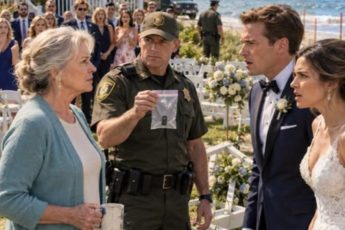

The next morning, in the Washington Military Police building, all of my father’s calls came to my phone.
At first, they were cold and commanding.
“This is a misunderstanding. I am already sending lawyers.”
Then his voice changed.
“Kate, answer. Your father is speaking to you.”
Then only silence remained.
His lawyer requested a meeting with me. At nine in the morning he entered a small room, placed a leather bag on the table, and sat down in the chair as if a heavy burden had been lifted from him.
“General Mercer, my client is prepared to cooperate.”
“Then why does he call me every ten minutes?”
The lawyer lowered his eyes.
“Because he realized for the first time what cooperation means.”
He closed the bag.
“I can no longer represent him if he tries to destroy documents or pressure witnesses.”
“Has he already tried?”
The lawyer did not answer me. That was enough.


That same evening, a search was conducted at Arthur’s penthouse. The television stations filmed computers, accounting books, and a black safe being carried out. Journalists stood by the staircase, but I did not go there.
I was not waiting for his downfall.
I was only waiting for the consequences of his decisions to finally remain with him.
Three days later, the recording was played publicly in the federal building. Arthur sat behind a glass wall. Trevor stood beside him, but no longer touched his father.
The young Arthur’s voice sounded in the recording.
“Kate must get nothing. She is dead to the family.”
A heavy silence descended in the room.
For the first time, my father heard his own words the way others heard them. Not as the firm decision of a father, but as the confession of a man who was afraid of his own daughter’s freedom.
He closed his eyes.
“Turn it off,” he said.
“You said that,” I told him.
“I was young then.”
“You were young twenty-six years ago. Not in the fraud of the last five years.”


He said my name the way he had in childhood.
“Kate, I wanted to protect you.”
“No. You wanted to protect your own secrets.”
Trevor pushed his chair back.
“Father, you said she was nothing. And now the whole country is listening to her.”
Arthur looked at his son and seemed to see for the first time how empty the legacy he had built was.
A week later I returned to my old house, where I had spent my childhood. The house had already been sold, and the buyer allowed me to take one thing.
My room was almost empty.
Only small nail holes remained on the wall. On the windowsill I found a wooden box in which my mother kept a small silver compass. The very compass that she had sewn into the pocket of my uniform twenty-six years ago.
Under the box lay a childhood photograph. I was seven years old and sitting on Arthur’s shoulders. We were both laughing.
I picked up the photograph.
And I held the compass in my hand for a long time.
I took only these two things from the house.

Three months later, the investigation confirmed that Mercer’s company had secretly controlled state tenders. Money was transferred to foreign accounts, while false accounts were opened in my name so that, if necessary, everything could be blamed on me.
That was why my father had been afraid of the existence of that account.
But my signature was not found on the account-opening document. There was the acknowledgment of his financial director, electronic correspondence, and camera footage in which Arthur’s assistant hid the files in the safe.
The witnesses came.
They presented the documents.
Arthur was arrested for state fraud and attempting to pressure witnesses, while the court sentenced him to a long prison term, and the company lost its state contracts.
I remained in the courtroom until the end.
Not for revenge.
I simply wanted that story to finally end without my disappearance.

Eight months later I was living in a small town in Colorado. I lectured at the military academy, and in the mornings I ran along the river. My daughter, Lea, asked me every evening why I had a silver compass on my chest.
“It shows me the direction,” I said.
“Then how do you know where you should go?”
“I do not always know. I simply keep moving.”
She placed a drawing on the table. In the drawing, a woman in a blue uniform stood holding a small compass, and beside her stood a child.
On it was written: “Mother came home.”
Those words hurt and warmed me more than any medal.
The first snow stopped in December. In the morning I opened the window and saw the tracks of Lea’s small boots in the yard. The smell of cinnamon and hot bread filled the kitchen. For the first time in many years, silence no longer resembled danger.

That same evening, a letter came from Arthur.
“Kate, I know that I do not deserve forgiveness. But if you are ever able, I want to speak with you once, not as the Mercer heir, but as a father.”
I read the letter three times.
Then I folded the envelope and put it in a drawer. I did not answer.
It was not cruelty.
It was a boundary that no one could cross anymore.
That night I entered Lea’s room. She was asleep and clutching her drawing in her hand. I placed the silver compass on the windowsill.
Its needle slowly stopped.
For the first time I knew that I myself was the right direction.
Missed the beginning?