
Giovanni’s phone was still ringing.
No one moved in the room.
Lorenzo looked at the screen.
“It is an unknown number.”
“Do not answer,” Giovanni said.
But the call stopped, and immediately the house security line rang. Someone downstairs shouted that a car was standing by the back gate.
Mrs. Gable suddenly regained her courage.
“You cannot prove anything to me. The recordings were obtained illegally.”
Lorenzo looked at her.
“For five years you poisoned my father, stole his property, and used my signature. And now you are talking to me about legality?”
“I was protecting this family!”
“No,” Giovanni said. “You were only protecting yourself.”

Lorenzo called the lawyer. A few seconds later, a stern-voiced woman, Diana Feretti, entered the room. She listened to the recording to the end, reread the folder, and said directly to Mrs. Gable:
“I no longer represent you.”
Mrs. Gable opened her mouth.
“Diana, you cannot treat me like this.”
“I already have. I will call the police myself.”
This was the first moment when Mrs. Gable had no answer.
Soon two investigators came to the house. They sealed the recorder, photographed the documents, and put handcuffs on Mrs. Gable. She still tried to have the last word.
“Nina, you think you survived? No one in this family will forgive you!”
I looked toward her.
“I am not asking for your forgiveness.”

Lorenzo added to the investigator that all the employees would need to be questioned. Then he knelt before Giovanni.
“Father, I listened to the recording.”
Giovanni said nothing.
“It was my voice. I betrayed you.”
The old man lowered his eyes.
“Yes.”
Lorenzo fell silent as if that one word had turned out to be heavier than any accusation.
The next morning his lawyer came once again. She held a new folder in her hands and was trying to convince Lorenzo that everything could be settled peacefully.
“Mr. Moretti, if you offer Nina a small amount of money, perhaps she will not file a complaint.”
“A small amount of money?” I asked.
Lorenzo raised his head.
“She is no longer a servant. She is a witness.”
“And this house?” I asked.
Giovanni told me:
“This house belongs to no one who rules it through fear.”

That same day Lorenzo heard his own words in full for the first time. Diana played the recording in the dining room, where his old voice said:
“If Father cannot sign, I will decide everything in his place.”
Lorenzo sat on a chair and listened to himself.
“I said this,” he muttered.
“Yes,” Diana replied.
“I was looking at my father and still could not see him.”
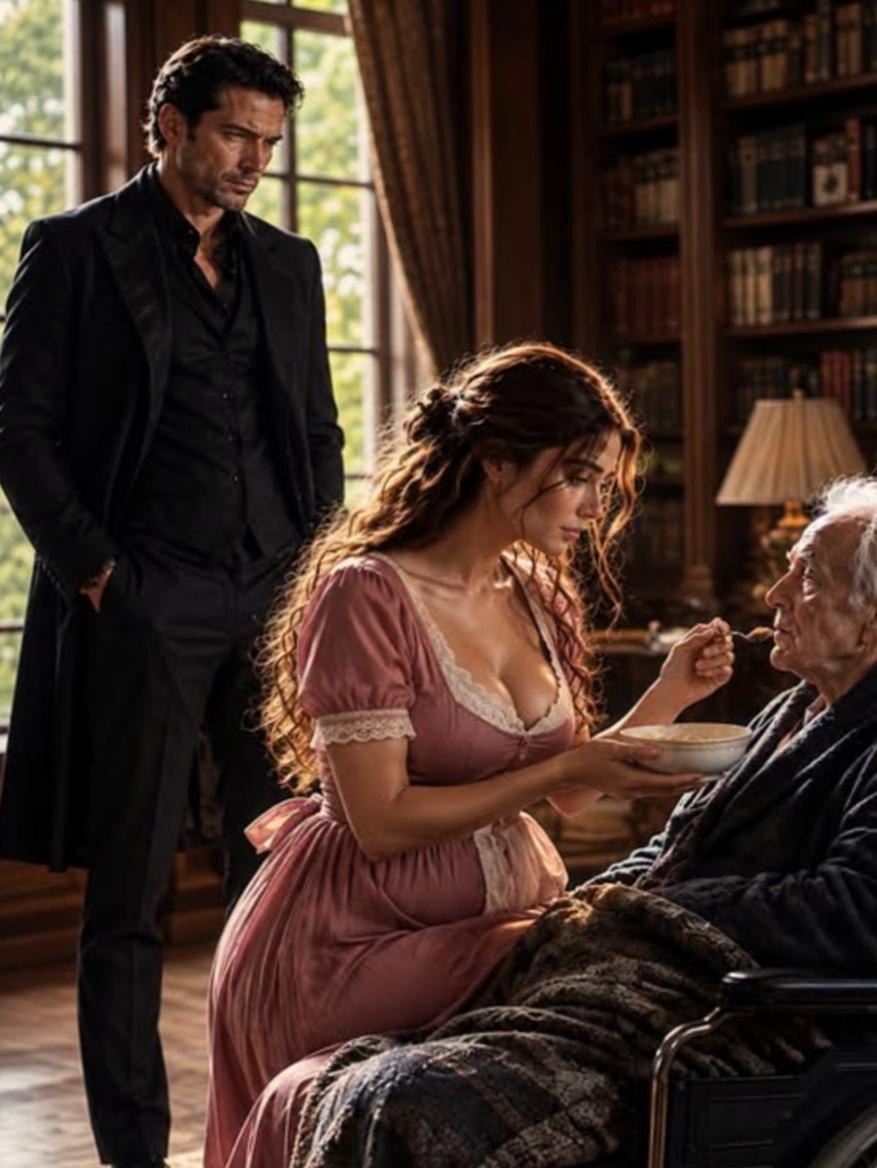
Giovanni had the wheelchair turned toward the window.
“Now you see.”
That week the house emptied. The employees took their belongings, the police sealed the study, and only a broken mirror remained in Mrs. Gable’s room. I emptied my little room as well.
I entered Giovanni’s room to get the last box. The brass key that had lain under the glass was no longer beside the bed. I was holding it in my hand.
“It is yours,” Giovanni told me.
“My mother left it to me.”
“Then now you must decide which door it will open.”

Three months later Lily was born.
When I first took her in my arms, snow was falling outside. Giovanni could not enter the maternity room, but he sat by the door and tapped his fingers three times on the wheelchair handle.
Lily cried with a small, red face.
“She looks like her father,” I smiled.
“No,” Giovanni said. “She looks like you. Therefore she will be strong.”
Then I rented a small apartment in another district of the city. In the mornings I worked at a library, and in the evenings I bathed Lily with the scent of lavender. I grew mint in green pots by the window. No one shouted at me anymore about how long I had to scrub the floor.
Lorenzo appeared before the court. He was proven guilty of misappropriating property and falsifying his father’s medical documents. Giovanni did not appear as a witness. He only sent a letter.
“I do not want revenge. I want my son to have to carry his own choice for the first time.”
Mrs. Gable was sentenced and left the house forever.
I did not greet her imprisonment with joy.
I only felt relief.
Six months later Lorenzo wrote to me. The letter was short.
“Nina, I have lost everything. If you can ever, I want to see Lily. Maybe we could start over.”
I put the letter on the kitchen table. I thought all night, because forgiving Lorenzo and allowing him to return to the past were not the same thing.
In the morning I wrote a reply.
“You can change your own life, but I will decide about your return to my child’s life. The answer is no for now.”

I sent the letter and for the first time did not feel guilty.
A year later Giovanni came to my apartment. He had brought a small wooden horse for Lily. The girl saw the brass key that I still wore around my neck and reached her hand toward it.
“Will this open a door?” she asked.
I placed the key in her hand.
“Only the door that you choose.”
Lily laughed and rested her head on Giovanni’s knees. For the first time the old man smiled in such a way that neither pain nor fear remained on his face.
The first spring rain was falling outside the window. And I looked at that little key and understood that the object brought from the past was no longer a sign of my captivity.
It had become a sign of my choice.
And this time I opened the door.
Missed the beginning?