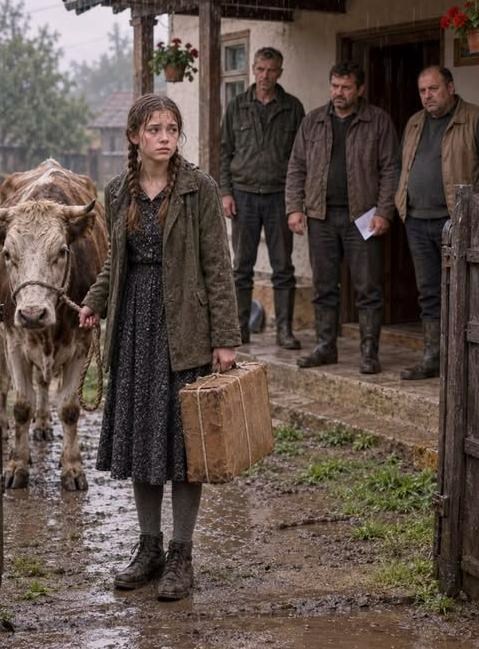
The morning after my mother’s funeral, my stepfather put a wet rope in my hand and told me the cow was my entire inheritance.
I was fifteen, still wearing my mother’s oversized brown coat, and the sleeves covered my fingers. Rain tapped against the kitchen windows while Peter stood beside the table, dividing everything she had owned as if he were sorting vegetables at market.
“Your nephew can take the horse,” Aunt Galina said. “The pigs belong to us. And the tractor should go to Peter’s brother.”
I stared at them.
“What about me?”
Peter did not look up from the notebook in front of him. “You are a child. You do not need land.”
“It was Mother’s land.”
“It is mine now.”
His answer struck harder than the rain against the roof.
I looked around the room. My mother’s embroidered cloth still covered the wall shelf. Her chipped blue cup stood beside the stove. Her scarf hung from the nail near the door, carrying the faint smell of dried apples and smoke.
“Can I at least take her things?” I asked.
“Later.”
That word had already become a locked gate.
Peter walked outside. A moment later, he returned holding a rope darkened by water and mud. He pushed it into my hand.
“There. Your share.”
At the end of the rope stood Joyana, our oldest cow. Her ribs showed beneath her dull brown coat, and the white patch between her eyes was streaked with rain.
“Mother left me a cow?”
“Be grateful,” Galina said with a laugh. “Someone has to feed that old beast.”
“Where am I supposed to live?”
Peter shrugged. “You have relatives.”
“I live here.”
“You lived here because your mother was alive.”
For a second, nobody moved. Then Galina folded my schoolbooks into a cloth bag and dropped them beside my boots.
“Do not make a scene,” Peter said. “You are not five years old.”
I wanted to scream. Instead, I packed two shirts, a pair of socks, my notebooks, and the last piece of bread from the cupboard. I reached for my mother’s scarf, but Peter caught my wrist.
“Leave it.”
His fingers were cold and hard.
I took Joyana through the gate.
Nobody followed.
The road beyond the village had turned into a ribbon of black mud. Joyana slipped twice, and each time I pressed my shoulder against her side to keep her upright. My hands shook so badly that the rope cut into my palm.
“I am sorry,” I whispered. “I do not know where we are going.”
We had passed the last house when a gate opened behind us.
“Maria!”
I turned.
My neighbor Nikolai stood beneath the narrow roof of his porch. He was a broad, quiet man who lived alone and rarely spoke to anyone after his wife died. His beard was silver, and rainwater ran from the brim of his cap.
“Did Peter send you away?” he asked.
I lowered my eyes.
Nikolai cursed softly, then opened the gate wider.
“Bring the cow inside.”
“I have no money.”
“I did not ask for money.”
He led Joyana beneath a wooden shelter, gave her hay, and wrapped me in a rough kitchen towel before setting a cup of hot tea in front of me.
Then he opened an old metal box.
Inside lay an envelope with my mother’s handwriting across the front: Maria. Only when she is alone.
I reached for it.
Nikolai stopped my hand.
“First, we must make sure Peter gave you the right cow.”
“What does that mean?”
“Your mother came to me two weeks before she died,” he said. “She knew she had little time. She was afraid of Peter, not of death.”
My throat tightened.
“Why did she never tell me?”
“Because she wanted you to survive the first day without her.”
At dawn, Nikolai brought an old veterinarian named Stefan. He examined Joyana’s teeth, hooves, ears, and swollen knees. Finally, he ran his fingers beneath the cow’s thick collar.
“There is something sewn inside,” he murmured.
My mother had always forbidden me to remove that collar.
Stefan cut one hidden stitch with a small knife.
A tiny brass key fell into his palm.
Nikolai’s face changed.
“She managed to hide it,” he whispered.
I opened the envelope. The letter inside contained only a few lines.
My dear Maria, if you are reading this, then Peter did exactly what I feared. Do not ask him for the house or the land. Take Joyana. The key in her collar opens what belongs to you. Nikolai knows where to take you. People often seize what they can see and miss what matters most.
I read it three times.
“Where are we going?” I asked.
Nikolai put on his coat and looked toward the abandoned mill beyond the fields.
“To the place Peter believes burned down years ago.”
He lifted the brass key from the table, and somewhere behind us, a wagon stopped outside the gate…
PART 2
The wagon wheels groaned in the mud, and Joyana gave a low, uneasy moo beneath the shelter.
Nikolai blew out the lamp.
“Do not speak,” he whispered.
I stood beside the stove, still clutching my mother’s letter. Through a crack in the curtain, I saw Peter’s dark coat near the gate. Aunt Galina sat beside him, holding an umbrella over her head while rain streamed from its edges.
“Maria!” Peter shouted. “Come out.”
Nikolai stepped between me and the window.
“She is asleep.”
“She has no business hiding in your house.”
“She has every business staying dry.”
Peter’s gaze moved toward the shelter. “That cow belongs to my farm.”
“Then why did you give it to her?”
Peter’s jaw tightened. “I gave her an animal because I was being generous.”
“Generous men do not throw children into the road.”
For several seconds, only rain answered them. Then Peter struck the gate with his fist.
“Send her back before sunset.”
Nikolai did not move. “Go home, Peter.”
The wagon left, but its wheels remained in my mind long after the sound disappeared.
At sunrise, Nikolai led me and Joyana toward the old mill. The path crossed a field of flattened reeds and descended toward the river. The mill had not worked since I was a little girl. Its stone walls were blackened by an old fire, and the roof sagged over the empty machinery.
“Mother came here?” I asked.
“Many times.”
“Why?”
“Because your grandfather trusted no bank.”
Inside, wet leaves covered the floor. A broken gear hung from the ceiling like a giant iron flower. Nikolai took the brass key and crossed to a wall where the stones looked darker than the rest.
He pressed one loose brick.
A narrow panel shifted.
My heart began to pound.
Behind it was a small iron door, almost invisible beneath soot and moss. The key turned with a dry click.
Inside lay a leather ledger, a bundle of folded papers, and a tin box sealed with red wax. The papers smelled of dust and river water. Nikolai spread them across a plank while I held a lantern above his shoulder.
“This is the original deed,” he said.
“To the farm?”
“To the farm, the orchard, and the lower meadow.”
I recognized my mother’s name at the bottom. Beneath it was another line, written in careful legal script: ownership held for Maria until her eighteenth birthday.
I could hardly breathe.
“Peter said everything became his.”
“Peter lied.”
Nikolai turned the next page. It was a ledger filled with dates, sums, and Peter’s initials. Beside each amount, my mother had written the name of a person who had witnessed a payment.
“Why did she keep this?”
“Because Peter had debts.”
A sound came from outside.
The lantern flame jumped.
Someone was walking across the mill floor.
Nikolai closed the ledger and pushed me behind the broken gear. Peter appeared through the doorway, followed by Galina and a thin man in a clean black coat.
“You should have handed her over,” Peter said.
Nikolai held the lantern low. “You followed us.”
“I followed what belongs to me.”
The thin man glanced at the walls. “We do not have time for village arguments. The buyer arrives tomorrow. If the girl is removed, the transfer can be completed.”
My nails dug into my palm.
“What buyer?” I whispered.
Nikolai heard me. His expression hardened.
Peter stepped closer to the hidden wall.
“Maria is a minor,” he said. “Her signature is unnecessary.”
The thin man smiled. “Unless someone proves the land was placed in her name.”
Peter’s eyes flicked toward the panel.
That was when I understood. He had not come for the cow.
He had come for the key.
Nikolai suddenly shoved the lantern into Galina’s hands and kicked the loose stones away from the wall. The movement sent dust into the air. I grabbed the ledger and ran through a side passage toward the river.
Behind me, Peter shouted my name.
The passage ended at a collapsed bridge. Water roared beneath it, swollen by the storm. I turned and saw Peter blocking the entrance, his face pale with rage.
“Give me the papers,” he said.
“No.”
“You do not understand what will happen if you keep them.”
“I understand that you are afraid.”
He took one step forward.
Then a stone broke beneath his boot, and the floor dropped between us…
PART 3
The floor gave way beneath Peter, and he caught the edge of a beam with both hands.
For one terrible second, I saw only his fingers, white against the black wood.
“Maria!” he shouted. “Help me!”
Nikolai reached him first. He pulled Peter onto solid ground while Galina screamed from the passage. The thin man had vanished.
Peter lay coughing in the dust, one boot hanging over the broken gap. I held the ledger against my chest.
“You could have killed me,” he said.
“You came to take the proof that belongs to me.”
His eyes moved to the book. “You are a child. You do not know what you are holding.”
“Then tell me.”
Nikolai closed the mill door against the rain.
Peter pushed himself upright. “Your mother signed the farm over to me.”
“Where is the document?”
“In the house.”
“No,” Nikolai said. “The deed in Maria’s hands is older.”
Peter’s face lost its color.
Nikolai opened the ledger and pointed to the entries. “Your wife paid the bank with money from the orchard. She paid your gambling debts, your machinery loan, and the butcher who came looking for you. Every payment is recorded.”
Peter stared at the pages.
“She promised the farm to me,” he muttered.
“She promised Maria the farm,” Nikolai answered. “You were supposed to manage it until she came of age.”
I thought of my mother lying in the cemetery while Peter divided her animals before the grave soil had dried.
“Why did you throw me out?” I asked.
Peter’s mouth trembled. “The buyer offered enough to clear everything.”
“What buyer?”
“The mill company. They want the lower meadow for a loading road. The contract required the registered owner’s consent. I forged your mother’s signature on a transfer.”
Galina pressed a hand to her mouth.
“You forged it?” she whispered.
Peter turned on her. “You knew why I needed the money.”
“I knew you owed money. I did not know you were selling her child’s land.”
Nikolai took a second paper from the bundle. “You never completed the transfer. The clerk refused it because your wife’s signature was dated after the doctor’s report.”
Peter grabbed for the paper.
I stepped back.
“You killed her trust before you buried her,” I said.
His face twisted. “I kept this farm alive!”
“You kept yourself alive.”
The truth hung between us, heavier than the rain.
Then someone called from outside.
It was Stefan, the veterinarian, carrying a soaked canvas satchel. Behind him stood the village clerk, Mrs. Halyna, who had held the deed when my mother first registered it.
“I heard Peter went to the mill,” Stefan said. “So I brought the person who can explain the seal.”
Mrs. Halyna looked at Peter. “Your wife came to my office two weeks before her death. She told me never to accept a transfer from you. She also named Nikolai as Maria’s temporary guardian if you tried to remove her.”
Peter backed toward the doorway.
“You kept that from me?” he asked Nikolai.
“Your wife asked me to keep Maria alive long enough to hear it.”
Mrs. Halyna placed her thumb against the red wax on the tin box. “There is one more document.”
She opened it carefully.
Inside was a signed guardianship request, a medical certificate, and a letter addressed to the regional office. My mother had written that Peter might sell the farm, falsify papers, or abandon me after her death.
I looked at Nikolai. “She knew all of this?”
“She feared it,” he said. “Fear is not the same as certainty.”
Peter suddenly snatched the letter from Mrs. Halyna and threw it into the lantern flame.
The paper curled.
I lunged, but the fire had already reached my mother’s signature.
Then, from the doorway, a calm voice said, “That was not the only copy.”
The thin man in the black coat stood there again, holding a folder beneath his arm. He looked at Peter, not at me.
“You should have told me,” he said. “The buyer has already paid you a deposit.”
Peter stared at him.
“What deposit?” I asked.
The man smiled without warmth.
“The money he used to bury your mother was not his. It came from the sale of your farm. And the buyer wants it returned tonight…”
Peter saw the papers from the mill—and stepped backward…
I thought finding the deed would end the danger. It only revealed what Peter had already risked.
The final truth changed what I was willing to do with the farm.
“Your mother paid for my mistakes long enough.”
I could not tell whether it was remorse or fear.
👇 The final part of the story is already open






