PART 4
The man in the black coat stepped into the mill and shook river water from his sleeves.
Peter stared at him as if he had brought a new storm inside.
“Who are you?” I asked.
“My name is Victor Sokolov. I represent the company that planned to buy the lower meadow.”
Nikolai moved in front of me. “Then leave.”
Victor opened the folder.
“I would, but Peter owes my company forty thousand.”
Galina made a small choking sound.
Peter’s eyes flashed. “You said the payment could wait.”
“I said it could wait until the transfer was registered.”
“The transfer will be registered.”
Victor looked at the burned edge of my mother’s letter. “Not with that signature.”
The mill seemed to shrink around us. Rain struck the broken roof, and water ran down the stones in narrow black lines.
I held the ledger tighter.
“Why did you pay him?”
“Because he showed us a transfer document bearing your mother’s name and the village seal.”
“It was forged,” Mrs. Halyna said.
Victor nodded. “We know that now.”
Peter lunged toward him. “You cannot abandon the agreement.”
“I can, and I will. Your fraud has made the land impossible to insure.”
Peter’s face reddened. “You promised me the money.”
“I promised money for land you did not own.”
That was the first crack in Peter’s plan. He had not been trying to keep the farm. He had been trying to sell it quickly, pay his debts, and disappear before anyone discovered that the papers were false.
My mother had understood him better than I ever had.
But there was another question burning inside me.
“What did you use the first payment for?”
Victor looked at Peter.
Peter said nothing.
“Answer her,” Victor said.
Peter’s gaze dropped to the mud on his boots. “The funeral.”
“Only the funeral?”
He swallowed. “The doctor’s bill. The coffin. Food for the people who came.”
Nikolai’s hand closed into a fist.
“And the rest?” I asked.
Peter’s silence answered.
Galina stepped away from him. “You told us the farm had already been sold.”
“It was going to be sold.”
“You divided the animals before she was even buried.”
“I had no choice.”
“You always have a choice,” Galina said. “You chose yourself.”
Peter turned toward her, furious, but he looked older than he had that morning. The anger no longer made him powerful. It only showed how close he was to collapse.
Mrs. Halyna gathered the surviving papers from the floor.
“The regional office will receive copies today,” she said. “The deed, the guardianship request, the ledger, and my statement about the forged seal.”
Peter’s head snapped up. “You cannot do this.”
“I can. Your wife asked me to protect the child.”
“I am her family.”
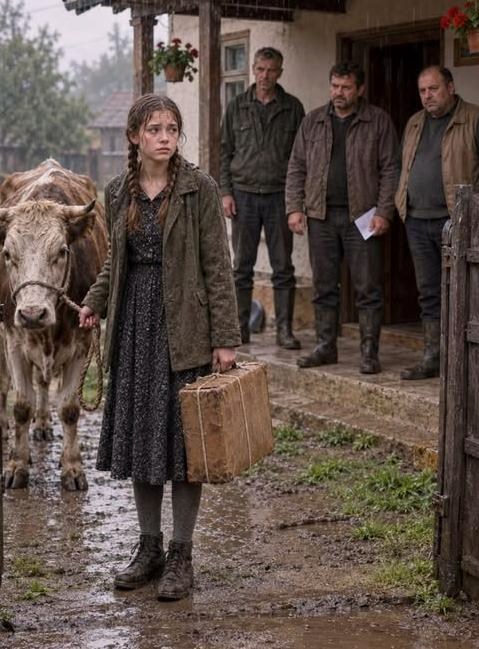
I looked at him. “You left me in the rain with a cow.”
His face changed, but I could not tell whether it was shame or fear.
Nikolai placed a hand on my shoulder. “Maria will stay with me until the office appoints a guardian.”
Peter laughed harshly. “You think they will let a farm go to a fifteen-year-old?”
“No,” Nikolai said. “They will let her keep it until she is old enough to decide what to do with it.”
Victor closed his folder.
“As for my company, we will withdraw from the purchase. But Peter still owes the deposit.”
Peter took one step backward.
“Sell the house,” Victor said.
Peter went still.
“That is my house.”
“No,” I said quietly. “It was my mother’s house.”
He looked at me, and the words seemed to strike deeper than any accusation.
For years, he had believed ownership was whatever he could seize before anyone stopped him. He had mistaken silence for permission and grief for weakness.
Then Joyana mooed beneath the shelter.
The sound carried through the mill like a summons.
I walked outside. Nikolai followed me, but I raised a hand.
“I need to see her.”
Joyana stood beneath the wooden roof, her collar still around her neck. The stitch Stefan had cut hung loose, and the brass key was warm in my palm.
“She saved the papers,” I said.
“Your mother saved them,” Nikolai answered.
“She trusted me to find them.”
“She trusted you to keep walking.”
I pressed my forehead against Joyana’s rough neck. She smelled of hay, wet earth, and the smoke from Nikolai’s stove. My mother had called her stubborn. I had always thought it was an insult.
It was not.
Behind us, voices rose inside the mill. Peter was arguing with Victor. Galina was demanding to know how much money he had taken. Mrs. Halyna was reading the names in the ledger aloud, one payment at a time.
No one needed to shout anymore. The numbers did the work.
That afternoon, Nikolai took me to the village office. I signed nothing. He signed as my temporary guardian, Mrs. Halyna attached the copies, and the clerk sealed them in a thick brown envelope. The farm could not be sold while the ownership dispute was being reviewed, and Peter could not remove another animal.
When we returned, the house looked different.
Not smaller.
Exposed.
Peter stood on the porch beside my mother’s scarf. He had taken it from the nail and was holding it in both hands.
“Your mother wanted you to have this,” he said.
I did not move.
“Why did you stop me from taking it?”
He looked at the fabric. “Because she wore it the night she told me the farm would never be mine.”
I waited.
“She said she had seen what I was doing with the money. She said you were the reason she had endured it so long.”
His voice cracked.
“I thought if I sold the meadow, I could pay everyone back. Then I thought I could sell the orchard. Then the bank came, and the buyer offered more, and suddenly the only thing I could see was escape.”
“Escape from what?”
“From being the man who ruined everything.”
I looked at the house, the barn, the empty patch where the horse had stood.
“You became him anyway.”
Peter nodded once.
It was not an apology. Not yet. Perhaps it never would be.
But he handed me the scarf.
I took it, not because it erased anything, but because it belonged to my mother and not to him.
Then he reached into his coat and placed a small cloth purse on the porch step.
“The money left from the deposit,” he said. “I did not spend all of it.”
Nikolai opened the purse. Inside were folded bills and a receipt from the doctor.
Peter had kept enough to pay the doctor’s final invoice, but he had lied about the rest. The money he had spent was gone. The money remaining was enough to buy feed for Joyana and repair the leaking roof of the barn.
I looked at him.
“Why give this back?”
“Because your mother paid for my mistakes long enough.”
He walked away before I could answer.
Victor took the forged contract with him. He did not threaten us. He only said his company would never return to the valley, and that Peter would have to repay the deposit through the sale of whatever property he still legally owned.
Galina left too. Before she climbed into her nephew’s wagon, she came to me with two piglets’ worth of feed and a red wool blanket.
“I was cruel,” she said.
“Yes.”
She flinched.
“I thought Peter had the right. I did not ask enough questions.”
“You can ask them now.”
She nodded and left the blanket in my hands.
That night, Nikolai spread my mother’s papers across his kitchen table. The brass key rested beside the deed. The candle flame trembled whenever the stove breathed.
“You can sell the farm when you are older,” he said. “You can keep it, rent it, or turn the lower meadow into something else. The choice will be yours.”
“What would you do?”
“I would repair the mill.”
I looked at him.
He tapped the deed with one finger. “Your mother loved that place. She said the river had carried grain through it for three generations. Maybe it can carry something useful again.”
I thought about the blackened stones, the broken gear, and the hidden room behind the wall. I thought about Peter standing at the edge of the collapsed bridge, begging me to save him after trying to steal the only thing my mother had secured for me.
“Could the mill become a dairy?” I asked.
Nikolai smiled faintly. “With Joyana as the first customer, perhaps.”
I laughed before I meant to.
It was a small sound, almost unfamiliar.
The next morning, I returned to the farm with the deed beneath my coat and my mother’s scarf tied around my shoulders. Joyana walked beside me, slow but steady. The muddy road still bore the marks of our departure, two long lines made by her hooves and my boots.
At the barn, I found Peter loading a suitcase onto a cart.
“Where are you going?” I asked.
“To my brother’s place until I can pay Victor.”
“Will you come back?”
He looked toward the house.
“I do not know.”
I took the brass key from my pocket and closed my fingers around it.
“If you do come back, you will work for wages. You will not touch the deed, the accounts, or the animals without asking.”
Peter stared at me.
“You would let me work here?”
“I would let you earn the right to stand here.”
His eyes filled, but I did not step closer. He had to carry the distance himself.
After he left, I led Joyana to the fresh straw. She lowered her head and began to eat. Sunlight slipped through a broken board in the barn wall and fell across the white patch between her eyes.
I untied the collar, repaired the hidden stitch, and placed the brass key back inside it.
Not because I needed to hide the truth anymore.
Because some promises are meant to keep traveling.
Then I heard my mother’s voice in memory, soft beneath the rain: “As long as we have Joyana, we will not go hungry.”
Joyana lifted her head, and the little brass key chimed against her collar like a bell from the old mill.
Missed the beginning?






