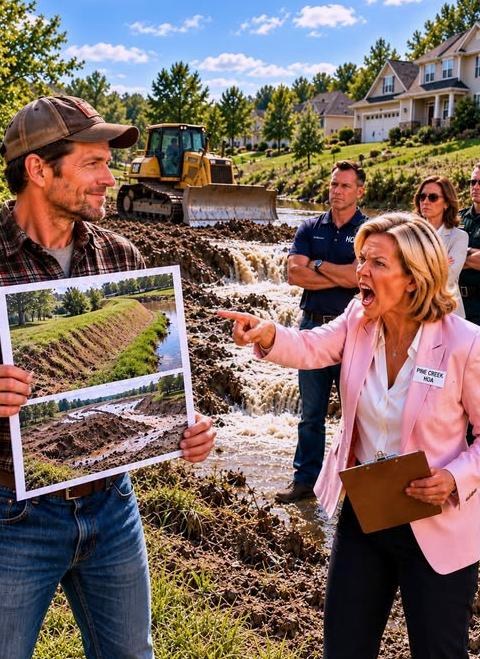
The excavator was already chewing through my father’s flood barrier when I reached the pasture, and the HOA president was standing beside it with a clipboard.
“Shut that machine down before you make this everybody’s problem!” I shouted.
The engine groaned once more, then died. Diesel fumes hung in the morning fog above Alder Creek. Fresh Tennessee clay lay in long red ridges across the grass, and nearly sixty feet of the six-foot berm had been scraped away.
Luke Harmon climbed from the cab. Mud clung to his boots, and a steel thermos swung from one hand.
“Ethan, I was told this was association property,” he said.
“You were told wrong.”
A white sport utility vehicle rolled down the Cedar Hollow access lane. Denise Whitaker stepped out in polished boots that sank slightly into the wet ground.
“It’s a pile of dirt,” she said.
I pointed at the machine. “You brought a twenty-ton excavator for a pile of dirt?”
“We’re restoring the creek corridor. The berm ruins the view from the greenbelt.”
“On whose land?”
Her smile stayed in place, but her fingers tightened around the clipboard.
“The association has drainage authority.”
“Show me the survey.”
“We have maintenance rights.”
“Show me the survey.”
Luke glanced at her, then at me. “I’m not running this machine again until somebody proves the boundary.”
“Do not interfere with authorized HOA work,” Denise snapped.
“I’m not interfering. I’m asking why your contractor crossed onto my property and removed something my father built.”
Alder Creek whispered behind us. I could hear water sliding over stones beneath the fog.
Then I saw a brass cap exposed beside the torn earth. I crouched and wiped mud from its face. Stamped into the metal were the numbers 842.6.
I had seen that marker since I was a teenager. My father, Raymond Walker, had once grabbed my wrist when I tried to pull it from the ground.
“Leave it alone,” he’d said. “That number matters more than you understand.”
I had never asked why.
Denise looked over my shoulder. “What is it?”
“I don’t know yet.”
That answer unsettled me more than it should have. My father never placed a marker, shaped a ditch, or packed a layer of clay without a reason. He had taught me excavation at fourteen, and by fifty-one I had spent more than twenty-five years running Walker Earthworks and Drainage.
His favorite warning came back to me now.
Water remembers every low spot.
I photographed the bucket marks, the machine tracks, the exposed marker, and the broken ends of the berm. Then I told Denise nobody would touch the site again until I knew exactly what her crew had removed.
She laughed. “You’re making a lot out of dirt.”
An hour later, inside my father’s steel filing cabinet, I found a rolled drawing labeled WALKER FLOOD BERM. The paper showed a clay core, a rock toe, an eight-foot crest, and a horizontal line across the top.
CREST ELEVATION: 842.6.
A county review stamp sat in the corner, dated nineteen years earlier—the same year Cedar Hollow had been built.
My wife, Laura, leaned over my shoulder. “So he didn’t just pile this up in the pasture.”
“No,” I said. “He built part of a system.”
I found photographs next. In one, Raymond stood beside a crawler tractor while Cedar Hollow was still raw ground covered with survey stakes. A county worker stood beside the brass marker, holding an elevation rod.
My phone buzzed.
Denise had sent a violation notice accusing me of obstructing community drainage. It warned of daily fines if I attempted to rebuild the berm without HOA approval.
Four minutes later, she sent her contractor authorization.
One sentence stopped my breathing: PROPERTY CONTROLLED BY CEDAR HOLLOW HOMEOWNERS ASSOCIATION. OWNER CONSENT NOT REQUIRED.
I called Luke.
“Did Denise show you a survey?”
“No,” he said. “Only a maintenance map.”
The next morning, licensed surveyor Ben Carter arrived. By noon, his stakes showed the machine had crossed more than ten feet onto my land. The drainage easement stopped on Cedar Hollow’s side. It did not include my berm.
Ben opened the original recorded subdivision plat. Near the creek, in lettering so small I had missed it, was a note: EXISTING WALKER FLOOD ATTENUATION BERM TO REMAIN UNDISTURBED.
Denise arrived while we were reading it.
For the first time, she stopped calling the berm an eyesore.
“Who put that note there?” she asked.
Ben looked up. “The people who approved your subdivision.”
That afternoon, county stormwater engineer Sarah Collins studied the old drainage model. Her finger stopped on the same number.
“Eight forty-two point six,” she whispered. “This neighborhood was designed around that elevation.”
Outside, thunder rolled beyond the ridge. Sarah checked the forecast and closed the file.
“Two to three inches tonight,” she said. “Nobody touches that breach until we document what happens.”
Denise stared at the sixty-foot gap as if it had suddenly become a mouth.
Then her phone rang. She listened, turned toward me, and said, “You are going to rebuild it before dark.”
Sarah stepped between us. “He is not.”
Denise reached into her folder and pulled out a sealed county envelope.
“Then we’ll see what the records say,” she replied, sliding one finger beneath the flap…
PART 2
The flap tore with a dry, papery sound.
Denise pulled out a temporary work directive bearing a county logo, but Sarah took it before she could wave it in my face. The paper trembled between them, though I couldn’t tell whether the tremor came from the wind or Denise’s hand.
“This is not an authorization to rebuild,” Sarah said. “It’s a notice that the site must remain undisturbed for inspection.”
Denise’s cheeks colored. “You expect me to let water pour into my neighborhood?”
“I expect you to stop changing evidence.”
“I am trying to protect residents.”
“Then stop ordering contractors onto private land.”
Luke stood beside the excavator, his cap darkened by mist. “For what it’s worth, I never received a boundary survey.”
Denise swung toward him. “You received my authorization.”
“That authorization said association property. Ben’s stakes say otherwise.”
Her eyes narrowed. “You were paid to work, Luke.”
“And I’m not paid enough to become the only person blamed when the creek rises.”
At four that afternoon, county staff placed orange erosion-control blankets along the raw clay. They drove wooden stakes into the ground, measured every exposed layer, and refused to fill the breach. I stood under a canvas jacket while Laura held my father’s drawing inside a plastic sleeve.
“You’re shaking,” she said.
“I’m angry.”
“No. You’re scared.”
I looked at the broken berm. “Both can be true.”
At 12:18 a.m., rain began striking the roof of our house. By 3:40, Alder Creek had changed from a narrow ribbon into a dark, muscular current. Sarah called me from the county monitoring station.
“Get to the upper pasture,” she said. “Do not go near the gap.”
At 5:00, I stood behind the safety line with Ben and Sarah. Rain ran from the brim of Ben’s yellow helmet. His elevation notes were sealed in a clear bag, and the brass marker gleamed beneath the rushing water.
The intact berm held the creek inside its channel. Then the water reached the crest.
“Eight forty-two point six,” Ben said.
The current pressed against the packed clay and spread sideways, searching for weakness. At the demolished section, it found the low spot immediately.
A muddy sheet swept across the breach and into Cedar Hollow’s lower greenbelt. The walking trail vanished. Mulch beds dissolved into brown water. A maintenance shed shifted on its foundation and knocked against a chain-link fence.
The houses and public streets remained dry, but there was no mistaking the direction of the overflow.
Denise arrived beneath a black umbrella, her hair already plastered to her forehead.
“What did you do?” she shouted.
“Nothing,” I said.
“You refused to rebuild it!”
“County staff ordered me not to alter the site,” I answered.
Sarah turned toward her. “That instruction came from me.”
Denise pointed at the water. “Your berm caused this!”
Ben knelt beside the marker and checked his gauge. “The water is matching the recorded elevation. The berm is holding everywhere it still exists.”
Only the sixty feet Denise had removed had become the opening.
By late morning, the rain weakened. Cedar Hollow’s board gathered in the clubhouse, where wet coats steamed against the radiators. Denise sat at the head of the long table, insisting the flood was an act of nature.
Then Martin Shaw, the HOA treasurer, placed a printed email chain beside my father’s drawing.
“I found this in the association archive,” he said.
Denise’s head snapped up. “That file was not for this meeting.”
“It concerns the berm.”
“Give it to me.”
Martin kept his hand on the pages. “I should have read it seven months ago.”
I stepped closer. The first message came from Sarah Collins. The subject line read: WALKER BERM—DO NOT DISTURB.
The email warned that removing the berm could redirect stormwater into the Cedar Hollow greenbelt. It included the elevation 842.6, the original plat, and a request for a formal engineering review.
Denise had replied the same afternoon.
Martin’s voice dropped. “You received this.”
“I received dozens of maintenance emails.”
“You answered this one.”
Her chair scraped the floor. “I said I would look into it.”
“You authorized demolition six months later.”
Nobody moved. Rain ticked against the clubhouse windows like fingernails.
I looked at Denise. “Why?”
She lifted her chin. “Because the berm blocked the view, and the board had approved a landscape redesign.”
Martin turned the final page over.
“What is this?” he asked.
Denise’s face changed before I could read the document.
Beneath the email chain was a private appraisal for the empty parcel beyond the greenbelt—and a handwritten note in Denise’s unmistakable script: REMOVE BERM BEFORE SHOWING. BUYER WILL WALK IF FLOOD WORKS ARE VISIBLE.
She reached for the page.
Martin pulled it away.
Then Laura’s phone rang. She answered, listened for three seconds, and looked directly at me.
“It’s the county recorder,” she said. “They found another filing under your father’s name, and they say it changes who was responsible for maintaining this entire corridor…”
PART 3
The room seemed to contract around Laura’s words.
“Put them on speaker,” I said.
She tapped the screen. A woman from the county recorder’s office introduced herself, then asked whether I was Raymond Walker’s son. When I confirmed it, she said a supplemental agreement had been misfiled under the original subdivision developer’s name.
“Can you send it?” I asked.
“It’s already being delivered to the clubhouse,” she replied. “A courier is outside.”
The door opened. An elderly man in a soaked canvas vest entered carrying a flat archival box. He looked at the drawing in my hands and stopped.
“Raymond’s boy,” he said.
I recognized him from my father’s photographs. “You’re the county worker.”
“Thomas Bell. I was the field inspector when Cedar Hollow was built.”
Denise pushed back from the table. “This meeting is over.”
Thomas looked at her. “No, ma’am. It isn’t.”
He opened the box and removed a document protected by transparent film. At the bottom was Raymond’s signature, the developer’s signature, and Thomas Bell’s witness line.
The agreement stated that the berm remained on Walker land, but Cedar Hollow’s developer had accepted a permanent maintenance obligation. The association was required to preserve the structure, fund inspections, and obtain written consent before any alteration.
I read the clause twice.
“Why did my father sign this?” I asked.
Thomas folded his hands over the box. “Because the developer wanted to build where the creek used to spread. Your father agreed only after they promised to protect the berm forever.”
Martin looked at Denise. “The association was paying for inspections until two years ago.”
Denise’s mouth opened. “We stopped because the engineer said the berm was unnecessary.”
Sarah stepped forward. “I never said that.”
Martin held up the email. “You said the opposite.”
Denise grabbed the appraisal note from the table. “You’re all pretending this is about water. It’s about an ugly wall that lowered property values.”
“And the parcel?” I asked.
Her eyes flashed. “That has nothing to do with you.”
“The note says otherwise.”
“The parcel belonged to the developer. I was trying to improve the community.”
Thomas pointed at the agreement. “The developer’s sale contract also contains a drainage disclosure. Any buyer was supposed to be told the berm could not be removed.”
Sarah took the document and scanned the final page. Her expression hardened.
“Denise,” she said, “the appraisal you ordered was for the parcel beside the greenbelt, wasn’t it?”
Denise said nothing.
Martin answered for her. “Her brother’s company made an offer.”
A murmur moved through the room.
Denise slammed both hands on the table. “The sale would have funded improvements for everyone!”
“After you removed the protection everyone depended on?” I asked.
She stared at the flooded photographs. “The storm was unusual.”
Ben shook his head. “The model predicted exactly this path.”
Sarah pointed at the warning email. “That is why I wrote you seven months ago.”
Denise’s confidence finally cracked. “I thought you were exaggerating.”
“No,” Sarah said. “You thought the risk was cheaper than the view.”
The county recorder’s representative then sent one more page to Laura’s phone. It was a notice showing that the developer’s maintenance covenant had been recorded against Cedar Hollow’s property, not mine.
Martin read it aloud. The association was financially responsible for restoring any damage caused by unauthorized interference.
Denise looked at me. “You can’t make us pay for a flood.”
“I’m not asking you to pay for rain,” I said. “I’m asking you to pay for the sixty feet your board destroyed.”
Before anyone could answer, Sarah’s phone rang. She listened, then covered the receiver.
“The county has a second concern,” she said. “The lower greenbelt isn’t the only place the water went. It entered a buried drainage line beneath the new luxury lots.”
Ben’s face tightened. “Those lots were built over the old overflow channel.”
Sarah nodded. “And the plans were approved using the berm’s elevation.”
Denise looked toward the clubhouse windows, where brown water still covered the trail.
“What does that mean?” Martin asked.
Sarah lowered the phone.
“It means the subdivision’s final occupancy certification may be based on a condition the HOA just destroyed.”
Nobody spoke.
Then the recorder’s representative sent a final message: the county wanted every original filing, every email, and every board vote before sunrise—and Denise’s signature appeared on the certification request…
The missing filing exposed what Denise had signed…
I thought the flood had already revealed everything. Then one forgotten document changed who was responsible for the damage.
“ I removed the warnings because I wanted the view.”
The residents heard every word.
👇 The final part of the story is now open.






