PART 4
The message remained on Laura’s phone while rainwater dripped from the clubhouse awning.
Denise reached for it.
Laura pulled the phone against her chest.
“Do not touch her,” I said.
Denise stopped with her hand suspended between us. Her face had lost the practiced warmth she used at neighborhood meetings. Behind her, the flooded greenbelt reflected the clubhouse lights in broken strips.
Martin read the message again.
“Every original filing,” he said. “Every email. Every board vote.”
“And the certification request,” Sarah added. “Signed by the HOA president.”
Denise looked at me. “You planned this.”
“I found a brass marker in the mud.”
“You waited for the storm.”
“I begged you to stop the machine.”
Luke, who had been standing near the coffee station with his wet cap in both hands, stepped forward.
“I told her the ground was private,” he said.
Denise spun toward him. “You said you weren’t sure.”
“I said I needed a survey. You told me the association would cover me.”
“Because it was association property.”
“No,” Luke replied. “Because you wanted it gone before the buyer came.”
The sentence landed harder than the thunder outside.
Denise’s shoulders rose and fell. “You have no idea what you’re talking about.”
Luke reached into his work jacket and removed a folded receipt. It was stained with grease and rain.
“I do. Your office paid my company a bonus for finishing the demolition before the parcel inspection. You called it a view correction.”
Martin took the receipt. His eyes moved across the page.
“Where did you get this?” he asked.
“My bookkeeper gave me a copy after I told her I wouldn’t hide the job.”
Denise stared at him. “You’re destroying your own contract.”
“I’m preserving my business.”
Sarah gathered the old agreement, the plat, and my father’s drawing into separate folders. She handled each page as if it were fragile enough to collapse under an accusation.
“Ethan, the county is stopping all new approvals in the lower section until the drainage system is certified again.”
Martin looked sick. “That includes the homes under construction?”
“And the parcel Denise was trying to sell,” Sarah said.
Denise’s fingers closed around the edge of the table.
Her brother’s company had not bought the land yet. The private appraisal had been based on a clear view from the greenbelt and no visible flood controls. With the county freeze, the purchase offer would vanish. The luxury lots beside the buried channel would be examined individually. The thing Denise had risked the entire neighborhood to obtain was now the one thing nobody could legally market.
But that was not the worst of it.
At dawn, the county asked us to meet at the breach. The storm had passed, but Alder Creek still ran high and brown. The surviving sections of the berm were scarred with water lines. In the gap, the mud had carved a fan-shaped path through the grass and into Cedar Hollow.
Thomas Bell stood beside the brass marker.
“Your father understood this place,” he said.
I looked at the torn earth. “He understood water.”
“He understood promises too.”
He handed me a photocopy of the maintenance agreement. On the back, in faded pencil, Raymond had written a note for the county inspector.
If the association ever forgets why this exists, show them the creek after a hard rain.
My throat tightened. I could hear his voice saying it. I could see the crease beside his left eye when he tried to make a warning sound like ordinary advice.
Sarah explained the remedy. The berm would not simply be pushed back into place. The county would redesign the damaged section with a reinforced clay core, a rock toe, and a controlled overflow channel. Cedar Hollow would pay for the engineering and restoration under the covenant. My company would perform the earthwork only if an independent inspector supervised every lift.
Denise arrived late, walking across the soaked grass in shoes ruined by red clay.
“I want to speak with you,” she said.
“You can speak here.”
Her gaze moved from the broken berm to the county folders. “I made a mistake.”
“You made a decision.”
“I thought the wall was unnecessary.”
“You received a warning that said exactly what would happen.”
“I thought the engineer was protecting the county from liability.”
Sarah’s expression sharpened. “You did not misunderstand me. You ignored me.”
Denise looked down. A tiny piece of gravel was caught in the seam of her polished shoe.
“I was trying to save Cedar Hollow,” she said.
“No,” Martin answered behind her. “You were trying to save the sale.”
She turned toward him. “You approved the landscaping plan.”
“I approved a view improvement. I did not approve cutting through a flood barrier.”
“You signed the meeting minutes.”
“I signed what you gave me.”
“And you never read them?”
Martin swallowed. “That is my failure. Yours was knowing.”
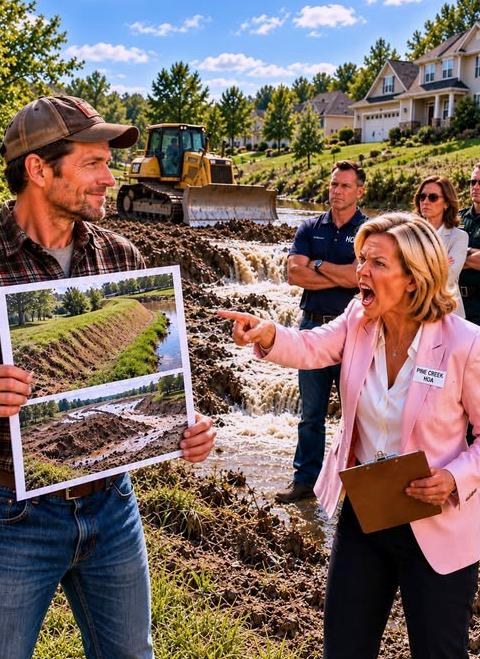
The board held an emergency vote that afternoon in the elementary school gym because the clubhouse smelled of wet drywall. Folding chairs scraped across the floor. Residents stood along the walls with photographs of submerged gardens and ruined trail signs.
Denise sat at the end of the first row.
No one asked her to lead the meeting.
Martin presented the email chain. Sarah explained the flood model. Thomas described the original covenant. Luke described the instructions he received. Then I showed the photographs from before and after the demolition.
A woman from the lower greenbelt raised her hand.
“Did the berm protect our houses?” she asked.
Sarah answered carefully. “Yes. The remaining sections performed as designed. The damaged section redirected water into the community.”
The woman looked at Denise. “And you knew?”
Denise’s lips parted.
For several seconds, she said nothing. Then she stood.
“I knew there was a warning,” she said. “I believed removing the berm would make the neighborhood more attractive. I believed the risk was manageable. I was wrong.”
A man near the bleachers shouted, “You lied to us!”
Denise flinched but did not sit down.
“I told the board the wall was outside the association’s responsibility,” she continued. “That was false. I altered the maintenance schedule and removed the engineer’s warning from the packet.”
Martin closed his eyes.
There it was: not an excuse, not a technicality. The decision in her own voice, spoken before the residents who had trusted her.
She resigned before the vote could remove her. The board suspended the landscaping contract, canceled the parcel recommendation, and required Denise’s brother’s company to disclose its connection to the proposed purchase. The association’s insurer denied the first claim because the demolition had been unauthorized. The restoration cost came from the reserve fund Denise had tried to protect by cutting maintenance.
No dramatic chain of handcuffs followed.
The consequences were more intimate than that.
Neighbors who had applauded the better view now carried sandbags. The board had to publish every email connected to the creek. The county froze construction along the lower channel until the new design passed inspection. Denise lost the presidency, the parcel deal, and the confidence of the people who had once repeated her words without checking them.
I lost something too.
My father’s berm would never be exactly the one he built. The sixty-foot section had been torn apart, and restoring it meant cutting into the old clay core, replacing stone, and burying the original shape beneath a safer design.
On the first morning of construction, I stood beside the excavator and handed Luke the grade plan.
He studied it. “You sure you want me on this job?”
“You stopped when I asked.”
“I should have asked first.”
“Yes,” I said. “You should have.”
He nodded. “I’ll do it right.”
For three days, my crew rebuilt the breach under Sarah’s supervision. Every layer was tested. Every elevation was recorded. The brass marker stayed in place, protected by a wooden frame painted orange so nobody could pretend not to see it.
On the fourth day, Denise came to the worksite carrying a cardboard box.
“I brought the remaining association files,” she said.
Martin, who was checking invoices nearby, turned toward her.
“Why?” I asked.
“Because there are more records than the ones I gave the board.”
She opened the box. Inside were maintenance logs, contractor bills, and a handwritten inspection schedule with several pages torn out.
“I removed the warnings,” she said. “Not all of them. I kept copies because I thought I might need to prove the engineers were overreacting.”
Sarah took the box. “You kept evidence against yourself.”
“I kept what I was afraid of.”
I looked at the torn pages. “Why bring this now?”
Denise’s eyes went to the forming berm. “Because I spent so long treating the creek like a problem to hide. I don’t know how to undo that.”
“You can start by telling the truth without asking anyone to comfort you.”
She nodded.
It was not forgiveness. It was not redemption.
It was the first useful thing she had offered.
The county later approved the restoration with an additional spillway that directed extraordinary flows toward a protected meadow instead of the neighborhood. The covenant was rewritten into a public drainage easement, and my father’s name was listed on the engineering archive as the original designer of the flood attenuation berm.
I kept the old drawing in a new frame above my office desk. The paper still carried the crease from the steel cabinet, and the red clay stain from the morning the excavator arrived.
At the bottom, beneath the county stamp, Raymond’s pencil note remained visible.
Show them the creek after a hard rain.
Weeks later, after another storm far smaller than the one that exposed Denise’s decision, I walked the rebuilt crest with Thomas Bell. Alder Creek pressed against the clay, rose to the marked elevation, and slid toward the new spillway exactly as Sarah’s model predicted.
Thomas rested both hands on his cane.
“Your father would approve,” he said.
I watched the water bend around the stone toe and move safely toward the meadow.
“No,” I said. “He would ask who checked the marker.”
Thomas laughed.
I crouched beside the orange frame and brushed away a fleck of mud. The number was still there, sharp against the brass.
842.6.
Behind me, Cedar Hollow’s new board had posted the maintenance schedule where every resident could read it. Nobody could call the berm a pile of dirt anymore.
The creek had written the correction itself, one muddy line at a time.
And beneath the restored earth, my father’s warning was still holding: “Water remembers every low spot.”
Missed the beginning?






