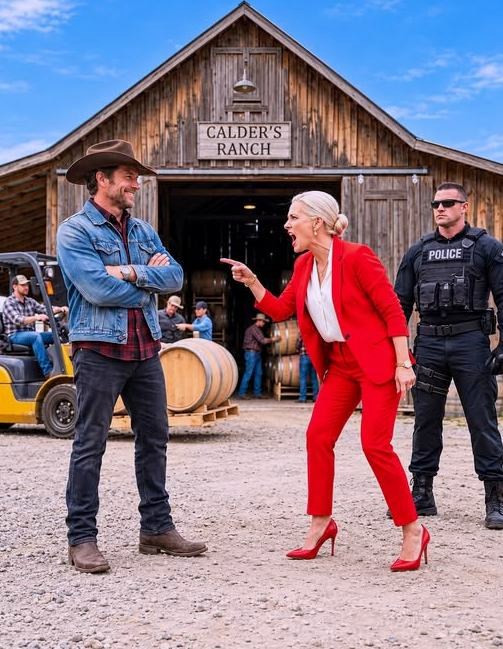
At sunrise on Monday, I opened my east barn and found four hundred wine barrels where my tractor and hay wagons should have been.
For a few seconds, I stood beneath the warped oak beam, staring at the rows of barrels stretching from one wall to the other. The air smelled of damp wood, sharp alcohol, and the hot dust kicked up by machinery. Every barrel carried a white label: BRIAR CREST COMMUNITY ASSET RESERVE.
Then I saw the padlock on the ground.
It had been cut clean through.
Fresh forklift scars crossed the concrete. Thick electrical cables had been drilled through my wall and connected to two cooling units beside my tractor bay. One support post had a crack running halfway through it. Someone had turned my family’s barn into a wine warehouse while I was away negotiating a cattle contract.
My name is Calder Vaughn. My family has owned Vaughn Ridge Ranch for three generations, and nobody had ever confused my property with public storage. I took out my phone and photographed everything: the broken lock, the tire tracks, the cables, the cracked post, and every serial number I could reach.
At eight twenty, I called the shipping company listed on a tag stapled to the nearest pallet. Twenty minutes later, three black sport utility vehicles rolled up my driveway.
Marjorie Sloan stepped out first. She wore a cream blazer, oversized sunglasses, and the calm expression of someone arriving at a place she already owned. Two homeowners association board members followed her, carrying folders.
I pointed toward the barn.
“What is this?”
“Temporary emergency storage,” Marjorie said.
“You cut my lock.”
“We exercised emergency authority available to the association.”
“Your association ends six hundred feet from my fence.”
She sighed. “Mr. Vaughn, Briar Crest has historical easement rights throughout this area.”
“Show me one covering my barn.”
She opened a folder and handed me three pages. I did not touch them.
“Show me my signature.”
Her mouth tightened. “There was no time to contact you.”
“So that’s a no.”
“The wine is extremely valuable,” she said. “It needed secure, climate-controlled storage.”
“Then rent a warehouse.”
“It’s temporary.”
I walked to my truck and spread the original property survey across the hood. The paper snapped in the wind. The nearest Briar Crest boundary ended well short of my land. There was no covenant, no recorded easement, and no emergency clause allowing anyone to occupy my building or alter its wiring.
“You have seventy-two hours,” I told her. “Remove every barrel with a licensed transporter. You’ll pay for the power, the damaged floor, the broken lock, and that support beam.”
For the first time, her sunglasses came off.
“And if I don’t?”
“Then I file for trespass and damages.”
Her expression hardened into something colder than anger.
“Touch one barrel, Mr. Vaughn, and I will own this ranch before the lawsuit ends.”
That afternoon, I photographed the entire inventory and changed every lock. I wanted nothing to do with the wine. I only wanted to keep strangers from changing the evidence.
Marjorie never replied to my notice.
At nine twelve the next morning, a process server handed me a lawsuit demanding immediate access to my barn and accusing me of wrongfully detaining HOA property worth $2.8 million. Briar Crest also demanded damages exceeding $3.4 million if the wine deteriorated while I “unlawfully withheld” it.
My attorney, Elias Hartwell, arrived that afternoon. He read the complaint in silence until he reached Marjorie’s sworn declaration. Then he stopped, tapped her signature, and looked up at me.
“She just swore under oath who owns every barrel, where every barrel is, and what the collection is worth.”
“I’m being sued for millions. Why do you look pleased?”
“Because now we ask how a homeowners association acquired nearly three million dollars in wine.”
Three days later, a packet of internal records arrived. Elias opened the first page, then slowly turned it toward me.
The subject line of an email from Marjorie contained four words: MOVE THEM BEFORE HE RETURNS.
His finger moved toward the printed page…
PART 2
His finger touched the page, and Elias read the email aloud.
“Move them before he returns. Do not use the main gate. Keep the inventory under reserve assets.”
My stomach tightened. “Who was she talking about?”
“Probably you.”
“There’s more.”
He slid the page across his desk. The message had been sent four days earlier, while I was away. The recipient was Vincent Pike, the association’s treasurer. Beneath the email was a shipping schedule showing two refrigerated trucks arriving at my barn at 2:40 in the morning.
I looked at the date. “They knew exactly when I’d be gone.”
Elias nodded. “And they knew the gate code.”
At noon, we drove to Briar Crest’s clubhouse. The building smelled of lemon cleaner and burnt coffee. Marjorie sat at the long boardroom table with Vincent Pike and two directors. A brass plaque behind her read COMMUNITY TRUST.
Elias placed copies of the email on the table.
“Who authorized the move?” he asked.
Marjorie folded her hands. “The board acted under emergency provisions.”
“Which emergency?”
“A security concern at our original facility.”
“Why did you instruct Mr. Pike to avoid the main gate?”
Her eyes flicked toward him. “For privacy.”
I leaned forward. “You broke into my barn in the middle of the night and now you’re calling that privacy?”
Vincent shifted. His wedding ring scraped against the polished table.
Marjorie glared at him. “You don’t need to answer every accusation.”
“I’m asking a question,” Elias said. “Who purchased the wine?”
“The association.”
“With what account?”
“The reserve account.”
“Show us the approval.”
The room went still except for the hum of the air conditioner.
Marjorie opened a binder. “The board approved an investment in community assets.”
Elias turned the binder around. The resolution was dated three weeks after the purchase invoices. Two signatures appeared beneath it, but one belonged to a director who had moved to Arizona the year before.
I recognized the other signature. It was Marjorie’s.
Vincent stood so quickly that his chair struck the wall. “I never approved that.”
Marjorie’s face changed. “You signed the payment release.”
“After you told me it was a short-term bond purchase.”
“You were treasurer.”
“I was lied to.”
Elias lifted a bank statement. “Three payments totaling $2.8 million went to a company called North Vale Cellars. The company was formed two weeks before the first payment.”
Marjorie snatched the paper. “That is irrelevant to the storage dispute.”
“It becomes relevant when your lawsuit claims the association owns the wine,” Elias said.
At four thirty, we returned to my ranch. The sun had dropped behind the cottonwoods, leaving the barn windows orange. I stood outside while Elias inspected the hinges and the new wiring. A faint vibration traveled through the metal siding from the cooling units inside.
“You can’t leave this collection here indefinitely,” he said.
“I know.”
“If we move it, they’ll say we damaged or converted it.”
“If we don’t, they’ll say we caused the deterioration.”
He looked at me. “Then we make them choose in writing.”
The next morning, Elias sent Briar Crest a demand for lawful removal, reimbursement, and a complete accounting of the purchase. Marjorie answered within eleven minutes. She offered to remove the wine only if I surrendered the barn for ninety days and paid their legal expenses.
I laughed once, without humor.
That evening, a woman named Nina Cole arrived at my office. She had been Briar Crest’s bookkeeper for six years. Her hands trembled around a paper cup of coffee, and a tiny silver thimble hung from a chain at her throat.
“I shouldn’t be here,” she whispered.
“Then why are you?”
“Because the barrels weren’t bought as an investment.”
Elias closed the blinds. “What were they bought for?”
Nina looked toward the barn.
“Marjorie planned to sell them privately, but the money was never supposed to go back to Briar Crest.”
I felt the room contract around me.
“Whose money was it?” I asked.
Nina reached into her handbag and pulled out a folded ledger page.
Before she could unfold it, headlights swept across the office wall. A vehicle stopped outside. Someone stepped out and began walking toward our door…
PART 3
Someone stepped out and began walking toward our door. Nina’s coffee cup slipped from her hand and struck the floor, spreading a dark stain across the boards.
“Turn off the lights,” she whispered.
Elias moved first. He pulled me away from the window and tucked Nina behind a filing cabinet. Three slow knocks sounded against the glass door.
“Mr. Vaughn,” Marjorie called. “We need to discuss a reasonable resolution.”
I stared at Nina. “Did you tell her you were coming here?”
She shook her head.
Elias opened the door but kept the chain fastened. “You have counsel. Speak through them.”
Marjorie stood beneath the porch lamp with Vincent Pike behind her. Unlike the previous day, Vincent was carrying no folder. His face looked pale and exhausted.
“I want my records returned,” Marjorie said.
“You mean the records you hid from your own board?” Elias replied.
Her eyes moved past him, searching the office. “This intimidation is unnecessary.”
Vincent suddenly stepped forward. “Nina, I know you’re in there.”
She rose slowly. “You knew about the transfers.”
“I knew the payments. I didn’t know where the money was going.”
“You signed the releases.”
“Because Marjorie told me North Vale Cellars was buying municipal bonds.”
Marjorie snapped, “This is absurd.”
Nina opened the folded ledger page. Her voice shook, but she did not lower it.
“North Vale Cellars was registered to Marjorie’s brother, Arthur Sloan. The association paid $2.8 million for wine that had already been pledged to a private lender. The barrels were never a community investment.”
Marjorie’s face drained of color.
I looked at her. “You used reserve funds to buy wine from your own family.”
“It was a legitimate transaction.”
“Then why move it secretly?”
“Because the original warehouse was being inspected.”
“By whom?” Elias asked.
She said nothing.
Nina answered for her. “The lender. Arthur had defaulted. They were going to seize the barrels.”
Vincent gripped the porch railing. “You hid them on Calder’s ranch to keep them from being taken.”
Marjorie turned on him. “I saved the association from a catastrophic loss.”
“No,” Nina said. “You moved the loss where nobody could see it.”
The next morning, the judge held an emergency hearing in a county conference room because the courthouse plumbing had failed. Rain hammered the metal roof. Marjorie sat at the front table in a navy suit, with her attorney beside her. Elias placed the property survey, photographs, shipping records, and Nina’s ledger copy before the judge.
Marjorie’s attorney insisted I had no right to restrict access to HOA property.
Elias stood. “The association’s own sworn declaration establishes ownership and value. It also establishes that its president placed the property on land the association did not own or control.”
The judge turned to Marjorie. “Did you authorize the entry?”
“Yes,” she said. “To protect community assets.”
“Did you authorize the wiring and climate equipment?”
“Yes.”
“Did you instruct anyone to avoid the main gate?”
Marjorie hesitated. “For security.”
The judge looked at the ledger. “And did the association purchase these barrels from a company owned by your brother?”
Her attorney touched her elbow. “Do not answer without—”
“Yes,” Marjorie said sharply. “But that does not change the ownership.”
The answer landed heavily in the room.
Elias requested a storage lien for the power, structural damage, and unauthorized occupation. Marjorie’s attorney argued that the wine was worth too much to remain locked away. Then, trying to prove that the association could satisfy any future judgment, he offered the entire collection as security.
“Briar Crest pledges all four hundred barrels,” he said. “Their value more than covers any legitimate claim.”
Elias turned toward me. I understood his expression immediately.
The judge dictated the terms: the barrels would remain sealed, independently valued, and held as security for the association’s obligations. If Briar Crest failed to satisfy the final award, ownership of the pledged collection would transfer to me to the extent necessary to satisfy it.
Marjorie stood. “I object.”
Her attorney looked at her. “You wanted the court to recognize the association’s ownership.”
“You are pledging everything.”
“You said the collection was worth $2.8 million.”
The judge signed the order.
Outside, Elias read the final paragraph twice. “She gave us a path to the barrels.”
I looked back at Marjorie, who was arguing with her own attorney beneath the rain awning.
Then Elias’s phone rang. He listened, frowned, and handed it to me.
A lender from North Vale Cellars was calling. He said the barrels had already been promised as collateral for a debt Marjorie had never disclosed—and he had documents proving someone else might claim them before the court order took effect…
FINAL PART BELOW
Then the lender arrived with one document Marjorie feared…
I thought the court order had settled everything. Then a hidden claim threatened to overturn the entire collection.
“Marjorie planned to make the homeowners absorb the loss.”
The room seemed to lose all its air.
👇 The final part of the story is now open.






