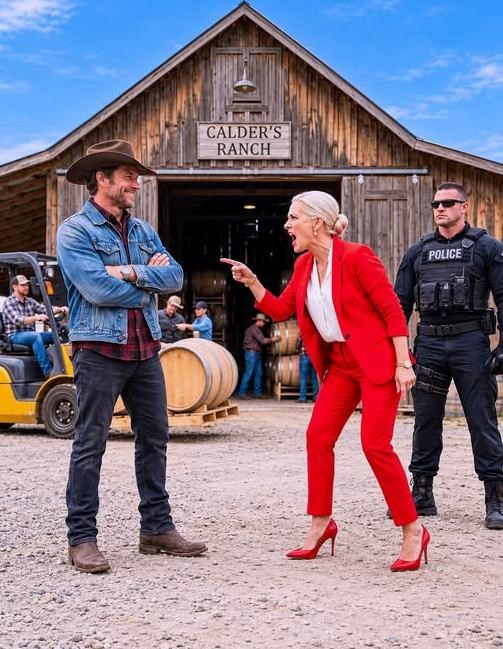
PART 4
The lender was waiting in a coffee shop across from the courthouse.
His name was Samuel Reed. He was a narrow man with a brown wool coat, a legal pad, and a habit of tapping his thumbnail against his wedding ring whenever he was nervous.
He slid a folder across the table.
“These are warehouse financing records,” he said. “Arthur Sloan borrowed against the barrels before Briar Crest paid him. When he defaulted, Marjorie moved the collection.”
Elias opened the first document. “Why didn’t you seize them?”
“Because I couldn’t find them.”
“You found them when you saw the lawsuit?”
Samuel looked at me. “The lawsuit described the exact inventory and location. Marjorie gave me everything I needed.”
The realization felt almost physical.
Marjorie had tried to use the court to force open my barn. Instead, she had publicly identified the collateral, its location, its value, and the fact that she controlled it.
Elias turned another page. “Your lien predates the association’s purchase.”
“Yes. But the barrels were moved before I could enforce it.”
“So you want priority.”
“I want repayment.”
“Then we have the same problem,” Elias said. “If the collection disappears, none of us gets paid.”
Samuel tapped the judge’s order. “It won’t disappear. Not after this.”
By noon, three competing claims had been filed against the barrels. Arthur Sloan claimed the wine had never been properly sold. North Vale Cellars claimed the original collateral interest. Briar Crest claimed ownership through its purchase records. Marjorie’s attorney claimed all three disputes were irrelevant to my right to lock the barn.
The judge disagreed.
The following morning, she ordered the barrels inspected by an independent appraiser. Nobody was allowed to remove or open them without written permission. A certified wine specialist named Lila Moreno arrived at my ranch with a brass temperature probe, a clipboard, and a scar across her left eyebrow.
She inspected the labels for nearly four hours.
Marjorie stood behind the yellow tape, her arms folded tightly across her chest.
“Are they worth the amount in the declaration?” Elias asked.
Lila checked a serial number against her database.
“Some are,” she said. “Some are not.”
Marjorie’s head snapped up. “What does that mean?”
“It means the inventory was inflated.”
“How much?” I asked.
“Roughly eighty barrels are ordinary commercial stock. They were labeled as reserve vintages.”
Nina, who had come with us, pressed a hand against her mouth.
Marjorie turned on her. “You knew.”
“I knew the labels had been changed,” Nina said. “I didn’t know who ordered it.”
“You signed the inventory.”
“Because you threatened to report me for theft if I refused.”
The wind pushed dust beneath the barn doors. One of the cooling units rattled against the wall.
Marjorie looked at me. “You think this makes you a hero?”
“No,” I said. “I think it makes your lawsuit worse.”
She stepped closer to the tape. “You have no idea what this association would become without me.”
“Then tell the truth.”
Her laugh was thin. “The truth doesn’t pay invoices.”
Nina took a step forward. “You took money from the road reserve.”
Marjorie’s face tightened.
“You took money from the roof fund and the emergency drainage fund,” Nina continued. “You told the board the accounts would be restored after the sale.”
Vincent had arrived behind Elias. He looked at Marjorie as if the woman in front of him had been assembled from pieces he no longer recognized.
“You said the sale was guaranteed,” he whispered.
“It was,” she said. “Until Arthur failed.”
“So you put the wine in Calder’s barn.”
“I put it somewhere safe.”
“You put it somewhere you thought nobody would challenge you,” I said.
That was the first time she looked down at the floor.
The appraisal took two days. The verified collection was worth $2.31 million, not $2.8 million. The disputed eighty barrels were worth less than a quarter of the amount claimed. Samuel’s secured debt came first, then my storage and structural lien. Briar Crest’s remaining claim depended on what the association could prove it had actually purchased.
At the final hearing, Marjorie arrived without her original attorney. He had withdrawn after discovering that she had concealed the warehouse financing records from him.
The judge placed the appraisal on the bench.
“Ms. Sloan,” she said, “your association pledged the collection as security for any award arising from its unauthorized occupation of Mr. Vaughn’s property. Do you dispute that?”
Marjorie’s new attorney rose. “We dispute the valuation.”
“The valuation was performed by an independent expert.”
“We dispute the lien.”
Elias stood. “The association has not paid for six months of power, emergency repairs, structural assessment, or the cost of maintaining climate control. It also caused direct damage to the barn.”
The judge studied Marjorie. “Has Briar Crest made any offer to satisfy those obligations?”
“No,” the attorney said.
Marjorie turned toward him. “We could have borrowed against the collection.”
“With what lender?” Elias asked.
Samuel Reed stood from the gallery. “Not mine.”
A murmur moved through the room.
The judge entered the order. The association had thirty days to satisfy the verified amount owed to me and resolve the secured claim held by North Vale Cellars. If it failed, the pledged barrels would transfer through a supervised sale, with the proceeds distributed according to priority. Because Briar Crest had specifically pledged the collection and failed to pay, it could not withdraw the security without satisfying the obligations attached to it.
Marjorie gripped the edge of the table.
“That was never supposed to happen,” she said.
Elias gathered his papers. “That is usually the danger of signing something under oath.”
But the unexpected turn came outside the courtroom.
Nina stopped me beneath the stone awning and handed me a small envelope. It was not gray or official. It was a cream receipt sleeve, softened at the corners from being carried in her handbag.
“I found this in the old accounting cabinet,” she said.
Inside was a handwritten note from Marjorie to her brother, dated three weeks before the barrels entered my barn.
Arthur had written that he could not sell the wine quickly enough to cover the debt. Marjorie’s reply was only six lines long.
Move the collection through Briar Crest. If anything goes wrong, the homeowners will absorb the loss. I will make sure the paperwork points to Calder Vaughn’s property until the sale is complete.
Beneath the note was a list of names: directors who would be blamed, vendors who would be pressured, and Nina’s name with one word beside it—replaceable.
Nina stared at the pavement.
“I thought if I handed this over, I would destroy everyone.”
“You didn’t destroy them,” I said. “You stopped helping her do it.”
“I should have spoken sooner.”
“Yes.”
She looked at me, wounded by the answer.
I softened my voice. “But sooner isn’t the same as never.”
Briar Crest could not raise the money. Its insurance carrier denied coverage because Marjorie had authorized the entry without permission. The board removed her at an emergency meeting held in the clubhouse beneath the brass COMMUNITY TRUST plaque. Vincent testified to the unauthorized payments. Nina provided the ledgers. Three directors admitted they had signed resolutions after the transactions had already occurred.
Marjorie did not lose the ranch because of a dramatic courtroom seizure. She lost the ranch because the lawsuit forced her to mortgage what she did own, and the proceeds went toward the association’s debts, the secured lender, and the damages attached to my property.
Her brother’s company folded under the warehouse claim. The private lender recovered enough to close its file. Briar Crest kept the disputed commercial barrels, but only after paying for the verified losses and replacing the damaged roads and drainage systems with the funds that remained.
As for the collection, I did not want four hundred barrels sitting in my barn forever.
Lila found a regional winery willing to purchase the verified reserve stock. The sale covered Samuel’s claim, my lien, the repairs, and every dollar of electricity used by those humming cooling units. The remaining proceeds were placed in a court-supervised account for Briar Crest’s homeowners, not Marjorie.
I kept the eighty ordinary barrels.
Not because they were valuable.
Because they had been falsely labeled, and I was tired of other people deciding what a thing was worth before anyone inspected it properly.
That summer, I turned part of the east barn into a small public tasting room and storage cooperative for ranch families who had nowhere to keep their harvests. The cracked support post became part of the renovation. I reinforced it with a steel sleeve and left the original fracture visible beneath the paint.
Nina became the cooperative’s bookkeeper. She insisted on two signatures for every payment and kept every receipt in a red metal cabinet beside the office door.
Vincent resigned from the HOA board and spent his weekends repairing the drainage ditch Marjorie had neglected. He never asked me to forgive him. He simply showed up with gloves and a shovel.
Marjorie came to the barn once, six weeks after the sale, carrying a folder with no lawyer beside her.
She stopped beneath the repaired beam.
“I wanted you to know,” she said, “that the board removed my name from every account.”
“I know.”
“They’re calling for an audit.”
“I know that too.”
Her fingers tightened around the folder. “I thought if I moved the barrels, I could save Briar Crest.”
“You saved yourself.”
Her eyes filled, but she did not ask me to comfort her.
“I was afraid,” she said.
“I believe you.”
“Does that make any difference?”
“No,” I answered. “But it makes the truth more complicated.”
She nodded once and left without touching the barrels.
On the day the final verified shipment departed, Lila rolled the last reserve barrel toward the loading ramp. Its white inventory label still read BRIAR CREST COMMUNITY ASSET RESERVE. The words had begun to peel at the corners.
Nina reached for a scraper.
“Should I remove it?” she asked.
I looked at the barrel, then at the steel sleeve holding up my barn’s damaged beam.
“Not yet,” I said. “Let it show how it got here.”
The barrel crossed the threshold beneath the morning sun, carrying its old label into a future Marjorie had never managed to control.
Missed the beginning?






