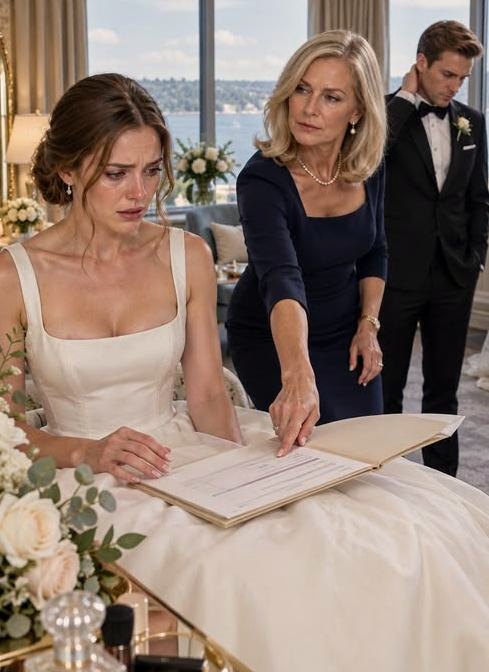
Twenty-three minutes before I was supposed to walk down the aisle, my future mother-in-law spread a financing plan across my wedding dress and pointed to the value of my dead parents’ home.
There were 180 people downstairs at the waterfront hotel outside Seattle. My aunt Susan had flown in from Chicago. Two coworkers had come from San Francisco. A string quartet was playing somewhere beyond the bridal suite, and Nora, my maid of honor, was arguing with the photographer about my bouquet.
Then Diane Mitchell walked in without knocking.
Ryan followed her.
He looked at me once, then at the carpet.
Diane placed a beige folder on the vanity. Its metal clasp struck the marble with a small, deliberate click.
“I know this is not the ideal time to discuss finances,” she said.
I laughed because the alternative was screaming.
“No. It really isn’t.”
She opened the folder anyway.
The first page showed a five-bedroom house in Kirkland listed at $1.28 million.
“What is this?”
“A home Ryan and I believe would be perfect for you both.”
“We?”
Ryan rubbed the back of his neck. He had done that for four years whenever he wanted discomfort to pass without making a decision.
“Emma, just hear her out.”
That was the first answer that frightened me.
The next page listed Ryan’s savings at roughly $110,000. Diane and Michael were contributing another $100,000. Then I saw my name.
Emma Carter—projected contribution: $430,000 to $470,000.
Source: net proceeds from the North Seattle property.
My parents’ house.
I read the line twice. The lace at my wrist scratched against the paper as my hand began to shake.
“You knew about this?” I asked.
Ryan swallowed.
“My mom put together an idea.”
“When?”
He hesitated.
“Last month.”
The answer landed harder than the numbers.
That house was where pencil marks on a doorframe measured my height from age seven onward. My father’s unfinished trellis still leaned behind the garage. My mother’s hydrangeas swallowed the fence every summer. They had been dead for two years, but the house was the one place where their voices still seemed to exist.
I had never said I wanted to sell it.
Diane tapped the spreadsheet.
“From a purely financial standpoint, this is sensible. The lower level could accommodate us when you have children.”
I stared at her.
“You have already planned where you would stay?”
“That is not what I said.”
I turned to Ryan.
“You toured this house?”
“It was only a viewing.”
“How many times?”
He said nothing.
Diane answered for him.
“Twice.”
The room seemed to tilt beneath my satin shoes.
“Where is Ryan’s retirement account?” I asked. “His car loan? His debts? Where is the page showing what he is selling?”
Diane’s mouth tightened.
“You are making this adversarial.”
Ryan exhaled sharply.
“Exactly.”
Then he saw my face.
“That is not what I meant.”
I looked at the clock. The second hand crawled toward the ceremony.
“If I say I am not selling my parents’ house, what happens?”
Ryan opened his mouth, closed it, and finally said, “I don’t think we should make a forever decision today.”
I remembered the realtor’s card from six months earlier. I had said no. Ryan had said okay. Apparently he had heard not yet.
“Why bring this to me now?” I asked.
“I didn’t want to stress you out.”
Diane glanced at the time.
“Whatever disagreement you are having, there is no reason to destroy a wedding over it.”
I had never said destroy.
Ryan reached for my hand.
“Please. Let us get through today.”
That sentence finally showed me what our marriage would require: my silence, delivered on schedule.
I slid off my engagement ring and placed it over my name on the financing sheet.
Ryan went pale.
“Emma, don’t.”
“I am not marrying you.”
Nora found me in the hallway minutes later. One look at my bare hand, and she stopped asking questions.
Twelve minutes after that, I stood beneath the ballroom chandeliers with a microphone. Guests smiled, thinking I was making an early entrance.
“There will not be a wedding today,” I said.
The room filled with whispers.
Ryan entered through the side door with Diane. Michael followed, confused and red-faced.
I told the guests only that I had learned something I should have understood earlier. I did not explain the house. I could not yet make the words leave my mouth.
Then Michael caught me in the hallway, his fingers locked around the edge of a linen-covered table.
“I knew Diane had been looking at houses,” he said. “I did not know they had run numbers on your parents’ property. And I did not know they were bringing those papers today.”
He looked toward Diane, who was arguing with Ryan beside the elevator.
“Emma,” he whispered, “there is something else you need to see.”
His hand moved toward the beige folder, and the clasp began to open…
PART 2
His hand moved toward the beige folder, and the clasp began to open, but Diane saw him first.
“Michael,” she snapped. “Do not make this worse.”
He froze with one finger beneath the metal tab.
I could hear the ballroom behind us: a chair scraping, someone crying, the quartet stopping halfway through a song. The scent of white roses had become sickeningly sweet.
“Worse than what?” I asked.
Diane stepped between us.
“This is a private family matter.”
“My family is dead,” I said. “You are the one who turned their house into a deposit.”
Ryan moved closer.
“Emma, please, not in the hallway.”
“Where would you prefer it? The bridal suite? The mortgage office?”
His face tightened at the last word.
Michael looked at him.
“Mortgage office?”
Ryan’s eyes flicked toward Diane.
She answered too quickly.
“It was only a preliminary consultation.”
“With whom?” I asked.
No one answered.
Michael pulled the beige folder from Diane’s hand. The paper bent under his grip.
“I found these in her study last night,” he said. “I thought they were estimates. I did not realize Emma’s name was on the application page.”
He opened the folder to a section I had not seen upstairs.
A lender worksheet listed the Kirkland property as a future source of funds. Beside my name, under anticipated authorization, someone had written: after ceremony.
My stomach dropped.
“I never authorized anything.”
“I know,” Michael said.
Diane’s voice became quiet and polished.
“No lender approved a loan. No sale was arranged. This was planning.”
“Planning what?”
Ryan rubbed his neck again.
“Buying a house.”
“Using money that is not yours.”
“It would have been ours,” he said.
The word struck me harder than the canceled wedding. Not mine. Ours. As if marriage would transfer not only my future, but the last physical piece of my parents.
Susan came out of the ballroom and took my elbow. Her phone was still in her hand, the screen cracked at one corner.
“Are you coming with me?” she asked.
I nodded, but Michael stopped me.
“There is a broker downstairs,” he said. “Her name is Lena Ortiz. Diane asked her to prepare the numbers. Lena has been waiting because she believed you were going to sign something today.”
Diane’s face changed.
“Michael, stop.”
“Why?” he asked. “Because you are embarrassed, or because she might tell Emma what you actually said?”
For the first time, Diane looked frightened rather than offended.
We found Lena in a small conference room beside the ballroom. She was holding a red leather portfolio against her chest. A brass hotel pen trembled between her fingers.
“I am sorry,” she said to me. “I was told you had agreed in principle.”
“Who told you?”
She glanced at Ryan.
“Your fiancé.”
Ryan shook his head.
“I said she was considering it.”
“You said the house would be liquidated after the ceremony,” Lena replied. “You asked me to keep the sellers from accepting another offer until Monday.”
The room went still.
I looked at Ryan.
“You reserved a house?”
“No. I asked a question.”
Lena opened her portfolio. Inside was a printed email and a property hold form. The signature line for the buyer was blank, but the notes beneath it were not.
Buyer’s equity to originate from North Seattle property. Title preference: Ryan Mitchell and Emma Carter, with Ryan controlling final sale decisions.
My pulse began pounding in my ears.
“Who wrote the title preference?” I asked.
Lena looked at the page.
“Ryan did.”
He reached for it.
“It was a draft.”
“Then why does it say controlling final sale decisions?”
Diane stepped toward me.
“Because Ryan understands property management better than you do.”
A laugh escaped me, sharp and empty.
“I manage commercial properties for a living.”
“I know,” she said. “That is why you should understand that sentiment is not a financial strategy.”
Susan’s hand tightened around my arm. I could feel her thumbnail through the silk of my sleeve.
Michael stared at Diane.
“What else did you tell them?”
She turned on him.
“You want to pretend this is all my fault? Ryan has been drowning for months.”
Ryan’s head snapped toward her.
“Mom.”
The word came out like a warning.
But Michael had already heard it.
“Drowning in what?” I asked.
Ryan backed into the conference table. A stack of hotel menus slid to the floor.
Diane looked at him, then at me.
No one spoke.
Finally, Ryan whispered, “It is not what you think.”
At that exact moment, Lena’s phone rang. She glanced at the screen, answered, and listened.
Her expression drained of color.
“Emma,” she said, “the title company is asking why someone submitted a signed authorization to release information about your parents’ property…”
PART 3
“Emma,” Lena said, “the title company is asking why someone submitted a signed authorization to release information about your parents’ property…”
The room seemed to lose its air.
“Signed by whom?” I asked.
Lena looked at the form.
“By you.”
“I did not sign anything.”
Michael took the paper from her. His hands were no longer trembling. They were rigid.
The signature beneath the authorization looked like mine from a distance, but the final stroke of the C in Carter curled too far upward. My father had taught me to make that letter with one clean motion. I had never written it that way.
Ryan stared at the page.
“Diane,” he said.
She lifted her chin.
“Do not accuse me without understanding the context.”
“What context could make this acceptable?” I asked.
She turned to me, and all the softness vanished from her voice.
“Ryan owes money.”
He flinched.
“Mom, stop.”
“He owes $186,400 to the company that financed his restaurant investment. The payment deadline is next Friday. If he misses it, they can take his share and pursue him personally.”
I looked at Ryan.
“You told me the restaurant loan was settled.”
“It was supposed to be.”
“You told me you had never invested in a restaurant.”
“I said I was not involved anymore.”
The confession fell between us like broken glass.
Michael closed his eyes.
Diane kept talking, as if speed could make betrayal sound like necessity.
“We were trying to protect you both. Selling the empty house, buying a better property, consolidating the debt—”
“It is not empty,” I said. “You know it is not empty.”
Ryan’s voice cracked.
“I thought once we were married, you would understand that my debt became our problem.”
“No. You decided it became my property.”
Lena pointed to the authorization.
“Who submitted this?”
Diane said nothing.
Michael took a step toward his son.
“Ryan?”
Ryan looked at the floor.
“I gave Mom the old closing paperwork from Emma’s estate. She said the title company only needed a sample signature to verify the file.”
My skin went cold.
“You gave her my parents’ documents?”
“I did not know she would use them.”
Diane’s face tightened.
“I did not forge anything. I prepared a draft so the process would not be delayed.”
“By writing my name on an authorization?” Michael demanded.
The red leather portfolio slipped from Lena’s arms and struck the carpet.
She knelt to gather the papers, then stopped.
“There is another page,” she said.
She pulled out a document stamped by the title company. At the bottom was a handwritten note from an employee: Do not proceed. Owner called directly and denied consent.
I remembered the call from a blocked number two weeks earlier. A woman had asked whether I was planning to sell my property. I had assumed it was a marketing mistake.
It had not been.
The title company had stopped the inquiry because I said no.
Ryan had known that and continued anyway.
I looked at him.
“Did you expect me to sign after the ceremony?”
His silence answered before he did.
“Not immediately,” he said. “But eventually.”
Diane gave a bitter laugh.
“You would have agreed once the wedding was over and the pressure was gone.”
“No,” I said. “You were counting on me being too embarrassed to leave.”
Michael turned toward the ballroom, where their relatives were waiting among untouched champagne glasses.
“Tell them,” he said to Diane.
She stared at him.
“Tell them what?”
“That the wedding ended because you tried to convert Emma’s inheritance into Ryan’s rescue plan.”
Ryan grabbed his father’s sleeve.
“Do not do this.”
Michael pulled away.
“You did it when you let them bring that folder upstairs.”
My phone rang.
It was the title company.
A woman named Priya asked whether I wanted the property placed under an immediate fraud alert and whether I could come in Monday morning to review every inquiry made against it.
I said yes.
Then she added, “There is one more issue. Someone requested a certified copy of your parents’ trust this morning. The request included a delivery address in Kirkland.”
I looked at the house numbers on the folder.
The Kirkland house was not merely a plan.
Someone had already begun moving my parents’ property toward it…
Then the title company called with one more name…
I thought the wedding had been the worst part. I was wrong. The final documents showed how far their plan had already reached.
“Your parents’ property is no one’s rescue plan.”
I finally understood what his signature would cost him.
👇 The final part of the story is already open.






