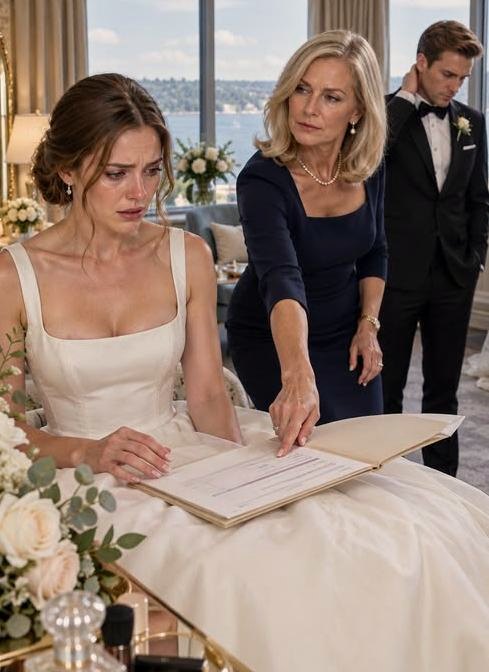
PART 4
Someone had already begun moving my parents’ property toward it, and the thought made my hands go numb.
“Who requested the trust?” I asked.
Priya hesitated.
“Your late mother’s name appears on the request, but the delivery address belongs to a private mailbox in Kirkland.”
I looked at Michael.
He understood before I explained.
“Diane,” he said.
She shook her head.
“I did not request anything this morning.”
Lena reached for the red portfolio and turned one page backward. A yellow sticky note had been pressed beneath the title company stamp. The ink was green, and the handwriting was cramped.
Call before releasing. Owner refused all contact. Request came through Mitchell Family Holdings.
Michael’s face changed.
“What is Mitchell Family Holdings?” I asked.
Ryan answered too softly.
“Nothing.”
Diane snapped toward him.
“Do not be dramatic.”
“Nothing?” I repeated.
Ryan dragged both hands over his face. The cuff of his wedding shirt caught on his watch, pulling a thread loose.
“It is a company my father and I set up years ago.”
“For what?”
“Property investments.”
“You never told me you owned a property company.”
“Because it never did anything.”
Michael gave a short, humorless laugh.
“That is not true.”
The ballroom doors opened behind us. A cousin stepped into the corridor, saw all four faces, and quietly closed them again.
I kept my eyes on Michael.
“What did it do?”
He looked at his son.
“Ryan used it to guarantee the restaurant loan.”
The corridor seemed to narrow.
Diane had not only wanted my parents’ house sold. She had wanted the money routed through a company that already carried Ryan’s debt.
If I had signed after the ceremony, my inheritance would have entered a structure I did not control. The Kirkland house would have been purchased, but my money would have stood behind a business obligation I had never agreed to carry.
And the title note had already said Ryan would control final sale decisions.
I turned to him.
“Did you know that?”
He did not answer.
“Ryan.”
“I knew the company had the guarantee.”
Diane stepped forward.
“We were going to refinance it.”
“With my money.”
“With family money,” she said.
That word finally broke something in me.
“Family is not the person who finds your mother’s house and puts a price on it while you are getting dressed for the wedding.”
Susan came beside me.
“Emma, we should leave.”
I nodded, but Michael blocked the elevator.
“Before you go, you need to hear what happened in the ballroom.”
“I have heard enough.”
“No,” he said. “You have heard what they planned. You have not heard what they told everyone.”
He opened the ballroom door.
The room had changed. Guests stood in clusters beneath the chandeliers. The untouched cake leaned slightly to one side, its sugar flowers beginning to slide in the heat.
Diane walked in behind us.
“Please,” she called. “Everyone, there has been a misunderstanding.”
I felt Susan’s hand at my back.
Ryan followed his mother, desperate and pale.
“Mom, stop.”
She ignored him.
“Emma is upset because she misunderstood a private financial discussion.”
A dozen faces turned toward me.
The shame was deliberate. If she could make me look irrational, she could turn the numbers into a family disagreement instead of what they were.
I stepped toward the microphone still standing near the altar.
“Then let us discuss it clearly.”
Diane’s smile flickered.
I lifted the beige folder.
“This plan lists my parents’ home as the source of nearly half a million dollars. It was prepared without my agreement. It includes a property I never approved, a company I was never told about, and a note saying Ryan would control the final sale decisions.”
A glass slipped from someone’s hand and shattered.
Ryan whispered, “Emma.”
I kept going.
“It also includes an authorization using my name that I did not sign.”
Diane rushed toward me.
“That is an outrageous accusation.”
Michael stepped between us.
“No. The outrageous thing was bringing the papers upstairs and expecting her to smile for photographs afterward.”
The room went silent.
Then Ryan’s business partner, Mark Ellison, stood near the back wall.
I had met him once at a barbecue. He was holding a folded napkin in one hand.
“Ryan,” Mark said, “you told me she would sign today.”
Ryan turned sharply.
“Not here.”
“You told me the wedding would make it impossible for her to back out without losing face.”
Diane closed her eyes.
Mark looked at me.
“I am sorry. I thought you knew.”
The final piece settled into place.
This had never been a spontaneous idea from an overbearing mother. Ryan had used the wedding as a deadline. Diane had used the family as pressure. The property had been treated as collateral before I had even become his wife.
Ryan came toward me.
“I was scared,” he said. “The restaurant failed. I thought I could fix everything before you found out.”
“You had four years to tell me.”
“I loved you.”
“Then why was my name written on papers I had not seen?”
He looked at the floor.
Because there was no loving answer.
Michael removed a checkbook from his jacket and tore out a check. His pen scratched loudly in the bright room.
“What are you doing?” Diane demanded.
“Paying Ryan’s share of the debt,” he said. “The company guarantee ends tonight. The house plan ends tonight. And so does my involvement in anything that uses Emma as a solution.”
Ryan stared at him.
“Dad, you cannot.”
“I can, and I should have done it before you learned to call concealment kindness.”
He handed the check to Mark.
It was not forgiveness. It was a boundary drawn in ink.
Diane looked at Michael as if he had betrayed her.
“You are choosing her.”
“No,” he said. “I am choosing not to help you lie.”
Priya from the title company arrived forty minutes later with two printed forms and a small blue stamp pad. She met me in the conference room while Susan waited outside.
The fraud alert was placed on my parents’ property. Every inquiry was frozen. No broker, lender, or title company could receive information without a new verbal confirmation and a signed request witnessed in person.
I signed the restriction with a pen that leaked black ink onto my thumb.
The stain stayed there all evening.
It seemed appropriate.
The wedding guests left in waves. Some hugged me. Some avoided my eyes. One of Diane’s cousins told Susan that I had ruined a beautiful day, and Susan replied that a beautiful day did not require an invisible bill sent to the bride.
Ryan waited outside the hotel near the service entrance. His boutonniere had fallen apart, leaving a white petal stuck to his shirt.
“I can explain the debt,” he said.
“I know about the debt.”
“I can sell my car. I can move out. I can repay your parents’ estate if you give me time.”
“The money was never yours.”
“I know.”
It was the first honest sentence he had offered me all afternoon.
I looked at the ring in my palm. I had placed it in the folder, but Michael had returned it before leaving. Its stone caught the orange light from the hotel sign.
“Why did you stay silent when your mother put the number beside my name?” I asked.
Ryan’s eyes filled.
“Because I thought once you saw the house, you would understand.”
“No. You thought once everyone was waiting, I would be too ashamed to say no.”
His shoulders folded.
“I was afraid you would leave.”
“You made leaving the only decision that belonged to me.”
He reached for my hand, then stopped himself.
That small movement hurt more than his excuses. It was the first time he understood that wanting forgiveness did not create an obligation to receive it.
I gave the ring to Susan.
“Keep it,” I said. “I do not want it near any paperwork.”
She closed her fingers around it.
Michael came outside carrying the beige folder. He had removed every page except one: a blank sheet from the hotel notepad.
“I thought you might want this,” he said.
“For what?”
“To write down what belongs to you before anyone else decides.”
I took the paper.
On it, I wrote three names: Emma Carter, Susan Carter, and North Seattle property.
Then I wrote one instruction beneath them: No sale. No transfer. No permission by marriage.
Michael read it and nodded.
“I will sign as witness.”
“You do not have to.”
“I do.”
The next morning, I drove to my parents’ house with Susan beside me. The hydrangeas had begun to brown at the edges, and the unfinished trellis leaned exactly as my father had left it.
Inside, the pencil marks on the doorframe were still there.
Susan touched the lowest line.
“You were so small.”
“I know.”
She pointed to the highest mark.
“Your father wrote that one.”
I ran my thumb over the faded number. The black ink from the title forms had finally washed away, but a pale trace remained beneath my nail.
At noon, Priya called to confirm that the property restriction was active. At twelve fifteen, Lena sent a message saying the Kirkland sellers had released the house to another buyer. At twelve thirty, Mark confirmed that Michael’s payment had removed the immediate pressure from Ryan’s business debt, but Ryan had signed away his ownership in Mitchell Family Holdings to repay his father.
He had wanted a house he could control.
He lost the company that gave him the illusion of control instead.
Diane left one message. I did not return it.
Michael sent only a photograph of the signed debt agreement and a sentence: “Your parents’ property is no one’s rescue plan.”
I printed it and placed it beside the old height chart.
Not as a monument.
As a warning to myself about the difference between help and surrender.
That afternoon, I went into the basement and found my father’s unfinished trellis leaning against the workbench. I carried it outside alone, set it upright, and secured the loose joint with a brass screw from his coffee tin.
The wood creaked, but it held.
Then I took the blank hotel page and nailed it above the workbench.
Beneath my three names, the final line remained visible in my handwriting:
“No permission by marriage.”
Missed the beginning?






