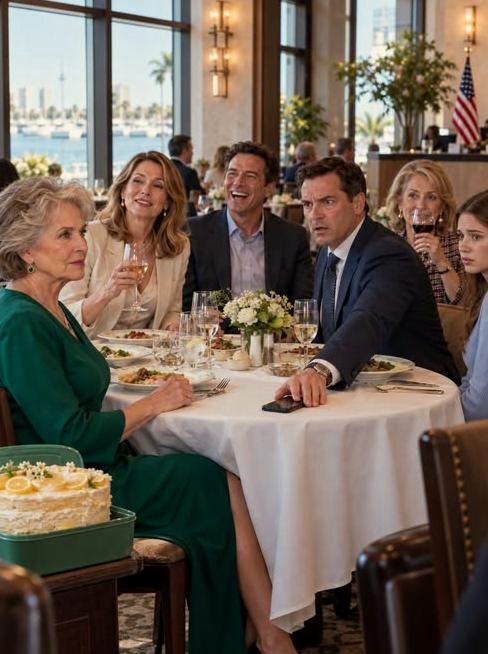
At seventy-one, I watched my daughter turn my birthday lunch into a public trial, and the sentence she gave me was that I had done nothing with my life.
We were seated at Corbin’s beneath a brass chandelier that flickered whenever the kitchen door opened. Six people surrounded the window table: Nicole, my daughter; Grant, my son; Trevor, Nicole’s husband; Karen, Trevor’s mother; my granddaughter Hannah; and me.
My lemon icebox cake sat beside my chair in a green plastic carrier. Seven thin layers, each one chilled overnight and decorated with curls of lemon peel. I had made it that morning because nobody else had offered.
Lunch had been ordinary until Nicole placed her wineglass on the table.
“Mom,” she said, smiling as if she were asking about the weather, “what is it like being the only person here without a career?”
Trevor laughed first.
Grant joined him a second later. Karen hid her smile behind her napkin. Hannah stared at the salt shaker, her cheeks turning pink.
I felt the edge of my fork press into my palm.
“Nicole,” I said, “is that how you wanted to spend my birthday?”
“She’s teasing you,” Trevor said. “You know how Nicole is.”
I looked at him.
“Do you?”
His grin held for another heartbeat.
Then I asked, “How does it feel knowing I sign your paychecks?”
The laughter vanished so completely that I could hear ice shifting inside someone’s glass.
Trevor’s face changed. He picked up his phone and turned it facedown on the white tablecloth.
Nobody asked what I meant.
That was their first mistake.
For years, my family believed I spent three mornings a week doing quiet paperwork for a church charity. They had never asked why my alarm rang at 5:40 every morning, or why I drove twelve minutes toward the industrial district instead of toward any church.
They never asked about the gray building with no sign on the front.
I had kept those answers private because my husband, Samuel, had made me promise before he died.
“Let them build their own names,” he had told me. “If they know what we own, they’ll never know what they can become without it.”
So I said nothing when Nicole called me “retired.” I said nothing when Grant joked that I had never held a serious job. I even smiled when Karen told people I had been “fortunate enough not to need ambition.”
But three weeks before my birthday, the president of Callaway Precision had placed nineteen invoices on my desk.
The total was $61,400.
The vendor was Redline Promotional Group, owned by Trevor’s older brother, Marcus. Two invoices described trade shows that had never existed. Trevor had approved every payment and signed annual disclosure forms stating that he had no related-party vendors.
I had delayed action because Nicole was my daughter.
Because Hannah was still in college.
Because I knew exactly how many people would suffer if Trevor lost his job.
The next morning, I drove to the gray building and parked beneath the crooked maple tree near the loading dock. Callaway Precision employed 240 people and brought in nearly forty-eight million dollars a year.
Sixty-one percent belonged to the Monroe Family Trust.
I was the sole trustee and chair of the board.
Trevor had worked there for six years and never suspected it.
Neither had Nicole.
Neither had Grant.
That evening, I opened an email containing the nineteen invoices again. My finger hovered over the attachment when my phone rang.
It was Nicole.
“Mom,” she said, “we need to talk about your house.”
“Why?”
“Because everyone thinks it would be safer if you moved.”
“Everyone?”
She exhaled impatiently. “Don’t make this difficult.”
I looked at the green cake carrier still sitting untouched on my kitchen counter.
Then I heard paper sliding across a table on her end of the call.
“Just sign the authorization,” Nicole said. “It’s already prepared…”
PART 2
The word authorization landed harder than the insult at lunch.
I stood in my kitchen at 8:16 that evening, one hand resting on the cake carrier, while the refrigerator hummed behind me.
“What authorization?” I asked.
“The one allowing me to handle your housing arrangements.”
“My housing arrangements?”
“You shouldn’t be driving to that industrial area every morning. You forget things. You get tired.”
“I remember enough to know when someone is trying to take control of my life.”
Her voice sharpened. “This is exactly what I mean. You make everything a battle.”
“Who drafted it?”
There was a pause.
“Grant found a standard form.”
I knew then that the conversation was not about a retirement community. It was about access. To my accounts. To my house. Perhaps to something they still did not know existed.
At 9:03, Grant arrived without calling. His truck stopped beneath my bedroom window, and the headlights swept across the framed photograph of Samuel and me outside the first Callaway warehouse.
Grant entered carrying a rolled-up set of blueprints.
“Mom, please don’t be dramatic,” he said.
“What are those?”
“Plans for selling this place and moving you somewhere manageable.”
“Manageable for whom?”
He placed the blueprints on my dining table. The paper smelled of fresh ink. A red line ran through the room where Samuel’s workbench stood.
“Your house is worth a fortune,” Grant said. “You can’t maintain it forever.”
“I’ve maintained it for thirty-two years.”
“You’ve been lucky.”
“No,” I said. “I’ve been working.”
His mouth tightened. “Doing paperwork for a church isn’t working.”
I almost told him then.
Instead, I asked, “Who told you what my house is worth?”
He looked away.
At Sunday dinner, the answer appeared on my phone by accident. Nicole had left her tablet open beside the fruit bowl while she helped Hannah with a chemistry assignment. A family chat filled the screen.
There was a photograph of me collecting mail from my porch.
Under it, Trevor had written, “The retired professional is still mobile.”
Karen had replied, “Shift Tuesday is mine.”
Grant was assigned Thursday.
Nicole had written, “She’s not a person you invite. She’s a person you manage.”
My hands became so cold that I could barely lift the tablet.
Hannah saw my face.
“Grandma?”
I closed the screen.
“What did you see?” she asked.
“Enough.”
“Did Mom say something awful?”
I looked at my granddaughter, at the scholarship receipt tucked beneath her textbook, at the small silver charm hanging from her bracelet. I had paid the scholarship through a foundation no one connected to me. Hannah believed she had earned every dollar herself.
She had.
That was the point.
On Monday morning, I called Ellen Price, Callaway’s president.
“Move the anniversary breakfast to October second,” I told her.
“It’s already scheduled.”
“Then keep every seat exactly where it is.”
Ellen was quiet. She had managed the company for eleven years and understood the weight of my voice.
“Are you ready to tell them?” she asked.
“No,” I said. “But I’m ready to stop letting them invent me.”
Trevor was set to receive the President’s Club Award that morning. Nicole’s design firm was presenting the company’s new branding campaign. Grant would attend as a vendor. Two hundred forty employees would be watching.
The night before the breakfast, Nicole called again.
“Mom, I think it would be better if you didn’t come.”
“Why?”
“It’s a professional environment. Everyone there has a career.”
I opened my closet and touched the emerald dress I had worn to Samuel’s retirement dinner. Its sleeve still carried a tiny thread of gold from the old embroidery.
“Nicole,” I said, “what exactly do you think my career was?”
She laughed under her breath.
“Please don’t embarrass yourself.”
At 6:42 the next morning, I drove to Callaway and entered through the side door. The lobby smelled of coffee, polished concrete, and machine oil. Employees moved between tables carrying folders and paper cups.
I sat quietly in row seven.
At 7:18, Nicole saw me.
Her expression cracked.
She hurried down the aisle, her heels striking the floor like impatient taps.
“Mom, you need to leave right now.”
Trevor appeared behind her, already wearing his award ribbon.
“This is a client-facing event, Darlene,” he said.
I folded my hands over my emerald skirt.
“I’m going to stay.”
Before he could answer, Ellen stepped onto the platform. She adjusted the microphone, glanced toward row seven, and then walked past every employee.
She stopped beside my chair.
“Mrs. Monroe,” she said loudly, “we’re ready for you.”
Nicole froze.
Trevor’s fingers tightened around the award envelope.
Ellen opened a brown folder and removed a document stamped March 17, 1994.
Then she looked at the crowd and began to read…
❤️ Thank you for reading this far! The rest of the story is waiting in the first comment. 👇
PART 3
The first line of the document was written in Samuel’s unmistakable block letters.
“On March 17, 1994, Samuel Monroe and Darlene Monroe transfer controlling ownership of Callaway Precision Incorporated into the Monroe Family Trust.”
Ellen’s voice carried to the back wall.
A coffee cup slipped from someone’s hand and struck the floor.
Nicole stared at me. “What is this?”
I rose from row seven.
“It is the reason your father and I never wanted you to know.”
Trevor shook his head. “That trust is dormant. It has nothing to do with my position.”
Ellen turned another page.
“The trust retains the authority to appoint and remove board members, approve executive compensation, and review all related-party transactions.”
Trevor’s award ribbon hung crooked across his chest.
“Darlene,” he said, lowering his voice, “we can discuss this privately.”
“No,” I answered. “We have discussed everything privately for six years. That is how the invoices got through.”
A murmur moved across the room.
Ellen lifted a second folder, this one containing copies of the nineteen payments.
“Redline Promotional Group received sixty-one thousand four hundred dollars,” she said. “Two listed trade shows were never held. The remaining invoices describe promotional materials that were never delivered.”
Trevor’s face drained of color.
“That’s not true,” he said.
“Then explain the signatures.”
Ellen placed the documents on the lectern. Every page carried Trevor’s approval and his disclosure certification.
Nicole turned toward him.
“You told me those payments were reimbursements.”
Trevor snapped, “I told you what you needed to know.”
The room went still.
Hannah stood near the refreshments, one hand pressed against the silver charm on her bracelet.
“Mom,” she whispered, “did you know?”
Nicole looked at her daughter and then at me. Shame crossed her face, but anger followed it quickly.
“You hid a company from us for thirty years,” she said. “You let us think you were helpless.”
“I let you think I was ordinary,” I replied. “There is a difference.”
Grant stepped forward. “You could have helped us.”
“I helped you by refusing to make dependence look like success.”
Trevor grabbed the folder from the lectern. Ellen caught his wrist.
“Put it down.”
His eyes flashed. “You can’t fire me in front of these people.”
“I can,” I said. “And I am removing you from every company role, effective today.”
He turned toward Nicole.
“Tell her what the money was for.”
Nicole’s breath caught.
Trevor looked at the employees surrounding us and made the mistake of trying to save himself with the truth.
“Your branding firm was about to fail,” he said. “I moved the money so you could keep your contracts.”
Nicole slapped him.
The sound cracked through the breakfast hall.
“I never asked you to steal from her,” she said.
“You asked me to save us.”
“I asked you to stop lying.”
Ellen handed me a final page. It was a notice from the bank, dated that morning.
“Darlene,” she said quietly, “there’s another issue.”
The notice stated that Callaway’s credit line had been used as collateral for a private loan. The signature authorizing it was mine.
I had never signed it.
Across the bottom, the lender had listed the borrower: Monroe Family Holdings.
My family’s private chat had been cruel.
But someone had been planning something much larger.
I looked at Trevor.
He had stopped breathing for a second.
Then my phone rang.
The caller was Marcus, his older brother.
I answered on speaker.
“Darlene,” Marcus said, “you need to hear what Trevor promised me about the company…”
The signature on that loan changed everything…
I thought the birthday insult was the deepest betrayal. I was wrong. The final discovery forced every person at that table to choose what kind of family they wanted to be.
“Your company was never supposed to remain yours.”
Trevor’s award ribbon slipped from his jacket.
👇 The final part is already open.






