PART 4
Marcus’s voice came through the breakfast hall, thin and frightened beneath the hum of the speaker.
Trevor lunged toward my phone.
I stepped back.
“Keep talking, Marcus,” I said.
There was a ragged breath on the line.
“Trevor told me the trust was going to be dissolved,” Marcus said. “He said Nicole and Grant had agreed to sell the company after you were moved into assisted living.”
Nicole’s face went white.
Grant whispered, “That’s not possible.”
“It’s what he told me,” Marcus continued. “He said the buyer was already prepared. He needed the invoices to make Redline look legitimate, then he planned to use the money as a deposit.”
Trevor stared at the rows of employees who had once applauded him.
“You’re lying,” he said.
“No,” Marcus answered. “I’m terrified.”
The call ended.
For several seconds, no one moved. A paper banner reading THIRTY YEARS OF PRECISION sagged behind the platform, one corner peeling away from the wall.
Ellen took the bank notice from my hand.
“The private loan is for two hundred eighty thousand dollars,” she said. “The lender believes it is secured by a company asset.”
“What asset?” I asked.
She looked at Trevor.
“The North River property.”
My stomach tightened.
North River was the parcel Samuel and I had bought for one purpose: to build Callaway’s training center. It held the original warehouse, the machine shop, and the tiny office where we had signed our first contract. It was not merely land. It was the company’s spine.
Trevor had tried to pledge it without authorization.
“Who accepted the signature?” I asked.
“A private lender called Vantage Bridge,” Ellen said. “Their representative is waiting in the lobby.”
A man in a navy suit appeared at the entrance. He carried a leather portfolio and wore a worried expression.
“Mrs. Monroe?” he asked.
“I’m here.”
“I’m Daniel Reed. I handled the loan.”
Trevor moved toward him.
“You were told the board approved this.”
Daniel’s gaze shifted to me. “I was shown a resolution bearing the chair’s signature.”
“Which chair?”
He opened the portfolio and removed the page.
The signature looked like mine from a distance. Up close, the final stroke was too heavy and the middle initial was wrong.
Samuel had taught me to sign his name only once, when he was in the hospital and could not approve a payroll transfer. I had hated the feeling of it. Since then, I had never used anything but my own full signature.
“This is forged,” I said.
Daniel swallowed. “If that is true, I was deceived as well.”
Trevor pointed at the document.
“You approved every payment,” he said to me. “You built the system. Don’t pretend you’re innocent.”
“I am not pretending anything,” I answered. “I am separating your choices from mine.”
Nicole turned on him.
“You used my company to disguise the invoices?”
“Our company,” he said.
“No. Mine.”
She looked at me, and the anger in her face finally broke apart.
“Mom,” she whispered, “I didn’t know about the loan.”
“I believe you.”
That frightened her more than accusation would have.
“Why?” she asked.
“Because you were arrogant enough to think you were managing me, but not clever enough to understand what you were managing.”
Her eyes filled.
“I was ashamed,” she said. “Your whole life looked finished to me. You had no office, no title, no photographs of yourself in a lobby. I thought you had stopped trying.”
“I had stepped out of the picture so you could stand in it.”
Grant lowered his head.
“I wanted the house,” he said. “Not because I wanted you gone. I thought if we sold it, we could divide things fairly before something happened to you.”
“Fairly?” I asked. “Without asking me?”
His shoulders collapsed.
“I thought you would refuse.”
“I would have.”
Hannah approached slowly. The silver charm on her bracelet trembled against the chain.
“Grandma,” she said, “did you pay for my scholarship?”
Nicole looked sharply at me.
I nodded.
“Through the Monroe Foundation.”
Hannah’s eyes filled. “You told me it was a merit award.”
“It was. You earned it. I only made sure money did not decide whether you could use what you earned.”
She stepped forward and hugged me so suddenly that the emerald sleeve of my dress creased beneath her hands.
Behind her, Nicole began to cry.
Not the polished tears she used when trying to end an argument. These were uneven and angry, the kind that seemed to surprise the person shedding them.
“Can you forgive me?” she asked.
The employees were still watching. So was Trevor. So was her mother-in-law, Karen, who had spent years calling me lucky.
“I can forgive the insult,” I said. “I cannot pretend the plan was harmless.”
Nicole nodded.
“What do I do?”
“Tell the truth without asking me to comfort you afterward.”
She turned toward the employees.
“My branding firm received money connected to these invoices,” she said. “I did not authorize the theft, but I benefited from the lie. I am returning every dollar I can return, and I am withdrawing from Callaway’s campaign.”
Her voice shook, but she kept going.
“I also owe my mother an apology that cannot be fixed by a speech.”
Trevor laughed bitterly.
“You think they’ll keep you after this?”
Nicole faced him.
“No. I think I finally understand what keeping something costs.”
Ellen stepped beside me.
“Trevor, your employment and board authority are terminated. The company will seek recovery of the funds and invalidate any transaction made without trust approval.”
Trevor looked at me.
“You’re destroying my family.”
“No,” I said. “You borrowed against a family you thought was too foolish to notice.”
He glanced at the red award ribbon still pinned to his jacket. Then he tore it off. The metal clasp snagged in the fabric, leaving a small dark puncture near his heart.
Daniel Reed gathered the forged resolution.
“I will contact our compliance office,” he said. “The loan can be withdrawn before the property changes hands.”
“Send every document to Ellen,” I replied. “And to Marcus. He deserves to know which invoices were real.”
Marcus later admitted that Trevor had pressured him to create false descriptions, but he had kept the original delivery logs because he feared being blamed alone. Those logs proved that only a fraction of the goods had ever existed. He lost the vendor contract, but he repaid the money through a structured agreement instead of disappearing behind his brother’s lies.
Trevor did not leave Callaway quietly. He tried to bargain, threaten, and accuse. None of it changed the signatures, the invoices, or the forged loan resolution. He lost the job he had treated as a private inheritance, and the buyer withdrew when the North River property could no longer be used as collateral.
Grant rolled up the blueprints for my house and carried them to the recycling bin himself.
Karen stopped coming to Sunday dinners. She sent one letter, apologizing for the jokes and asking whether I had really owned the company all those years. I answered only the first question.
“Yes,” I wrote. “But ownership was never the part that mattered most.”
Nicole closed her branding firm rather than accept another contract from Callaway. She took a position with a small nonprofit and began repaying the money her firm had received. She did not ask me to hire her. That was the first useful decision she made in years.
On the following board meeting, I changed the trust rules. My children could inherit shares, but none could control them through a private agreement or a medical authorization. Every related-party transaction would be disclosed to the employees’ council, not hidden in a drawer beneath the executive office.
I also invited Hannah to the meeting.
She sat beside me with a notebook and the same silver charm at her wrist.
“Why me?” she asked.
“Because you asked questions before you asked for power.”
She looked across the table at the original March 17 document.
“Did Grandpa know you would still be doing this at seventy-one?”
I touched the corner of the page.
“Your grandfather thought I would be running the company forever.”
“Were you?”
“No,” I said. “I was waiting for the right person to understand that a title is not proof of a life.”
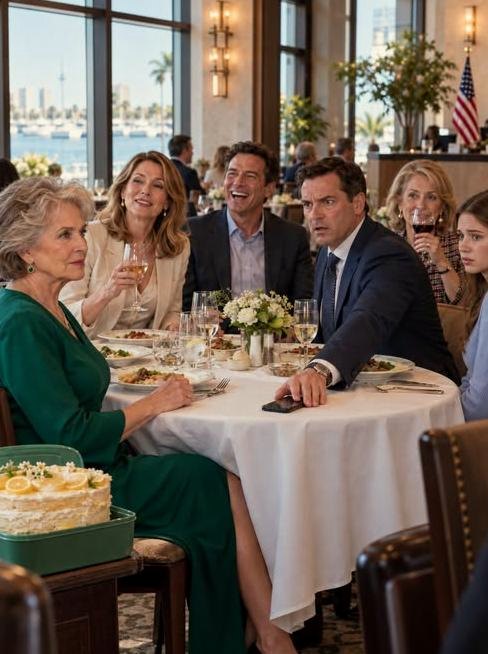
After the meeting, Nicole found me in the archive room. The shelves smelled of dust, paper, and machine oil. On the table lay the green carrier from my birthday lunch.
She had brought it back.
The cake inside was uneven, its lemon layers leaning slightly to one side.
“I couldn’t throw it away,” she said.
“You didn’t have to bring it here.”
“I wanted to ask if we could eat it.”
I looked at her.
“Without an audience?”
“Without an audience.”
We cut two slices with a plastic knife. The cake had dried around the edges, but the center was still tart and cold.
Nicole took one bite and winced.
“It’s not very good,” she said.
“It was made after I spent all morning cleaning the house and before I drove to work. It was never meant to win a prize.”
She lowered her fork.
“I’m sorry I made you feel invisible.”
“You didn’t make me invisible,” I said. “You only proved you had stopped looking.”
She nodded and kept eating.
At the end of the month, Callaway held its employee meeting in the North River warehouse. We stood beneath the old blue sign Samuel had painted by hand. The letters were chipped, but they were still readable.
Ellen announced that the property would become the company’s training center, as Samuel and I had originally planned. The employees applauded. Hannah recorded the announcement in her notebook instead of on her phone.
Then Ellen handed me a microphone.
I looked at the faces in front of me: machinists, designers, accountants, apprentices, people who had spent decades building something they did not personally own.
“My husband and I signed the first trust document in this building,” I said. “We thought protecting a company meant protecting its money. We learned that it also means protecting the people who trust one another inside it.”
No one clapped immediately.
That was all right.
Some truths need a moment to reach the far end of a room.
Then Hannah raised her hand.
“Grandma,” she called, “what should the training center be named?”
I looked at the old machine shop, at the oil-stained floor where Samuel had once slept during a winter breakdown, and at Nicole standing beside the employees with her head lifted.
“Name it after the people who built the work,” I said. “Not after the people who tried to own it.”
Hannah wrote the sentence down.
On the warehouse wall, beneath the peeling blue sign, she later painted four words in black lettering:
Ask who is holding the ledger.
Missed the beginning?






