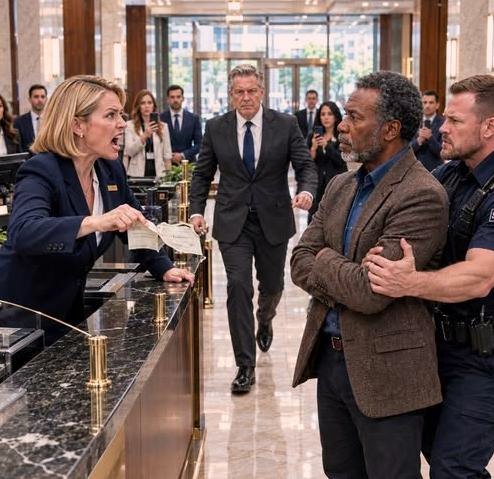
The bank manager tore my three-million-euro check in half while a security guard twisted my arm, and every phone in the branch turned toward me.
—People like you do not walk in here with three million euros and expect us to call it legitimate —Beatriz Salcedo announced.
The torn pieces landed against my coat and slid onto the polished marble floor.
I looked at them, then at her. My pulse was steady, but beneath my shirt, the small brass compass Clara had given me years ago pressed against my chest. I wore it whenever I had to make a decision she would have understood.
—You have just turned a thirty-second verification into the most expensive mistake of your career —I said.
The branch fell quiet.
It was 4:48 on a Thursday afternoon at Banco Alcázar in Madrid’s Salamanca district. Twelve minutes remained before closing. The chandeliers reflected off the marble walls, and everyone inside seemed dressed for a world that had never required them to explain where they came from.
I had arrived in my seventeen-year-old Seat, wearing a brown coat with frayed cuffs and shoes I had polished that morning. The coat was old. The shoes were not. My mother had taught me that dignity did not require money, only care.
I was sixty-one, the son of a nurse and a mechanic from Equatorial Guinea, and I had spent four decades learning that some people decided what you were before hearing your name.
In my leather folder was a certified check for three million euros. It was the first payment from the sale of a stake in an energy-logistics company I had helped rescue when nobody else wanted it. The money was meant to establish scholarships for young people without resources, in memory of Clara, my wife, who had died four years earlier.
After the bank, I planned to visit her grave at La Almudena with white lilies in the back seat.
Lucía Robles, a young clerk with a silver pencil tucked behind her ear, had started helping me at the counter.
—May I see the check and your identification, please?
I handed her my passport, national identity card, and account number. Then Beatriz appeared beside her.
—What exactly are you doing here?
—I am depositing a check.
Her eyes moved from my face to my coat, then finally to the document.
—Three million euros?
—That is what it says.
She typed rapidly. A warning appeared on her screen. I saw the color leave her cheeks, but she did not call the issuing bank.
—There is a reference code —I said. —You can verify it immediately.
—You do not tell me how to do my job.
—No. I am asking you to do it.
At the next desk, a cashier named Sergio smirked. Two customers turned around. One lifted his phone.
Beatriz leaned closer.
—This account is being placed under temporary review for suspected fraud.
—My account has been open here for twenty-six years.
—That does not make this check genuine.
—Then call the issuing bank.
Lucía spoke softly.
—Beatriz, I can verify the reference in less than a minute.
—Sit down, Lucía.
The manager lifted the check by one corner as if it were contaminated.
—Are you threatening me? —she asked loudly.
—I have not raised my voice.
—You are refusing to leave.
—I am waiting for a verification you have chosen not to make.
Then she tore the check.
The sound was small, but it seemed to split the entire room.
—Óscar —she ordered.
The security guard crossed the floor and grabbed my arm. His wedding ring scraped against my sleeve.
I did not pull away.
—Call the police if you want —I said. —But ask them to wait for your superior.
Beatriz dialed emergency services and told the operator that an aggressive man was refusing to leave after presenting fraudulent documents.
A customer whispered, “He does not look like he has that kind of money.”
I heard him clearly.
The glass door opened as Óscar guided me toward it. A man in a gray suit stepped inside, carrying a folder stamped with the bank’s gold emblem.
He saw the guard’s hand on my arm.
He stopped so abruptly that the folder fell from his fingers.
—Mr. Mena —he whispered, turning pale—what on earth is happening here…
PART 2
—Mr. Mena —Alberto Valdés repeated, looking from my face to the guard’s hand. —Please let him go.
Óscar released me so quickly that my sleeve snapped back against my wrist. The brass compass beneath my shirt struck my ribs. I touched it without thinking.
Beatriz recovered first.
—Alberto, we stopped a fraudulent transaction. This man brought in a counterfeit check for three million euros and became intimidating when I challenged him.
—He did not become intimidating —Lucía said.
Beatriz turned on her.
—You will not speak over me.
Alberto crossed the lobby and looked down at the torn pieces on the floor.
—What did you do?
—My job.
—You destroyed a negotiable instrument belonging to one of our most important clients.
The customers began recording openly. Sergio lowered his eyes. Óscar stepped away from me, rubbing the fingers that had gripped my arm.
Beatriz stared at Alberto.
—You know him?
—Everyone in the territorial office knows him. Samuel Mena founded Horizonte Sur Capital. His group is one of the largest institutional clients of Banco Alcázar.
Her mouth opened, but no sound came out.
Alberto picked up a fragment of the check with a hand that had started to shake.
—This payment was reviewed by me personally this morning.
—Then why did the system flag it? —Beatriz demanded.
—Because the issuing company sent a confirmation request after changing its settlement bank. It was a routine alert, not a fraud finding.
I bent down and gathered the other pieces. The marble was cold through my fingertips.
—The code was printed beside the signature —I said. —Lucía asked to verify it. You refused.
Beatriz looked at my coat again.
—No one told me who you were.
The sentence hung in the air.
I straightened.
—Finish it.
Her face tightened.
—That is not what I meant.
—It is exactly what you meant.
The two officers arrived at 4:57. Beatriz moved toward them immediately.
—He presented a suspicious document and resisted removal.
Alberto stepped between us.
—That report is false. The call was made before any verification was attempted. This branch is now subject to an internal review.
One officer glanced at the pieces in my hand.
—Would you like to make a formal complaint, sir?
—Not yet —I replied.
Beatriz blinked.
—Not yet?
I looked past her toward the dark wooden offices at the back of the branch.
—Today I came to decide whether Banco Alcázar should continue managing the Clara Mena Education Fund.
Alberto’s expression changed.
He knew the name. Everyone at headquarters did.
Two weeks earlier, my trustees and I had narrowed the final decision to Banco Alcázar and one competing institution. The agreement would transfer four hundred and twenty million euros into a long-term structure funding scholarships, training centers, and small-business loans for families who had never been welcomed into rooms like this one.
Beatriz slowly turned toward Alberto.
—Four hundred and twenty million?
—The agreement has not been signed —I said. —That is why I came.
—You were going to sign it here? —Lucía asked.
—I was going to ask one final question.
Alberto’s jaw tightened.
—Samuel, we can discuss this privately.
—No. The public humiliation was not private.
One of the officers asked Beatriz for the name of the employee who had authorized the call. She pointed at me.
—He was threatening me.
Lucía stepped forward, pale but determined.
—That is not true. I was at the counter the whole time.
—You have worked here for one month —Beatriz snapped.
—Long enough to know the verification button exists.
A small murmur moved through the branch.
Alberto looked at the cameras mounted above the entrance, then at the folder he had dropped. His face had gone from embarrassment to something harder.
—Mr. Mena, before you make a decision, you need to see what is inside that folder.
I watched his fingers close around the clasp.
—Why?
He glanced toward Beatriz.
—Because what happened today was not the first warning.
The folder opened, and Alberto slid out a single page. Before I could read it, his telephone began ringing. He checked the screen, and the blood drained from his face…
PART 3
—Who is calling? —I asked.
Alberto did not answer. The telephone kept vibrating against his palm, rattling the metal clasp of the folder.
Then Lucía looked at the page he had exposed.
—That is my report.
Beatriz spun toward her.
—What report?
Lucía’s silver pencil fell from behind her ear and struck the floor.
—The report I filed last Tuesday. About you.
The officers exchanged a glance.
Alberto finally answered the call, listened for three seconds, and ended it without speaking. His face had become rigid.
—The head office wants this resolved before the market closes —he said.
—Then resolve it here —I replied.
He placed the page on the counter. It was a complaint bearing Lucía’s signature, dated eight days earlier. She had described Beatriz instructing staff to delay or question clients whose clothing, accents, or appearance did not match the branch’s preferred image. She had named three customers and included times, desk numbers, and the exact words Beatriz had used.
Beatriz laughed once, sharply.
—A trainee’s interpretation is not evidence.
—There are four reports —Alberto said.
Her smile vanished.
He removed three more pages from the folder. One was from Óscar. One was from Sergio. The last had been signed by a former clerk who had left the branch in January.
—You told us to put certain clients in the side office so they would not make the main lobby look “uncontrolled,” —Lucía said. —You told me to ask a woman whether she understood the balance before letting her deposit cash.
—You are twisting ordinary risk procedures.
—You told me to call security when a man asked for a manager because his Spanish was not perfect.
—Enough! —Beatriz shouted.
The officers moved closer, but Alberto raised a hand.
—Let her finish.
That sentence broke something in the room. Lucía’s shoulders trembled, yet she kept going.
—Today, when you saw Mr. Mena’s check, you did not verify anything. You looked at him and decided the money could not belong to him. Then you told Óscar he was dangerous so nobody would question you.
Beatriz turned to me.
—You planned this.
I felt anger rise, hot and clean, but Clara’s compass pressed against my chest.
—No. I planned to give this bank an opportunity.
Alberto swallowed.
—The opportunity was conditional. The scholarship agreement includes an ethics clause. If the bank fails an independent conduct review, the entire four-hundred-and-twenty-million-euro transfer goes to the competing institution.
Beatriz stared at him.
—You were going to let one employee destroy the deal?
—You destroyed it yourself —I said.
She pointed at the torn check.
—That was a mistake.
—The check was a test of nothing. The way you treated me was the truth.
The branch had gone completely still. Even the officers were listening now.
Alberto turned to them.
—Please record that the check was authentic, that no threat was made, and that the manager knowingly provided inaccurate information during the emergency call.
Beatriz’s face collapsed.
—Alberto, I have a family.
—So did the people you humiliated —Lucía said.
My phone rang.
It was Marta Echevarría, chair of the Clara Mena Foundation. I answered on speaker because there was no reason left for secrecy.
—Samuel, we received the signed report from the external auditors —she said. —The bank’s branch conduct review is worse than we feared.
Alberto closed his eyes.
—Marta, listen—
—No, Alberto. We are not transferring the fund to your bank.
A sound escaped him, almost a breath.
—The board has already voted. But there is something else. The auditors found that the branch’s internal complaints were altered before being sent to headquarters. The missing pages were not destroyed by Beatriz.
Every face turned toward Alberto.
He looked at the folder in his hand.
Marta continued.
—They were removed from your office, Alberto. And the person who signed the deletion request is standing beside Samuel right now…
The missing complaints led to someone no one suspected…
I thought the humiliation had exposed one cruel manager. The final documents showed that the truth reached much higher than her desk.
“I hid them from the people who needed to read them.”
That was the first useful thing he had said.
👇 The ending of the story is now open.






