PART 4
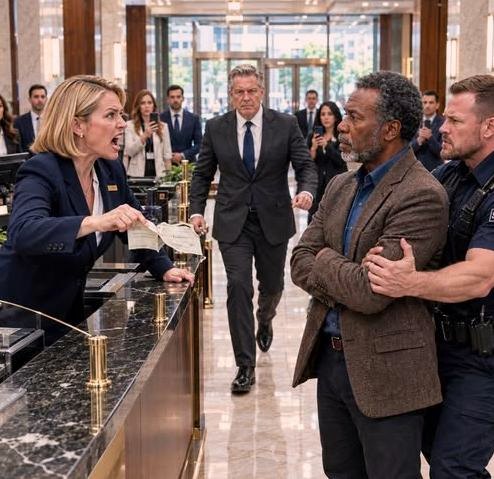
For a moment, nobody moved.
The telephone remained on speaker between us, humming faintly on the marble counter.
Alberto looked at the folder as if it had become too heavy to hold.
—Marta, this is not the place—
—It is exactly the place —she answered. —The branch is full of witnesses.
Beatriz stared at him.
—You said headquarters never received those complaints.
Alberto’s mouth tightened.
—Beatriz, stop talking.
That was the answer.
Not a confession, not in the theatrical sense. But everyone heard what his fear had tried to hide.
Lucía reached for the page on the counter.
—The deletion request has your authorization code.
—You do not understand internal systems.
—I understand my signature. I wrote the report before it disappeared.
One of the officers asked Alberto to hand over the folder. He hesitated, then placed it on the counter. The leather made a soft, final sound against the marble.
Inside were the four complaints, the ethics clause, the bank’s morning confirmation of my check, and a printed message from the external auditors. The missing reports had not vanished. Alberto had kept copies in his private office because he knew someone might eventually ask what happened to them.
Marta spoke again through the phone.
—Samuel, the board also found a payment from the regional office to a consulting company owned by Alberto’s brother. It was described as a client-retention fee.
Alberto’s face changed.
—That has nothing to do with this.
—The company received the payment three days after the foundation’s preliminary proposal was submitted.
I looked at him.
—What was your brother supposed to retain?
He said nothing.
Beatriz stepped backward until her hip struck the counter.
—You told me the fund was already secured.
Alberto turned on her.
—You were supposed to follow procedure.
—You told me Mr. Mena was coming to sign. You said the branch had to look controlled.
The words left her before she could stop them.
Alberto’s hand rose, but it did not reach her.
Lucía whispered, “You knew he was coming.”
I felt the weight of the room settle around us.
That was the part I had not expected. Beatriz had acted from prejudice, arrogance, and the certainty that nobody important would challenge her. Alberto had done something more deliberate. He had tried to protect a contract he believed belonged to him, and when the branch behaved exactly as he feared it might, he hid the evidence instead of changing the culture that produced it.
—You knew about the complaints before today —I said.
Alberto finally looked at me.
—Yes.
The word was quiet.
—Why hide them?
His eyes moved toward the gold emblem on the folder.
—Because if headquarters opened an investigation, I would lose the regional position. If I lost that, the foundation would take the fund elsewhere. I thought I could repair the branch after the agreement was signed.
—You thought four hundred and twenty million euros would make the damage disappear.
—People listen when money is involved.
—They should have listened when people were hurt.
Beatriz began to cry, but I did not look away from Alberto.
—And my check?
—The system flag was harmless. I told Beatriz the payment might arrive today. I did not tell her your name because I wanted the branch to handle a high-value client without special treatment.
I almost laughed, but there was nothing amusing in it.
—You wanted an honest test, so you hid the identity of the person being tested.
—Yes.
—And you kept the reports hidden when the result was obvious.
He lowered his head.
—Yes.
The officers took statements from everyone. No dramatic handcuffs followed. The consequences were already moving faster than any arrest could have made them move.
Marta sent the board’s decision to my telephone: the foundation would transfer the money to the competing institution, but only after one condition was met. The new bank had to create an oversight committee with seats reserved for scholarship recipients and branch employees.
I read the message twice.
Lucía watched me.
—Are you still going to sign with another bank?
—Yes.
—Then why stay here?
I looked at the torn pieces of the check. The issuing company had already confirmed the payment electronically, so the money was safe. But the check itself had carried Clara’s name in its authorization line, and its destruction felt strangely personal.
—Because leaving without saying anything would make today only an insult. I want it to become a record.
The next morning, Banco Alcázar’s national ethics committee arrived at the branch. Beatriz was removed from management pending a formal disciplinary review. Óscar was not dismissed; his statement made clear that he had followed a security order while believing it was legitimate, though he apologized to me in front of the staff.
—I should have asked what threat I was responding to —he said.
—You should have. But you came back and told the truth.
Sergio submitted his own account. He admitted that he had laughed because he wanted Beatriz’s approval.
—I thought being useful meant agreeing with her.
—Sometimes it means refusing to make someone smaller —I told him.
Lucía remained at the bank, but not at that branch. Marta offered her a position with the foundation’s new oversight committee. Lucía accepted only after asking whether she could keep working directly with clients.
—That is where the problem is visible —she said.
I signed the transfer agreement three weeks later in a plain meeting room, not beneath chandeliers. The competing bank accepted every condition we demanded: public complaint records, independent reviews, and a rule that no employee could use a client’s appearance as a risk indicator.
The Clara Mena Education Fund opened its first scholarship applications that summer. We did not name the program after the bank, or after me. Clara’s name was enough.
Alberto resigned before the committee completed its review. His brother’s company returned the payment, but the money did not restore his position. What he had wanted was not simply the contract. He had wanted to be the man who delivered it, the executive whose name appeared beside a number large enough to excuse everything underneath.
He lost that name.
Months later, he asked to meet me in the small archive room where the bank had stored the complaints. I agreed because I wanted to see whether he intended to defend himself again.
He arrived without the gray suit. He carried a cardboard box filled with copies of the reports.
—I am giving these to the committee —he said.
—They already have them.
—Not the original notes. I found them in my office after I resigned.
—Why bring them to me?
—Because I hid them from the people who needed to read them.
I studied his face. He looked older, but not transformed. Transformation was too easy a word for what had happened.
—Are you asking me to forgive you?
—No. I am asking you not to let me make the truth disappear again.
That was the first useful thing he had said.
I took the box, but not his hand.
—Then give it to Marta. She decides what happens next.
He nodded.
At the end of the corridor, Lucía was waiting with a document folder. She had come to deliver the final oversight rules to the bank’s new interim director.
—They accepted the employee seats —she told me. —Two scholarship recipients will sit on the committee too.
—Good.
She glanced at the brass compass visible beneath my collar.
—Was that Clara’s?
—Yes. She gave it to me before our first trip together. She said I had a talent for getting lost in places where I already knew the way.
Lucía smiled faintly.
—Did she mean Madrid?
—She meant people.
We walked back into the branch. The marble floor had been polished again. The chandeliers still shone. The room looked almost unchanged, which was why the new notices on the walls mattered so much: how to file a complaint, who received it, and how long the bank had to answer.
Near the counter, the original torn check had been placed in a clear archival sleeve. I had asked for it back. Not as a trophy. As proof that a document could be destroyed in seconds while the truth inside it remained.
The first scholarship recipient was announced on a Tuesday morning. Her name was Inés Duarte, seventeen years old, from Vallecas, with a place at a technical institute and no money for tuition or tools.
She came to the foundation office carrying a canvas folder decorated with tiny orange stars.
—Mr. Mena —she said nervously. —They told me the fund was created because someone was treated unfairly in a bank.
—That is part of the story.
—What is the other part?
I handed her the scholarship letter.
—Someone decided that the insult would not be the last thing written down.
She opened the letter, read the amount, and looked up.
—Why me?
—Because you earned it. Not because someone felt sorry for you.
Her fingers tightened around the paper.
—My mother says I should become an engineer.
—What do you want?
Inés looked at the letter again.
—I want to design machines that do not fail people when they need them most.
For a second, I heard Clara’s laugh in memory, bright and impatient, the sound she made whenever I tried to turn a simple promise into a speech.
I placed the clear sleeve containing the torn check beside Inés’s folder.
She studied it.
—Is that the check they tore?
—Yes.
—Then why keep it?
I looked at the orange stars on her canvas folder and at the three-million-euro promise that had survived a pair of careless hands.
—Because some things are worth preserving precisely where someone tried to throw them away.
Inés lifted her scholarship letter, and the torn check caught the morning light beside it.
The number on the check was three million euros; the future in her hands was worth more.
Missed the beginning?






