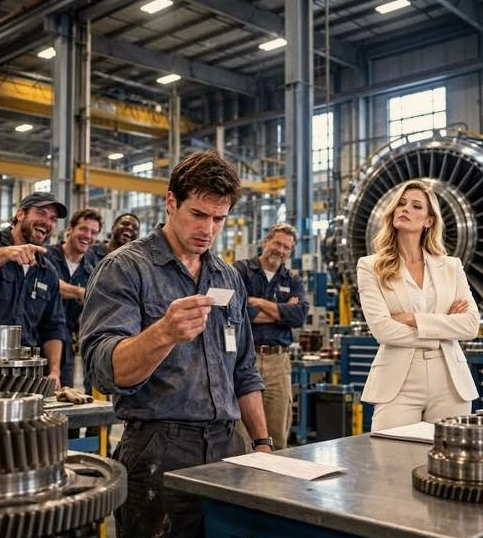
The four-cent bonus was still pressed against my heart when the company ordered me upstairs to rescue a contract worth seven hundred and twenty million dollars.
At 6:18 on that cold March evening, I stood beside my battered pickup in the Red Haven parking lot, staring at the emergency message glowing on my phone. The wind carried river soot across the asphalt and snapped the paper notice taped to the guardhouse window.
MANDATORY ON-SITE AVAILABILITY.
CRITICAL AUDIT.
EXECUTIVE SUITE IMMEDIATELY.
Jonah Pike came through the cafeteria doors behind me, still wearing his safety glasses. He held my merit voucher between two grease-stained fingers.
“Four cents,” he said. “They insulted you in front of three hundred people, and now they need you?”
I took the paper from him and folded it once more. The crease had become sharp enough to cut skin.
“Apparently,” I said.
Jonah glanced at the second-floor windows. Black sedans lined the curb below them, their polished hoods reflecting the factory lights.
“Don’t go up there alone.”
“Why?”
“Because people who hand a man four cents don’t call him upstairs to thank him.”
He was right. My stomach had already tightened around the feeling I had learned to trust after sixteen years of inspecting metal: something was under pressure, and everyone in the building was pretending not to hear it.
I entered through the employee corridor at 6:26. The hallway smelled of hot dust, machine oil, and the burnt coffee that came from the vending machine near shipping. A red emergency beacon flashed above the elevator, turning the framed photographs of Red Haven turbines into a sequence of warning lights.
At the security desk, a young guard blocked me with one palm.
“Mr. Keaton, Ms. Winthrop instructed us to send you straight to the executive suite.”
“Did she say why?”
“She said your signature was required.”
“My signature is required on quality releases every day.”
The guard swallowed. “Not this one.”
The elevator doors opened with a metallic shudder. Inside, the brass handrail was cold beneath my fingers. As the car rose, I could feel the four-cent slip in my pocket, light as a shaving and somehow heavier than the whole factory.
The executive floor was normally silent after six. That night, voices leaked from the boardroom before the doors had fully opened.
“Where is he?” a woman demanded.
“He is on the elevator,” another voice answered.
Celeste.
The doors parted. Her assistant, Mara Bell, stood waiting in a cream blouse with a tablet clutched against her ribs. Her eyes flicked to my work shirt, then to the red stitching over my pocket.
“Mr. Keaton, please come in.”
“What is the emergency?”
Mara lowered her voice. “The buyer’s delegation arrived early.”
“Then they can wait.”
Her fingers tightened around the tablet. “They have already waited three hours.”
Inside the boardroom, Celeste stood at the far end beneath a wall-sized display showing the proposed contract: Red Haven Turbine Works, Northstar Energy Consortium, seven hundred and twenty million dollars.
Around the table sat men and women in expensive clothing, including Northstar’s chief engineer, a silver-haired man named Adrian Vale. On the table lay a thick blue binder with a brass corner guard. A yellow inspection tag protruded from its pages.
Celeste turned toward me.
“Mr. Keaton,” she said, with the same tiny smile she had worn in the cafeteria. “You have caused quite a delay.”
“You sent for me.”
“I sent for your authorization.”
“For what?”
Adrian Vale leaned forward. “The final quality certification for the Havelock turbine assemblies.”
The room became very still.
I looked at the binder. “Those assemblies are not ready for release.”
Celeste’s smile hardened. “You will review the documentation and sign the certificate tonight.”
“I don’t sign documentation. I sign what I can verify.”
A man beside her, Red Haven’s chief financial officer, tapped his pen against the table. The sound struck the polished wood like a tiny hammer.
“Mr. Keaton,” he said, “this contract closes in seventy-two hours.”
“Then you should have called me before the parts left the bay.”
Celeste stepped closer. Her perfume smelled of cedar and something bitter beneath it.
“You are still angry about the bonus.”
“No.”
“Your face suggests otherwise.”
I reached into my pocket and placed the four-cent voucher on the table. It landed beside the blue binder.
“This isn’t about four cents,” I said. “It’s about whether you think a signature costs less than the person attached to it.”
Adrian Vale looked from the paper to Celeste. For the first time, her expression shifted.
Then the boardroom door opened, and a nervous young engineer hurried in carrying a sealed black inspection case. He set it beside the binder and whispered, “The missing gauge records are inside.”
Celeste extended her hand toward the case…
PART 2
Celeste extended her hand toward the case, but I reached it first.
The black latches were scratched from years of use, and one carried a strip of yellow paint from the metrology laboratory. I knew that case. It held the master instruments used to verify turbine housing tolerances before any release certificate could be signed.
“Who opened this?” I asked.
The young engineer looked at Celeste.
She answered for him. “The records were transferred for executive review.”
“By whom?”
“Does it matter?”
“It matters if the instruments were moved without a chain-of-custody entry.”
The chief financial officer gave a humorless laugh. “We are discussing a missing form while a seven-hundred-and-twenty-million-dollar transaction is at risk.”
“No,” I said. “You are discussing a missing form because the transaction is at risk.”
At 6:41, in the executive boardroom, I opened the case. The first gauge rested in black foam beneath a thin layer of dust. I lifted it by the handles and checked its calibration seal.
The seal had been broken.
A hot pulse moved through my neck.
“Who used this?”
The engineer answered quietly. “I don’t know.”
Celeste turned on him. “You were responsible for the transfer.”
“I was told to move the instruments from the lab.”
“By whom?” I asked.
His mouth opened, then closed.
Adrian Vale rose from his chair. His silver cuff links caught the overhead light.
“Mr. Keaton, Northstar’s engineers found dimensional inconsistencies in the sample housings. We were told your department had corrected them.”
“We haven’t.”
“Then why did Red Haven submit a release packet?”
I looked at Celeste. “That is what I am trying to find out.”
She folded her arms. “You have spent years treating every production decision as a personal kingdom. The company has advanced, and you have refused to advance with it.”
“My job is to stop defective parts.”
“Your job is to support the company.”
“My job keeps the company from killing people.”
The room seemed to shrink around us. Through the glass wall, I could see the factory floor far below, the yellow lines on the concrete glowing under white lamps. Men were still working beside the enormous turbine housings, unaware that executives were debating whether to attach my name to parts I had never approved.
At 7:03, Celeste ordered Mara to bring the original inspection ledger. Mara returned with a red folder and placed it before me. The pages contained my department’s daily readings, each line stamped with a serial number.
I turned three pages.
Then I stopped.
The handwriting looked like mine from a distance. The initials were mine. Even the small vertical slash I made after every verified measurement appeared beside the figures.
But the numbers were wrong.
“They forged the readings,” I said.
The CFO pushed back his chair. “Careful.”
“I wrote these entries for two housings. The readings here belong to neither.”
Celeste’s face remained composed. “You are making an accusation without evidence.”
I pointed to the lower margin. “My notebook never uses blue ink. I use black. Always. And I never write the final zero with a closed loop.”
Mara glanced at the pages, then at Celeste.
Adrian Vale picked up the folder. “If these records are false, Northstar will suspend the closing.”
Celeste’s voice sharpened. “No one is suspending anything.”
“Your buyer has the right to know,” I said.
Her hand struck the table. The sound made the young engineer flinch.
“You have no idea what is at stake.”
“I know exactly what is at stake. Workers, customers, and every person who will stand near those turbines when they turn.”
At 7:28, I was escorted to the metrology laboratory with Mara and two executives following close behind. The room smelled of solvent and warm steel. My workbench stood beneath a row of fluorescent tubes, and my black leather notebook lay inside the second drawer where I had left it that morning.
The drawer was open.
My notebook was gone.
I pulled it out completely and found a single object beneath the felt liner: a narrow brass shim, stamped with a number I recognized from a housing that had failed inspection three days earlier.
Mara whispered, “What is that?”
“A warning.”
“From whom?”
Before I could answer, the laboratory printer came alive behind us. It spat out one page, then another. The top page carried an electronic approval bearing my employee identification number and a timestamp from the previous night.
The second page contained a resignation letter with my name at the bottom.
Celeste took both pages from the tray and read them. Her eyes moved rapidly.
Then she looked at me and said, “You should have signed the certificate when you were asked.”
A sound came from the corridor beyond the lab. Someone was crying.
I turned toward it, and Mara suddenly went pale.
“It’s Nora,” she said. “The night calibration technician.”
The crying stopped.
A door slammed somewhere in the darkened plant, and footsteps began moving away…
PART 3
A door slammed somewhere in the darkened plant, and footsteps began moving away.
I ran first.
At 7:36, the corridor outside the calibration room was empty except for a dropped key card spinning on the concrete. Its plastic edge clicked against the floor until I caught it with my boot.
“Nora!” I shouted.
No answer.
Mara came around the corner, breathing hard. “She was here.”
Celeste followed at a slower pace, her heels striking the floor with controlled impatience. “This theatrics must stop.”
I held up the key card. “Why is Nora’s access card on the floor?”
“She may have dropped it.”
“She would never leave it unsecured.”
“Are you accusing her too?”
The calibration room door was locked. I pressed my ear to the metal and heard a faint scraping inside.
“Nora,” I said. “It’s Miles. Answer me.”
A weak voice replied, “Don’t let her take the ledger.”
Mara covered her mouth.
Celeste’s expression changed for the first time that night. “Open the door.”
I used the emergency release, and the lock snapped back. Nora Bell crouched beside the instrument cabinet, one hand pressed against a cut on her forehead. Her pale green work jacket was torn at the shoulder. Behind her, a drawer hung open and several calibration certificates lay scattered across the floor.
I knelt beside her.
“Who did this?”
She looked past me at Celeste.
“Mr. Rusk,” she whispered.
The CFO stiffened. “That is absurd.”
Nora pointed to his shoes. “He was wearing those. Brown leather. I saw them under the cabinet when he took the ledger.”
Rusk looked down at his polished shoes, then back at her.
“You are confused.”
“No,” Nora said. “I was scared. I wasn’t confused.”
Adrian Vale stepped into the room. “What ledger?”
Nora crawled to the lowest cabinet and pulled out a thin metal book wrapped in a shop towel. The cover was dented. A dark smear marked one corner.
She handed it to me.
“This is the real night log,” she said. “The readings were changed after midnight. I copied the original numbers before they came for it.”
I opened the ledger. Every page was written in Nora’s precise hand. Serial numbers, temperatures, pressure tests, and rejected tolerances filled the lines. The Havelock housings had not passed. Not one of them.
At the bottom of the final page was a note dated three nights earlier.
DO NOT RELEASE. INTERNAL WALL THICKNESS BELOW SPECIFICATION.
Underneath it was my name, copied badly.
Celeste reached for the ledger. I pulled it against my chest.
“You knew,” I said.
She stared at me. “I knew there was a production dispute.”
“You knew the parts were defective.”
“I knew the engineers were being conservative.”
Nora gave a broken laugh. “You ordered me to backdate the readings.”
“I ordered you to correct an administrative discrepancy.”
“You told me my son’s medical coverage would disappear if I refused.”
The room went silent.
Rusk moved toward Nora. “Be careful, young woman.”
Adrian Vale stepped between them. “Do not come closer.”
I turned the ledger to the last page. A signature appeared beneath Nora’s note—not mine, but Celeste’s. Her full name, written in the same sharp hand she used on investment contracts.
Celeste’s face drained of color.
“You signed the release instruction,” I said.
“That does not prove criminal intent.”
“It proves you ordered production to continue.”
“And you still haven’t signed the final certificate,” she snapped. “That is why this contract is trapped. Northstar requires your independent authorization because your name is attached to the original quality protocol.”
Adrian looked at me. “She is right about one thing. Without your signature, the closing cannot proceed.”
Celeste came close enough for me to see the tiny crack in the powder beneath her left eye.
“Sign,” she said. “You will receive a proper severance package. A generous one.”
I held up the four-cent voucher.
“You thought this would make me small.”
“I thought it would remind you who controls your future.”
“No,” I said. “It reminded me who was afraid of my name.”
At 7:52, Adrian took the ledger and called Northstar’s legal department. Rusk tried to seize it, but Mara stepped in front of him, her tablet trembling in both hands.
“Don’t touch him,” she said.
Celeste stared at her. “You work for me.”
“I did,” Mara replied.
Then the elevator bell rang in the corridor.
A messenger entered carrying a narrow copper document tube sealed with red wax. He handed it to Adrian and said, “This was delivered from the state manufacturing registry. It has been waiting for the authorized quality officer.”
Adrian broke the seal, unfolded the document, and read the first line.
His eyes lifted slowly toward Celeste.
“Who else has access to the Havelock contract?” he asked.
Celeste looked at Rusk.
Rusk looked at the copper tube.
And from somewhere below us came the deep, violent roar of a turbine beginning an unauthorized test run…
The document in Adrian’s hands changed everything…
I thought the forged records were the whole secret. I was wrong. The final part reveals what the contract was really being used to hide.
“Release only when verified.”
Nora pressed the seal into the red wax.
👇 The final part is already open.






