PART 4
And from somewhere below us came the deep, violent roar of a turbine beginning an unauthorized test run.
The sound shook dust from the ceiling tiles.
Nora grabbed my sleeve. “They’re spinning Havelock Three.”
“That housing failed pressure testing,” I said.
Adrian folded the registry document in his hand. “Who authorized the test?”
No one answered.
The turbine roared again, deeper this time, and every person in the calibration room felt the vibration travel through the soles of their shoes.
I ran toward the stairs.
“Miles!” Celeste shouted.
I kept going.
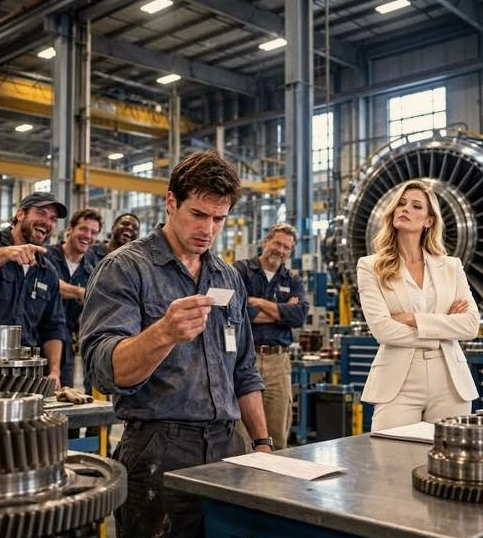
At 7:55, the production bay was a cathedral of steel and noise. Red Haven’s largest test rig stood behind a reinforced barrier, its warning lamps pulsing amber. Havelock Three spun inside the chamber, climbing toward operating speed.
Two technicians stood at the control console, frozen.
“Shut it down!” I yelled.
The younger technician looked over his shoulder. “The override is locked.”
“Who locked it?”
“Chief Rusk.”
I shoved past him and reached for the emergency lever. Its red handle was secured with a fresh wire seal.
The wire had been twisted three times.
That was not a factory seal. It was the kind used by someone who wanted the lever to look untouched while making sure no one could use it quickly.
I pulled my six-inch steel scale from my shirt pocket and slid it beneath the latch. The metal flexed. My palms burned, but the catch lifted.
“Clear the bay!” I shouted.
The technicians ran.
The chamber screamed.
I dragged the lever down. The rig fought me with every pound of hydraulic pressure. For one terrible second, nothing happened.
Then the turbine speed dropped.
A hairline fracture flashed across the inspection glass.
The chamber released a thunderous burst of pressure, and the entire bay filled with white vapor. I hit the floor beneath the console, covering my head as fragments of a gauge housing struck the far wall.
When the vapor cleared, Havelock Three had stopped.
The inspection glass was cracked from edge to edge.
Adrian reached the bay with Celeste, Rusk, Mara, and Nora behind him. His face had gone rigid.
“You were going to ship that?” he asked.
Celeste looked at the damaged chamber. “It was a controlled test.”
“It was an unauthorized test,” I said. “With a failed housing.”
Rusk pointed at me. “He sabotaged the test.”
The young technician turned from the console. “No. The override had already been locked before he arrived.”
Mara lifted her tablet. Her hands were steadier now.
“I checked the access log,” she said. “Mr. Rusk entered the control system at 7:31. Ms. Winthrop entered at 7:33.”
Celeste’s eyes cut toward her. “You accessed confidential company records.”
“I accessed the records you told me to organize.”
Adrian opened the copper registry document again. “This is a notice from the state manufacturing board. It says Red Haven’s quality protocol was amended yesterday without the approval of the registered quality officer.”
Everyone looked at me.
I read the second paragraph. My name appeared there, along with my employee identification number and a digital authorization I had never given.
The amendment removed the independent metrology review from all emergency production runs.
“That is why they needed my resignation letter,” I said. “They planned to make it look as if I had left voluntarily, then use the false authorization to replace the protocol.”
Adrian faced Celeste. “Did you authorize this amendment?”
She looked at Rusk.
Rusk looked toward the executive offices.
That hesitation told me there was someone else.
At 8:04, a man in a navy overcoat entered the bay with two Northstar representatives. I recognized him from the photographs in Red Haven’s annual reports: Lionel Winthrop, Celeste’s older brother and chairman of Winthrop Capital.
Celeste stepped toward him. “Lionel, you need to leave.”
He ignored her and looked at the cracked chamber.
“Did the housing fail?” he asked.
“No,” Rusk said quickly. “The technician mishandled the shutdown.”
I picked up the broken gauge from the floor. The brass rim was bent, but the stamped serial number remained visible.
“This gauge was removed from the calibration case tonight,” I said. “Its seal was broken before the test. Someone wanted the readings to appear valid.”
Lionel’s face tightened. “Celeste.”
She turned on him. “You told me the private placement required delivery by Friday.”
The words escaped before she could pull them back.
Adrian looked sharply at her. “Private placement?”
Lionel closed his eyes for a moment.
Celeste understood what she had done. “That is not relevant.”
“It is everything,” Adrian said. “You were using Northstar’s contract to secure financing for Winthrop Capital.”
Lionel finally spoke. “The fund has obligations.”
“How much?” Mara asked.
He stared at her.
“How much did you borrow against a contract that depended on fraudulent quality approval?”
No one moved.
Then Lionel answered, “Four hundred million.”
The number seemed to drain the heat from the bay.
Celeste had not humiliated me for four cents because she wanted to save money. She had done it because she needed a public record showing that my work was worthless, that my objections were personal bitterness, and that the company could replace my judgment with a cheaper signature.
She needed my name erased before she used it.
At 8:16, Adrian called Northstar’s board from the production bay. He placed the call on speaker.
A woman answered. “Mr. Vale?”
“We are suspending the closing,” Adrian said. “The certification records were falsified, the registered quality protocol was altered without authorization, and an unsafe turbine was tested tonight.”
Celeste stepped toward him. “You cannot suspend a signed commercial agreement.”
Adrian looked at her. “It is not signed.”
Her mouth opened.
“The final signature is missing,” he continued. “And now I understand why.”
Lionel’s phone began ringing. Then Rusk’s. Then Celeste’s.
The executive floor filled with calls from lenders, insurers, and Northstar’s engineers. Nobody shouted. The worst moments in powerful companies often arrived in calm voices, with people asking for documents that could no longer be produced.
Nora sat on an overturned tool chest while Mara cleaned the cut on her forehead with a sterile pad.
“You should have told someone sooner,” I said.
Nora looked at the floor. “My son’s treatment is paid through Red Haven. Rusk said they would cancel it.”
“I know.”
“I thought if I kept the real ledger, maybe it would matter someday.”
“It mattered tonight.”
She held my gaze. “Will they fire me?”
Adrian answered before I could. “Northstar will fund an independent safety review, and your position will be protected as a witness.”
Nora let out a breath that trembled all the way through her shoulders.
At 8:42, Celeste found me beside the silent test rig. The four-cent voucher was still in my pocket, softened along the fold.
“You could have signed,” she said.
“Yes.”
“You would have been rich.”
“No. I would have been useful to you for one night and disposable the next morning.”
Her eyes moved to the cracked inspection glass.
“I was trying to keep the company alive.”
“You were trying to keep your family’s fund alive.”
“Our employees would have lost everything.”
“Some of them nearly lost their lives.”
She looked at me for a long moment. There was no polished smile now, no careful angle to her chin. But I did not mistake exhaustion for regret.
“What do you want?” she asked.
The honest answer came slowly.
“I want the quality department separated from executive finance. I want every altered record restored, every technician who was threatened protected, and every worker told exactly what happened.”
“That will destroy Red Haven.”
“No. The truth about Red Haven will decide what survives.”
At 9:10, Lionel resigned from the board before the board could remove him. Rusk was escorted from the plant by the company’s own security director after Mara produced the access logs and Nora identified his shoes, his voice, and the damaged ledger clasp he had left inside the calibration room.
No dramatic courtroom followed.
There were too many creditors, regulators, insurers, and engineers for one room to contain. The consequences arrived as canceled transfers, frozen accounts, revoked approvals, and names removed from authority lists.
Celeste stayed until midnight, signing the emergency transfer that placed Red Haven’s safety operations under an independent trust. She lost control of Winthrop Capital before she left the building, though nobody announced it aloud. Her phone simply stopped ringing.
The next morning, she came to the cafeteria alone.
The banner still hung above the doors.
EFFICIENCY IS RESPECT.
She stood beneath it with a stack of corrected bonus statements in her hands. Every worker received the money that had been withheld, and every employee file was amended to remove the false performance scores.
When she reached me, she held out a new statement.
“Your merit payment has been corrected,” she said.
I looked at the figure.
It was fair. Not extravagant. Sixteen years of work could not be repaired with a number, but at least the number no longer lied.
“What about the four cents?” I asked.
Her fingers tightened around the paper. “Keep it.”
“I planned to.”
“Why?”
I took the voucher from my pocket and set it beside the corrected statement.
“Because it is the clearest record of what you believed my work was worth.”
She looked down at it.
Then Nora entered the cafeteria carrying the dented metal ledger. Behind her came Jonah, Bobby, and the night crew. Nobody applauded. They simply stood there, shoulder to shoulder, waiting to see whether the truth would be treated like another document to be filed away.
I picked up the ledger and walked to the front of the room.
The microphone was still on the wooden riser where Celeste had announced that recognition was arithmetic.
I opened the real night log to the page marked DO NOT RELEASE.
“These readings saved lives,” I said. “Not because one person was brilliant, but because someone wrote down what the metal was telling her, and someone else refused to erase it.”
Nora’s eyes filled.
Jonah tapped his missing finger against the table.
I turned to Celeste. “You asked what I wanted. I want Nora Bell appointed head of the independent calibration unit.”
Nora stared at me. “Miles—”
“You kept the ledger.”
“I was afraid.”
“So was everyone who did the right thing that night.”
Celeste looked at the workers, at the damaged voucher, and finally at the cracked red mark on my palm from forcing down the emergency lever.
“Approved,” she said.
It was the last authority she exercised at Red Haven.
By noon, the banner had come down. Not ceremoniously. Jonah tore it loose with a wrench, and the vinyl struck the floor with a flat, embarrassed slap.
The corrected records went to Northstar. The unsafe housings were quarantined. The contract was canceled, but Northstar later offered Red Haven a smaller rebuilding agreement under conditions Celeste could never control: independent inspections, open ledgers, and no executive signature overriding a failed measurement.
I signed that agreement myself.
Not because Celeste asked.
Because every tolerance line was true.
That evening, I returned to the metrology lab and placed the four-cent voucher inside the black calibration case. Beneath it, I set the brass gauge with the broken seal and Nora’s original ledger.
Three objects.
An insult.
A warning.
And the proof that someone had refused to let a lie pass inspection.
Nora stood beside me, holding the new department seal.
“What should we stamp on the case?” she asked.
I looked at the old yellow paint, the scratched latches, and the narrow space where the company’s crest had once been.
“Write the truth,” I said.
She pressed the seal into the red wax.
When she lifted it, the mark read: RELEASE ONLY WHEN VERIFIED.
Outside, the factory whistle sounded for the night shift, and the turbines waited in their bays, silent until every measurement earned the right to become motion.
Missed the beginning?






