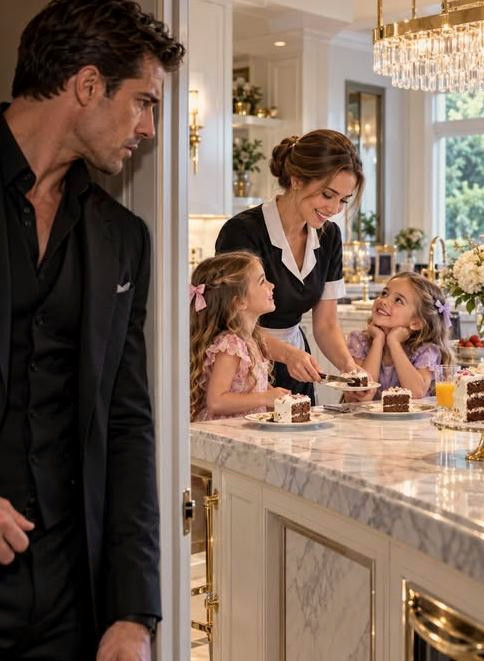
The first thing I heard after secretly returning home was my five-year-old daughter laughing as if grief had never entered our house.
I had left River Oaks at 7:10 that morning in a black SUV, carrying a leather briefcase and wearing the expression everyone associated with business trips. My driver believed I was headed for the airport. Patricia Hale believed it too.
Three blocks later, I told him to pull over.
“Keep driving after I get out,” I said.
He stared at me in the mirror. “Should I call security?”
“No. And don’t tell anyone I came back.”
The side gate opened with a soft mechanical click at 7:29. I slipped through it with one hand near the pistol beneath my jacket, though I knew the weapon would be useless against the kind of danger Patricia had described.
For three weeks, she had filled my head with quiet warnings about Clara Bennett, the housekeeper who had worked for us since my wife died.
“Clara is becoming too important,” Patricia had said over dinner.
“She knows the girls’ routines better than you do.”
“She corrects the tutors. She answers questions meant for you.”
The sentence that stayed with me was the last one.
“They listen to her more than they listen to their father.”
It hurt because it was true.
At 7:34, I crossed the stone terrace and heard voices from the kitchen. Not whispers. Laughter.
I stopped beside a column, where the smell of cinnamon and warm sugar drifted through the open windows. Clara stood at the island, cutting the last piece of birthday cake into careful squares. She wore a pale green cardigan with one sleeve rolled higher than the other, and a tiny silver spoon was tucked behind her ear.
“That corner belongs to Avery,” she said. “It has the most frosting.”
Avery clapped. “You remembered!”
“I treat frosting emergencies with professional seriousness.”
Sophie reached for her juice. Her hand trembled. The glass tapped against the marble.
Clara moved it closer without making a fuss.
My stomach tightened.
I had never noticed that tremor.
Sophie lowered her voice. “Since Daddy is gone, will you stay until I fall asleep?”
Clara crouched beside her.
“I’ll stay. Blue lamp on, door cracked open, Bunny on your left.”
Sophie breathed out and leaned against her shoulder.
I stood behind the column, suddenly aware of every expensive thing I had mistaken for care: the armored cars, the private tutors, the cameras, the locked gates. After their mother, Marianne, died in a traffic accident, I had built a fortress around the twins because I did not know how to build comfort.
Clara knew.
She knew Avery sorted food by color when she felt overwhelmed. She knew Sophie’s stomach hurt when she was frightened. She knew neither girl could sleep during thunderstorms unless someone counted the seconds between lightning and thunder.
Then Patricia’s voice returned to me.
“Once Clara is gone, the girls will learn who they should depend on.”
I had heard concern in those words.
Now I heard ownership.
At 7:41, Clara carried the plates toward the pantry. I stepped back, but the heel of my shoe struck a brass umbrella stand. It wobbled and clanged against the wall.
Clara froze.
Avery looked toward the hall. “Who’s there?”
Before I could move, Patricia appeared from the breakfast room. She wore a cream suit, pearl earrings, and the calm smile she used whenever she had already decided how a conversation would end.
“Mr. Whitaker,” she said softly. “You were supposed to be in Chicago.”
“I changed my plans.”
Her eyes flicked toward Clara, then back to me.
“Of course you did.”
I stepped into the kitchen. “We need to discuss your concerns about Clara.”
Patricia’s smile held for one second too long.
Clara took the twins by the hands and guided them toward the breakfast room.
“Stay where I can see you,” she told them.
Patricia reached beneath the sideboard and pulled out a narrow brown folder.
“You wanted proof,” she said. “I brought it.”
Her fingers closed around the clasp, and the metal snapped open…
PART 2
Her fingers closed around the clasp, and the metal snapped open.
Patricia placed the folder on the marble island as carefully as if it contained glass. The kitchen clock clicked toward 7:43. Behind me, Avery hummed while Clara helped Sophie arrange three cake pieces in a perfect row.
“What is this?” I asked.
“Records of Clara’s interference.”
“Interference with what?”
“With your family.”
She slid the first page toward me. It was a typed list of dates, times, and accusations. Clara had supposedly canceled a tutor’s lesson, refused a therapist’s instruction, and told the twins that their father was too busy to come home.
I looked at Clara. “Did you say that?”
She did not defend herself immediately. She wiped frosting from Sophie’s chin with a paper napkin and answered quietly.
“No.”
Patricia gave a small, sorrowful sigh. “That is exactly how she operates. She makes herself appear harmless.”
I picked up the page. The paper smelled faintly of lavender, the same detergent Patricia used in the upstairs office.
“Who wrote these reports?”
“I did.”
“Then they are your observations.”
“They are documented facts.”
Avery appeared beside Clara, clutching a wooden spoon. “Is Clara leaving?”
Patricia turned toward her. “Only if she has done something wrong.”
Clara’s face changed. Not fear for herself. Fear for the child.
“Patricia,” I said, “do not speak to her that way.”
Patricia’s eyes sharpened. “You asked me to protect this household.”
“I asked you to manage it.”
“You asked me to keep the girls safe after Marianne died.”
“And you decided that meant removing anyone they loved?”
The accusation struck harder than I expected. Patricia’s hand tightened around the folder.
At 7:49, my driver called from the driveway. I ignored the first call. The second came immediately.
“What?” I answered.
“Sir, Patricia’s assistant is at the west gate. She says she has authorization to collect the girls.”
I looked at Patricia. “Why is someone here to collect my daughters?”
She raised her chin. “Because I arranged for them to spend the morning with their aunt.”
“They have school.”
“School was canceled.”
I turned to Clara. “Was it?”
“No.”
Sophie began rubbing her stomach. Clara noticed at once and reached for her hand.
“Breathe with me,” Clara murmured. “In for four. Out for four.”
Patricia watched them, and something impatient flashed across her face before she hid it.
I opened the folder again. Beneath the reports lay a photocopy of a document bearing my name. The heading read Temporary Care Authorization. It granted Patricia broad control over the twins’ medical decisions, school arrangements, travel, and financial accounts if I became unavailable.
My signature appeared at the bottom.
It looked like mine.
But I had never seen the document.
“Where did you get this?” I asked.
“You signed it last winter.”
“No.”
“You were grieving, drinking, and barely sleeping. You asked me to handle everything.”
“I would remember giving you control of my children.”
“You remember what is convenient.”
The kitchen seemed to tilt. I could hear the refrigerator humming and Sophie’s small, uneven breaths.
Clara reached into the cabinet beneath the sink and removed a red enamel lunchbox with a crooked silver latch. I had seen it before and never asked about it.
“Ethan,” she said, “there is something you need to see.”
Patricia moved quickly, stepping between us.
“You have no right to go through that.”
Clara held the lunchbox against her chest. “I have every right to protect them.”
“Protect them from what?” I demanded.
Nobody answered.
Then the west gate alarm began to ring.
Avery grabbed my sleeve. “Daddy, don’t let Patricia take us.”
Patricia’s face went white.
I turned toward her. “What have you been telling my daughters?”
She backed toward the pantry, one hand pressing against the folder.
“You are making a terrible mistake.”
“Open the lunchbox,” Clara said.
Patricia looked at the girls, then at me, and whispered, “If you open that, you will destroy the only person who can keep this family together…”
PART 3
“If you open that, you will destroy the only person who can keep this family together…”
Patricia’s warning hung above the kitchen like smoke.
I held out my hand. “Clara.”
She placed the lunchbox on the island. The crooked silver latch scraped against the marble as she opened it.
Inside were folded papers, a child’s drawing of three figures holding hands, two pharmacy receipts, and a small spiral notebook with a yellow cover. The pages were filled with dates, symptoms, meals, and the twins’ exact words.
I looked at Clara. “What is this?”
“Everything I wrote down when the girls started changing.”
Patricia laughed once. It sounded forced. “A housekeeper’s diary is not evidence.”
“No,” Clara said. “But Dr. Ortiz’s notes are.”
She handed me the pharmacy receipts. Both were for a liquid sleep aid prescribed to Patricia Hale. The dates matched the nights Sophie had complained of dizziness and nausea.
My chest tightened.
“Why would you have these?”
“Because Patricia asked me to pick them up from the pharmacy.”
Patricia stepped forward. “That medication was mine.”
“Then why did the bottles disappear from your bathroom?” Clara asked.
The alarm at the west gate stopped. A moment later, heavy footsteps crossed the terrace.
My head of security, Marcus Reed, entered with Patricia’s assistant behind him. The assistant carried a pink overnight bag decorated with glittering stars.
“Who told you to collect the girls?” I asked.
Patricia answered before the assistant could.
“I did.”
“Why?”
“Because you were leaving them with a dangerous woman.”
Clara opened the notebook to a marked page. “Read the entry from February twelfth.”
I did.
Sophie had woken at 2:10 in the morning, shaking and saying that Patricia told her Clara would be sent away if the twins did not behave. Avery had hidden beneath her bed. The next afternoon, Sophie had been given a sweet-tasting medicine by Patricia because she was “too upset to eat.”
I looked at Patricia.
“Did you give Sophie medication?”
“She had a stomachache.”
“Who prescribed it?”
“Her doctor.”
Clara pulled a folded statement from the bottom of the lunchbox. “Dr. Ortiz says she never prescribed it.”
Patricia’s mouth tightened.
Marcus stepped closer. “Sir, I also found this in the west office.”
He placed a document beside the notebook. It was the original care authorization, not a copy. My signature was printed beneath a paragraph I had never read. The witness line carried the name of Patricia’s former assistant, Nora Bell.
But Nora had left our employment eight months earlier.
I called the number on the document. A woman answered after three rings.
“Nora?”
There was a long pause.
“Mr. Whitaker, I have been waiting for you to ask.”
Patricia rushed toward the phone. “Do not listen to her.”
I put the call on speaker.
Nora’s voice trembled. “Patricia told me you wanted temporary control transferred to her. She brought me papers and said you had signed them. When I questioned the signature, she threatened to tell everyone I had stolen money from the household account.”
Patricia’s face drained of color.
“You forged my signature?” I asked.
“I corrected a legal emergency,” she snapped. “You were incapable of parenting.”
“You frightened my daughters and drugged one of them.”
“I kept them calm.”
Clara stepped between Patricia and the twins. “You kept them dependent on you.”
Patricia pointed at her. “You think you are their mother?”
“No,” Clara replied. “I know I am not. That is why I never tried to replace one.”
The words struck me harder than any accusation.
Nora continued through the speaker. “There is more. Patricia moved money from the girls’ trust into a company called Hale Family Services. I found the transfers when I balanced the accounts.”
I stared at Patricia.
“How much?”
“Enough to keep the household running,” she said.
“Answer me.”
“Three hundred and eighty thousand dollars.”
Avery began to cry. Sophie pressed both hands against her stomach.
I reached for them, but Patricia suddenly smiled.
“You think this ends because you found papers?” she said. “Ask your banker who authorized the emergency withdrawal this morning.”
My phone vibrated in my pocket.
The caller identification showed the private number of Whitaker Holdings’ chief financial officer.
I answered.
“Mr. Whitaker,” he said, breathless, “you need to come to the office immediately. Someone has transferred control of the girls’ trust, and the authorization carries your signature…”
The banker’s message changed what I believed about Patricia…
I thought the forged papers were the worst discovery in that kitchen. I was wrong. The final turn forced me to confront the part I had played in letting Patricia enter our lives.
“Not a family. A cage with my name on it.”
Clara’s hand tightened around Sophie’s.
👇 The final part of the story is now open.






