PART 4
“Someone has transferred control of the girls’ trust, and the authorization carries your signature…”
The kitchen went still.
I heard the banker breathing through the phone.
“Who received the transfer?” I asked.
“A company called Hale Family Services. The transaction was submitted at 7:12 this morning.”
I looked at Patricia.
She did not look frightened anymore.
She looked relieved.
That was worse.
“Freeze everything,” I said.
“We already tried. The authorization names you as the requesting party.”
“My signature was forged.”
“Then you need to come in with identification and the original documents.”
“I’ll be there.”
I ended the call and turned toward Marcus.
“Lock the gates. Nobody leaves with my daughters.”
Patricia’s expression hardened. “You cannot imprison me in this house.”
“You can walk out whenever you want.”
I pointed at the lunchbox.
“But the papers stay.”
She glanced toward the red enamel box as if it were more dangerous than the security guards surrounding her.
Clara moved the twins behind her.
Sophie’s lips had gone pale. “Daddy, is Patricia angry because of us?”
I knelt in front of her.
“No, sweetheart. This is not your fault.”
“Will Clara go away?”
I looked at Clara.
She was holding the yellow notebook against her chest, her fingers pressed over the bent corner.
“No,” I said. “Not because of this.”
Patricia gave a bitter laugh.
“You say that now. By noon, you will be begging me to fix this.”
“Why would I beg you?”
“Because you have no idea what I have done for you.”
The answer came too quickly. It was not a defense. It was a confession wrapped in pride.
Marcus escorted the assistant away from the children and asked her to wait in the security office. She kept repeating that Patricia had promised her a permanent position if she followed instructions.
Patricia remained beside the island, one palm flat against the marble.
I picked up the care authorization.
“Tell me why you forged this.”
She looked at the twins.
“Because you were destroying them.”
I felt the words enter the room like cold air.
“You abandoned them inside a mansion,” she continued. “You hired people to feed them, teach them, transport them, and tell you when they were sad. Then you came home for ten minutes, bought something expensive, and called it love.”
Clara flinched.
I did not.
Because Patricia was cruel, but not entirely wrong.
After Marianne died, I had turned grief into schedules. I had placed the twins in rooms with soft carpets and security cameras, then convinced myself that protection was the same as presence.
Patricia had seen the emptiness.
Then she had moved into it.
“You could have told me,” I said.
“I did. You never listened.”
“So you frightened my children?”
“I made them understand that people leave.”
Avery buried her face against Clara’s cardigan.
Patricia watched her.
“Clara was making them forget who kept this house standing.”
“No,” Clara said. “I was teaching them that people can stay without demanding payment.”
Patricia’s face twisted.
That was the wound beneath everything. Not money. Not the mansion. Not even the trust.
She wanted to be indispensable.
Marianne had hired Patricia years earlier as an estate coordinator after Patricia’s own business collapsed. She had managed the household while Marianne was pregnant, learned every password, every medical appointment, every private fear. After the accident, Ethan had handed her more authority because she knew how to make the machinery of grief keep moving.
He had never asked what she wanted in return.
Now he knew.
She wanted the children to need her more than they needed him.
And when that was not enough, she had reached for their money.
At 8:16, Dr. Lena Ortiz arrived through the east entrance with a leather medical bag and a look of controlled anger. She had been called by Clara, not by me.
Sophie clung to my hand while the doctor examined her in the library. The room smelled of polished wood and peppermint tea. Avery sat on the rug beside Clara, squeezing the bent silver latch of the lunchbox.
“Her pulse is elevated,” Dr. Ortiz said. “But I see no sign of lasting harm. I want bloodwork and observation today.”
Patricia crossed her arms. “This is absurd.”
Dr. Ortiz turned toward her.
“I prescribed no sedative for Sophie. If you gave her medication, you should be grateful her body rejected more of it.”
Patricia’s jaw moved.
“You cannot prove I did anything.”
Clara opened the notebook.
“I wrote down every dose you asked me to give her.”
“You were supposed to obey me.”
“I was supposed to care for the children. Those are not the same thing.”
The doctor took the notebook and read several entries. Her expression changed at the page dated March third.
“Why did you not call me that night?” she asked Clara.
“Patricia said Mr. Whitaker would fire me if I made trouble.”
I closed my eyes briefly.
Clara had been afraid of losing the only work that allowed her to support her younger brother. Patricia had known exactly where to press.
I turned to Patricia.
“You used everyone in this house.”
“I held everyone together.”
“No. You made yourself the only person who could untie the knots.”
At 8:39, my chief financial officer, Daniel Price, arrived from Whitaker Holdings carrying a banker’s case. He placed the original transfer papers on the library table.
“The trust withdrawal was not the only movement,” he said. “Patricia created a second account six weeks ago. Payments went to a private care facility in Arizona.”
Patricia’s head snapped up.
“That has nothing to do with the girls.”
“Then why does the account list their initials as beneficiaries?” Daniel asked.
The room changed.
I looked at Patricia. “What facility?”
She said nothing.
Daniel opened a file. “A boarding and behavioral program called Bright Harbor. The enrollment forms describe Avery and Sophie as emotionally unstable and in need of residential treatment.”
Avery stopped squeezing the lunchbox latch.
Sophie whispered, “Are we going away?”
Clara moved instantly, gathering both girls against her.
Patricia shook her head. “It was temporary.”
“You arranged to send them away?” I asked.
“They needed structure.”
“They needed their father.”
“You were never going to become that.”
The sentence landed with such certainty that it revealed the entire plan.
Patricia had not merely wanted Clara gone. She wanted the girls removed from every adult who could weaken her influence. She would have placed them in a facility, managed their trust from the outside, and presented herself as the only person capable of rescuing them.
Daniel slid one final page toward me.
“There is also a letter from Marianne’s attorney,” he said. “It was sealed after her death and scheduled to be released if you attempted to transfer guardianship.”
My hands went cold.
I opened it.
Marianne’s handwriting filled the first page.
Ethan, if you are reading this, someone has convinced you that money can replace your presence. It cannot. Clara has agreed to remain with the girls if you need help, but she must never be treated as staff when she is doing the work of family. Patricia is capable, loyal, and deeply wounded. Do not give her authority she has not earned merely because you are afraid to make decisions.
I read the final line twice.
If the girls begin calling someone their only safe person, ask who taught them to be afraid of everyone else.
The library seemed to lose its walls.
Patricia sank into a chair.
“You knew about this letter?” I asked.
“No.”
“Marianne warned me about you.”
“She was grateful to me.”
“She trusted you with the household. She did not trust you with the children.”
Patricia’s eyes filled, but the tears did not soften her.
“She would have understood,” she whispered. “She knew what happens when men like you disappear into work.”
“She might have understood your loneliness.”
I folded the letter.
“She would not have forgiven what you did to Sophie.”
Patricia stood abruptly and knocked the medical bag from the table. A glass vial struck the carpet and rolled beneath a chair.
Avery screamed.
Clara pulled the girls close while Marcus stepped between Patricia and the children.
Patricia stared at the vial.
For a second, she looked less like a powerful woman and more like someone who had finally reached the edge of the story she had been telling herself.
Then she turned to me.
“Send me away,” she said. “That is what you do with people once they stop being useful.”
I thought of Marianne’s letter. I thought of Sophie’s shaking hand. I thought of Clara remembering the blue lamp while I had remembered the security code.
“I am not sending you away,” I said. “You are leaving because you chose to turn care into control.”
Her mouth trembled.
“And the money?”
“Returned to the trust.”
“The accounts?”
“Closed.”
“The house?”
“You will never work here again.”
She looked at Clara.
“You think he will finally see you as family?”
Clara answered before I could.
“I do not need to be called family to protect children who trust me.”
That was the moment Patricia truly lost the thing she had been fighting for.
Not her job.
Not the money.
The claim that she alone could define what the girls needed.
At 9:22, Patricia packed one suitcase under Marcus’s supervision. The pink overnight bag meant for the twins remained in the hall, glittering stars scattered across its fabric.
The assistant was dismissed after giving Daniel the access codes and confirming the Arizona arrangements. Nora agreed to provide a written statement, not because she hated Patricia, but because she wanted the lie to stop following her.
The financial transfers were reversed by noon. The forged authorization was sent to the company’s legal department, and every account Patricia had touched was locked pending review. There was no dramatic courtroom, no crowd, no satisfying speech from a judge.
There was only Patricia standing beneath the portrait of Marianne, holding a suitcase she had packed for someone else.
Before she left, she asked to speak to me alone.
We met in the library. The brass floor lamp cast a warm circle over the carpet where Sophie had once built towers from wooden blocks.
Patricia kept her hands folded.
“Did you ever love me?” she asked.
The question was so unexpected that I could not answer immediately.
“I depended on you,” I said.
“That is not the same.”
“No.”
She looked toward the portrait.
“I thought if the girls needed me, you would have to stay.”
There it was.
The truth beneath the forged papers, the medicine, the threats, and the money.
She had not begun by wanting to steal my daughters. She had begun by wanting to stop being abandoned.
But she had built her answer out of fear, and fear had become a cage.
“I should have seen you were drowning,” I told her. “But you do not get to pull the girls underwater because I failed to notice.”
Her eyes lowered.
“Will they remember me?”
“Yes,” I said. “They will remember everything. What they do with it will belong to them.”
She nodded once, picked up her suitcase, and walked away without touching the portrait.
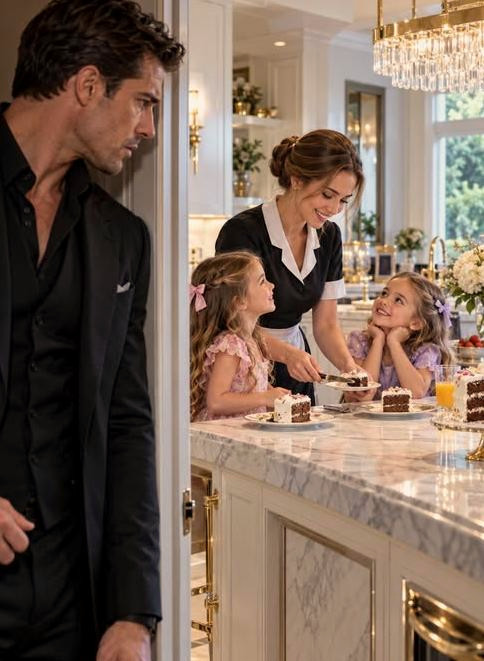
In the kitchen, Clara was helping Sophie choose between two cups. Avery sat on the counter, holding the red enamel lunchbox in her lap.
I entered slowly.
Avery looked at me. “Are you going to Chicago now?”
“No.”
“Are you going to work?”
“Later.”
Sophie studied my face. “Will you stay for the blue lamp?”
I swallowed.
“Yes.”
Clara glanced at me, cautious and tired.
I placed Marianne’s letter on the counter.
“She was right about you,” I said.
Clara’s expression tightened. “Please do not turn that into another job description.”
“I am not asking you to carry them alone.”
“What are you asking?”
I looked at the notebook, the pharmacy receipts, and the little drawing of three figures holding hands.
“I am asking you to help me learn how to be their father without making you disappear.”
Clara was silent for a moment.
Then she said, “That will take more than one apology.”
“I know.”
“More than one week.”
“I know.”
“More than money.”
“I know.”
Sophie tugged Clara’s sleeve. “Can Daddy cut the cake?”
Clara looked at me.
“Can he?”
I picked up the cake server. Its handle was shaped like a small brass star, worn smooth where Marianne’s thumb had rested for years.
“I can try.”
Avery pointed at the cake. “Maximum frosting.”
“I remember,” I said.
“No, you don’t,” she replied. “Clara remembers.”
The words stung, but I let them.
Clara guided my hand as I cut the first piece, not because I was incapable, but because I was still learning the exact pressure needed to keep the frosting from sliding off.
Sophie carried her blue lamp to the bedroom herself. Avery placed Bunny on the left side of the pillow. Clara checked the door, then looked back at me.
“Count with them,” she said.
I sat between the beds.
“One,” I began.
“Two,” Avery whispered.
“Three,” Sophie added.
Outside, the estate continued its mechanical rhythm: gates, cameras, engines, money moving through secure channels. Inside that room, none of it could help me.
The red lunchbox rested on the dresser, its crooked latch catching the lamplight.
I kept counting until both girls’ breathing slowed.
Then Sophie reached across the space between the beds and found my hand.
“Daddy?”
“Yes?”
“Tomorrow, can Clara cut the cake and you stay?”
I looked at Clara.
She gave me a tired, almost invisible smile.
“Yes,” I said. “Tomorrow, I’ll stay.”
The brass star server waited on the kitchen counter, still bright with frosting.
Missed the beginning?






