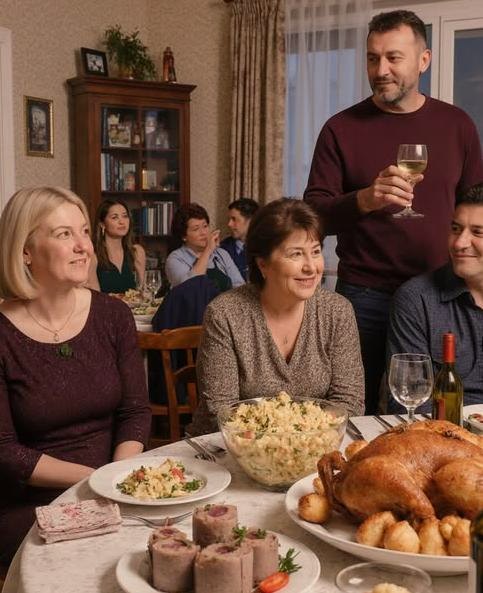
My husband stood beside the holiday table, raised his glass, and introduced me to his relatives as the woman who cleaned his house.
For two days I had cooked without sitting down. Thirty-two salads, four hot dishes, three trays of pastries, and a three-tier cake stood ready in our small apartment. The kitchen smelled of garlic, dill, roasted duck, and the sharp vinegar I had spilled on my wrist before dawn.
My hands were cracked from washing dishes. A strip of gauze covered the burn on my finger. I had tied it with a tiny red ribbon because the medicine cabinet was empty, and the ribbon kept catching on the towel whenever I reached for another pan.
At ten in the morning, my daughter Tanya leaned against the kitchen doorway.
“Mom, let me do something.”
“Cut the cucumbers,” I said. “And don’t make the pieces too large. Raisa counts them.”
Tanya glanced toward the bedroom, where Gennady was still sleeping.
“He could help.”
“He could,” I answered.
The word sat between us like a plate neither of us wanted to touch.
Gennady had always been good at appearing tired whenever work was required. He owned a small repair shop, though the shop had started with money from my mother’s inheritance. For eleven years he had called that money “our beginning.” For eleven years I had called it the reason there was still food in the refrigerator.
By noon, relatives began arriving. Raisa, Gennady’s mother, inspected the tablecloth with two fingers and frowned at a crease near the centerpiece.
“You should have ironed it again,” she said.
“Iron the food too?” Tanya asked from behind her.
Raisa’s mouth tightened.
Gennady appeared in a white shirt, smelling of expensive cologne and sleep. He kissed his mother, took a pastry from the tray, and nodded toward me.
“Good. You managed everything.”
I waited for him to notice the bandage on my finger.
He did not.
At two, the dining room filled with voices. Plates clinked. Someone laughed too loudly. Raisa told the story of how Gennady had been a difficult child, and Gennady pretended to be embarrassed while enjoying every second of it.
I carried the duck from the kitchen. The roasting dish burned through the towel, and pain flashed up my wrist, but I kept walking.
When everyone had been served, Gennady rose with his glass.
“To family,” he said.
The room quieted.
He looked at Tanya first, then at me.
“I want everyone to understand something. Marina is very useful. She keeps the place clean, cooks well, and knows how to serve guests.”
A few cousins smiled uncertainly.
Gennady lifted his chin.
“But let’s not confuse usefulness with being a wife. Marina is a housekeeper. That is all she has ever been.”
The fork in Tanya’s hand struck her plate.
Raisa lowered her eyes, as if she had been waiting for those words.
I felt the heat leave my face. Not anger. Something colder. Something that had been sleeping under eleven years of unpaid work.
Gennady turned toward me.
“Well? Aren’t you going to thank me for being honest?”
I placed the serving spoon on the table.
Then I looked at Tanya.
“Bring me the red recipe tin from the top shelf.”
Gennady laughed.
“What are you planning to do with recipes?”
Tanya disappeared into the hallway. A moment later, we heard the scrape of a chair, the rattle of glass jars, and her quick footsteps returning. She held the tin against her chest.
I reached for the lid, but before my fingers touched it, Gennady pushed back his chair and said, “You really don’t want to open that here…”
PART 2
“You really don’t want to open that here…”
Gennady’s hand remained on the back of his chair. His smile had disappeared, but his voice was still smooth enough to fool anyone who did not know him.
I knew him.
I knew how he rubbed his thumb across his knuckle whenever he was frightened. I knew how his left eyelid twitched when he lied. I knew he had stopped looking at the red recipe tin months ago.
Tanya set it in front of me.
“What is inside?” she asked.
“Things your father forgot.”
Raisa struck the table with her palm.
“Marina, do not make a scene in my son’s home.”
I looked at her.
“Your son’s home?”
The room became so quiet that I could hear gravy dripping from the serving spoon into the bowl.
Gennady leaned toward me.
“You have been living here because I allowed it.”
A cousin near the window shifted in his chair.
I touched the red ribbon around my bandaged finger. It had come loose, and the knot hung like a small, ridiculous flag.
“Did you allow the mortgage payments too?” I asked.
His face changed.
Tanya stared at him.
“What mortgage payments?”
“Nothing,” Gennady said quickly. “Your mother is tired. She has been cooking for two days and isn’t thinking clearly.”
I opened the tin.
Inside were recipes written in my mother’s careful handwriting, old grocery lists, and beneath them a thick bundle tied with kitchen twine. I lifted it out. The papers smelled faintly of flour and dust.
Raisa pushed herself up.
“Those are private family matters.”
“No,” I said. “They are financial matters.”
Gennady stepped closer.
“Put that away.”
“Why?”
“Because you are humiliating me.”
I almost laughed. For eleven years, he had humiliated me in smaller ways every day. He had called my work natural, my money temporary, my exhaustion dramatic. But he had never imagined that the person he ignored was keeping records.
Tanya reached for the top page.
“Mom, what is this?”
“Bank statements. Receipts. The loan agreement.”
Gennady grabbed the paper from her hand.
“Those prove nothing.”
“They prove that the down payment came from my mother’s inheritance,” I said. “They prove that I paid the mortgage from my salary at the clinic while you used shop income for your own expenses. And they prove the apartment is not registered the way you told everyone.”
Raisa turned sharply toward her son.
“You said the apartment was yours.”
“It is ours,” he snapped.
“Then why are you sweating?” Tanya asked.
His fingers crushed the corner of the statement.
I had not planned to open the tin at dinner. I had planned to wait until Monday, take the papers to a notary, and leave with Tanya before Gennady could turn the conversation into another performance.
But he had chosen the table. He had chosen the audience. He had called me a housekeeper in front of the people whose approval he had used to keep me silent.
So I reached deeper into the tin.
At the bottom lay an envelope sealed with red wax. It contained the document I had found three nights earlier beneath the spare tire in Gennady’s car.
He had thought I had not seen it.
I placed the envelope on the table.
Gennady lunged for it.
Tanya caught his wrist.
“Don’t touch my mother.”
His head snapped toward her.
“I am your father.”
“Then why are you afraid of a piece of paper?”
For a second, nobody moved.
Then someone knocked hard on the apartment door.
Gennady went white.
A woman’s voice came from the hallway.
“Mr. Volkov, open up. I brought the original transfer papers…”
PART 3
“Mr. Volkov, open up. I brought the original transfer papers…”
Gennady stared at the door as if the voice belonged to a ghost.
Raisa whispered, “Who is that?”
He did not answer.
The knocking came again, sharper this time. Tanya kept one hand around my wrist, as though she feared her father might pull me away from the table. I could feel her pulse against my skin.
“Open the door,” I said.
“Marina, don’t,” Gennady warned.
I stood.
The floor felt unsteady beneath my feet, but my voice did not.
“Open it.”
Gennady remained frozen until Raisa shoved past him and turned the handle.
A woman in a dark green coat stood in the corridor. She was in her fifties, with a leather folder under one arm and rainwater shining on her shoes.
The moment she saw the relatives gathered behind me, she stopped.
“Mr. Volkov,” she said, “you told me this was a private signing.”
“Who are you?” Raisa demanded.
“My name is Elena Markova. I was the notary who prepared the ownership transfer.”
The room seemed to tilt.
Gennady took a step toward her.
“You were supposed to come Monday.”
“You called me this morning and said your wife had agreed to sign today.” Elena looked at me. “Is that true?”
“No,” I said.
Her expression hardened.
“Then I need to explain something before anyone touches those papers. Three nights ago, Mr. Volkov brought me a copy of a power of attorney bearing your supposed signature. I refused to accept it because the signature did not match the identification record attached to it.”
Gennady’s face emptied of color.
“That is not what happened.”
“You also told me your wife was ill and unable to attend,” Elena continued. “You asked whether the apartment could be transferred to your company before the mortgage bank reviewed the account.”
Raisa turned on him.
“You were selling the apartment?”
“Not selling,” he said. “Restructuring.”
“Into your company?” I asked.
He looked at me then, and the fear in his eyes was no longer hidden.
I opened the red-wax envelope. Inside was a photocopy of the transfer request, the power of attorney, and a handwritten note from the bank employee who had called me after recognizing my account number.
Elena saw the papers and took a slow breath.
“I wondered whether you had received these.”
“You sent them to me?” I asked.
“No. Your bank did. They asked me to verify the signature after you appeared in their records as granting authority.”
Tanya looked at her father.
“You tried to take Mom’s apartment?”
Gennady’s shoulders sagged.
“I was trying to save the shop.”
“With her home?” I asked.
“The shop has debts. If I lose it, everything goes.”
“You said the shop was profitable.”
“I lied.”
The confession landed harder than his insult.
Raisa covered her mouth. One cousin quietly put down his glass. Elena opened her folder and placed the original bank notice beside the cake I had baked before sunrise.
“Your wife’s name is the only name on the ownership certificate,” she said. “The inheritance paid the entire initial contribution. The mortgage was paid from her account. Mr. Volkov has no authority to transfer this property.”
Gennady looked at me.
“Marina, please. I can fix this.”
“You had eleven years to fix the way you treated me.”
He reached for my hand.
I stepped back.
Then his phone rang.
He looked at the screen and answered with a trembling hand.
“Yes?”
He listened.
The color returned to his face, but not with relief. With terror.
“What do you mean the buyer is already at the shop?” he whispered.
He ended the call and stared at the table.
I thought the papers had exposed everything.
Then Elena pulled one more page from her folder.
“Mrs. Volkov,” she said softly, “there is something else you need to know. The transfer was not the only document he submitted…”
The last document made Gennady grip the table…
I thought the apartment papers were the whole truth. I was wrong, and the final document changed what everyone understood about that dinner.
“You will not sleep here.”
The room finally understood who had been carrying whom.
👇 The final part of the story is now open.






