PART 4
“The transfer was not the only document he submitted…”
Elena placed the last page beside the red-wax envelope.
Gennady moved so quickly that his chair struck the wall.
“Don’t show her that.”
Elena held the paper against her chest.
“What is it?” I asked.
“A loan application,” she said. “Submitted to a private lender using your name as guarantor.”
Tanya made a small, wounded sound.
I looked at the page.
My name was there. My clinic address. My account number. Even the spelling mistake I had made years ago when filling out a tax form.
But the signature was not mine.
It was close enough to fool someone who wanted the money quickly. The final letter curled too far upward. My mother had once said that my signature looked like a bird trying to escape a cage. This one looked like a hand pretending to be mine.
“Can he borrow against my account?” I asked.
“No,” Elena replied. “Not now. The lender has already frozen the application because the property documents were inconsistent. But the person who arranged it may not wait.”
Gennady pressed both hands against the table.
“I had no choice.”
Raisa stared at him.
“You forged her name?”
“I was going to repay it.”
“With what?” I asked.
He looked toward the window, toward the street where the shop stood three blocks away.
“The buyer,” he said. “He offered enough to cover everything.”
The room erupted.
Raisa slapped his shoulder.
“You were going to sell the shop and steal her home?”
“I was trying to keep us from losing everything!”
“No,” I said. “You were trying to keep yourself from admitting that you had already lost it.”
He turned on me.
“You think you are better than me because you kept receipts?”
“I think I am tired of being called useless by a man who could not survive one week without the things I paid for.”
His face twisted.
For a moment I saw the Gennady I had married: twenty-nine years old, frightened of failure, carrying a toolbox with a broken red latch. He had promised me he would build a business where no one could dismiss him. I had believed him. I had given him my mother’s inheritance, sold my car, worked evening shifts, and packed his lunches while he learned the trade.
The cruelest part was not that he had failed.
It was that he had hidden the failure by making me smaller.
A knock sounded from the corridor again.
This time a man in a wet work jacket stood outside. He held a metal case and a folder.
“Gennady Volkov?”
“Yes.”
“I’m Pavel Sidorin. I represent the lender. We need to discuss the collateral documents.”
Gennady looked at me.
“Marina, tell him this is a misunderstanding.”
I stepped into the hallway.
“It is not my debt,” I said. “And this apartment is not collateral.”
Pavel glanced at Elena, who nodded.
“Then Mr. Volkov has a serious problem,” he said.
Gennady grabbed my sleeve.
“Please don’t do this in front of everyone.”
I looked down at his hand.
That hand had taken my inheritance, my wages, my time, and the last piece of roast duck before I had eaten a proper meal. It had rested on my shoulder in public while privately pushing me toward the kitchen.
I pulled free.
“You brought everyone here,” I said. “You wanted an audience.”
The lender handed him a notice. Gennady read it, then sat down on the floor beside the coat rack.
Raisa began to cry.
Not for me.
For the son she had protected so carefully that he had never learned to stand without stepping on someone else.
Tanya came to my side.
“Are we leaving?”
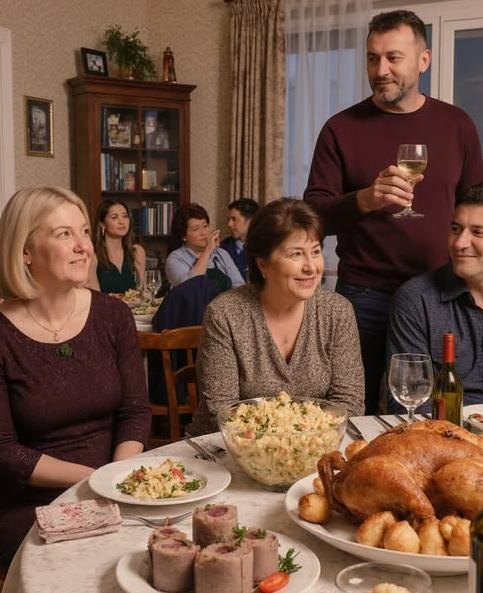
I looked back at the table. The duck was going cold. The cake leaned slightly to one side because I had rushed the final layer. Thirty-two salads waited beneath their plastic covers, each one made by hands no one had thanked.
“Yes,” I said. “But not yet.”
Gennady lifted his head.
“What do you mean?”
“I mean we are eating.”
Everyone stared at me.
I carried the cake knife to the table and cut the first slice. My bandage had loosened, and the little red ribbon fell onto the tablecloth.
I placed the slice in front of Tanya.
Then I turned to the relatives who had watched me work, watched me serve, and watched him insult me.
“Take what you brought,” I said. “The food is mine. The apartment is mine. The shame at this table is not.”
Nobody argued.
One by one, the relatives began to leave. Some avoided my eyes. Some touched my shoulder. Raisa remained seated until the room had emptied.
She approached me near the kitchen sink.
“I knew he treated you badly,” she whispered. “I told myself you were strong enough to bear it.”
“I was strong enough to survive it,” I said. “That is not the same thing.”
She nodded, crying silently.
“Can I help you?”
I looked at the mountain of dishes.
“No,” I said. “But you can take your son with you.”
Raisa went to Gennady.
He had not moved from the hallway floor. The lender and Elena stood nearby, discussing documents he could no longer hide behind excuses.
“Get up,” Raisa told him.
“Mom, I have nowhere to go.”
She pointed toward the coat rack.
“You can sleep in the shop office until you repay what you owe. But you will not sleep here.”
He looked at her, stunned.
“You’re choosing her?”
Raisa’s eyes went to my burned finger, the cracked skin, the untouched plate in front of me.
“No,” she said. “I am choosing not to lie for you anymore.”
Gennady stood slowly.
Before he left, he came to the kitchen doorway.
“Marina.”
I kept rinsing a glass.
“I did love you,” he said.
The water ran over my hands.
“I know,” I answered. “That is why it took me so long to understand what you were doing.”
He swallowed.
“Can we talk later?”
“About the loan, you will speak with Elena. About the shop, you will speak with the lender. About the marriage, you will speak with the truth.”
He waited for me to look at him.
I did not.
When they were gone, Tanya stood beside the red recipe tin.
“Mom,” she said, “what will happen now?”
I dried my hands and closed the tin.
“Tomorrow, I’m taking it to the bank.”
“And after that?”
“After that, I’m going back to the clinic.”
She smiled faintly.
“You still have work?”
“I always had work.”
That evening, we packed the food into containers and carried it to the women at the clinic who worked the night shift. The duck fed six people. The pastries disappeared before midnight. The crooked cake became a joke, then a second helping.
The apartment felt different without Gennady’s cologne clinging to the hallway.
Not empty.
Accurate.
The next morning, Elena met me at the bank. We canceled the false authorization, froze every account connected to the loan application, and filed the documents showing that the apartment belonged to me. The lender pursued Gennady’s shop, not my home. The buyer withdrew when he learned the property had never been available.
Gennady lost the shop because he had offered it as security for debts he could not repay. He did not lose it because I ruined him. He lost it because the numbers finally stopped obeying his stories.
The divorce was handled quietly. No courtroom performance. No relatives seated behind either of us. Just signatures, a clerk, and a question about whether I understood the division of property.
“I understand,” I said.
I kept the apartment.
I also kept the red recipe tin.
Months later, Tanya and I began selling pastries from a small counter near the clinic. She named the business after my mother’s recipe for honey cake, the one written on the oldest card in the tin. I did not call it a family business. I called it mine.
One afternoon, Raisa came in carrying a paper bag.
She placed it on the counter.
“I brought the old serving spoon,” she said. “It was in Gennady’s shop office.”
I recognized the dent near the handle. I had used it at every holiday table for eleven years.
“You can keep it,” I told her.
She shook her head.
“No. It belongs with the person who actually served everyone.”
She left before I could answer.
That night, Tanya found the red ribbon from my bandage tucked between the recipe cards. She tied it around the handle of the old serving spoon and set it beside the first honey cake we had baked for sale.
Then she cut a slice, held it out to me, and said, “Sit down, Mom. This one is yours.”
And for the first time, the serving spoon stayed on the table while I tasted what my own hands had made.






