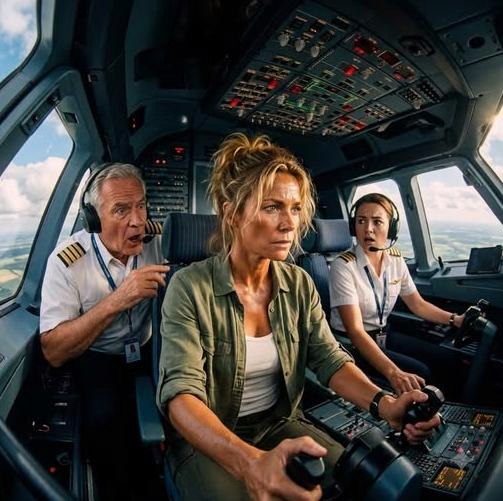
The captain announced that our plane was uncontrollable, and the woman beside me began praying into a paper napkin.
“Brace for impact,” Captain Thomas Reed said over the speakers. “I’m sorry. Tell your families you love them.”
The words moved through the cabin like a shockwave. A baby started crying near the front. Someone dropped a phone, and it skittered beneath the seats. The smell of coffee, spilled when the plane lurched, filled the air with something bitter and hot.
I was sitting in 14C, sixty-eight years old, wearing faded jeans, black work boots, and a canvas jacket with a brass aircraft-wrench pin on the collar. The passengers around me saw an old woman with scarred hands.
They did not know those hands had once flown experimental aircraft.
The plane rolled right again.
Fifteen degrees. Thirty. Then forty-two.
A man across the aisle shouted, “We’re falling!”
“No,” I whispered. “Not yet.”
The three shudders came seconds apart. A deep vibration under my feet. Then another. Then a hard metallic tremor that traveled through the seat frame and into my spine.
I had felt those three movements before.
Thirty-four years earlier, at Edwards Air Force Base, I had felt them inside a stealth prototype called the Wraith. All three hydraulic systems had failed in nine seconds. The engineers had known the system was defective. They had sent me into the sky anyway.
I had landed that aircraft using engine thrust and almost nothing else. Two people died on the ground. The Air Force blamed me, stripped away my medals, canceled my pension, and made sure my daughter grew up believing her mother was a reckless killer.
For fifteen years, Emily refused to speak to me.
Two months ago, she called.
“I found your test reports,” she said, her voice shaking. “Mom, I think they lied about you.”
She had invited me to her wedding in Seattle. I had spent the money Gus gave me on a navy dress and a ticket for Pacific Crest Flight 2891.
Gus had been my crew chief at Edwards. He was the only person who had never accepted the official story. That morning in Las Vegas, he had driven me to the airport in his rattling blue pickup and pressed a folded receipt into my hand.
“Give Emily my love, Phoenix,” he said.
Nobody had called me that name in decades.
Now the cabin tilted toward the clouds and the floor seemed to disappear beneath us.
A flight attendant grabbed my arm.
“Ma’am, sit down and fasten your belt!”
“Get me to the cockpit.”
“Are you out of your mind?”
“I’m a test pilot.”
The woman stared at my hands. Burn scars crossed my knuckles like pale ropes.
Captain Reed’s voice broke through the screaming. “We have no response from the controls. Prepare for impact.”
I unbuckled.
The passenger beside me seized my sleeve. “Where are you going?”
“To keep us alive.”
I pulled myself along the seatbacks as the aircraft rolled farther. A suitcase tore loose from an overhead bin and struck the ceiling. The flight attendant stumbled, caught herself against a service cart, and looked toward the cockpit door.
“You can’t just walk in there,” she said.
“Then watch 187 people die while you protect a locked door.”
Her lips parted.
The floor angled beneath us. I felt the old mathematics begin forming in my mind: engine thrust, rudder pressure, bank angle, airspeed. No hydraulics meant no normal control surfaces. But a jet was still a machine with two engines, and machines obeyed physics even when people panicked.
The attendant stepped aside.
I reached the cockpit and wrapped my fingers around the handle. Behind it, Captain Reed was shouting into the radio while First Officer Jennifer Parker fought useless controls.
I pulled the door open, and both pilots turned toward me.
Then Captain Reed saw the scars on my hands and went completely still…
PART 2
Then Captain Reed saw the scars on my hands and went completely still.
“Who are you?” he demanded.
“Someone who has landed a jet without hydraulics.”
Jennifer Parker looked at him. “Captain?”
“Get out,” Reed snapped.
The aircraft dropped hard enough to lift us from the floor. Warning lights flashed across the instrument panel. The cockpit smelled of hot insulation and fuel.
I grabbed the back of the jump seat.
“Your controls are dead because the hydraulic reservoirs are empty,” I said. “Stop pulling on them.”
Reed’s face had gone gray. “You’re a passenger.”
“I was Lieutenant Colonel Sarah Mitchell. Edwards test division. Call sign Phoenix.”
Jennifer stared at me. “The Wraith crash?”
“The same.”
“I read about that,” she said. “You lost control.”
“I did not lose control. It was taken from me.”
Another alarm screamed. The plane rolled to fifty degrees. Reed’s hand slipped from the yoke.
“Fuel flow,” I said. “Throttle back the left engine and increase the right by two percent.”
Jennifer hesitated. “That will make us turn.”
“Exactly. The engines are our rudder now.”
Reed’s eyes narrowed. “If you’re wrong, you kill everyone.”
“If I’m wrong, we die in the next minute anyway.”
He looked at Jennifer.
She moved first. Her fingers closed around the throttles, steady despite the trembling cockpit. The aircraft answered with a slow, painful change in direction.
The bank eased from fifty degrees to forty-six.
A roar went through the cabin behind us.
“Again,” I said. “Small correction. Do not chase the instruments.”
Reed swallowed. “Where did you learn this?”
“From a machine that was supposed to kill me.”
He adjusted the engines. The nose rose by a fraction. Outside the windshield, the horizon crawled back into view, bright and impossibly calm.
Jennifer pointed at a display. “Hydraulic pressure is not just gone. The lines ruptured at the same time.”
“Three systems?”
“All three.”
My stomach tightened. Three independent systems did not fail together unless something connected them. Or unless the same defective part had been placed in all three.
I leaned toward the maintenance screen.
“Pull up the component history.”
Reed gave a bitter laugh. “We’re trying to fly a crippled aircraft.”
“And the reason it became crippled is on that screen.”
Jennifer entered the command. A list appeared: pump assemblies, lot numbers, supplier codes, installation dates.
Then I saw it.
HX-4417.
The number had been stamped into the Wraith’s failed pumps thirty-four years earlier. I remembered it because I had copied it by hand before the crash, while lying on a hospital bed with both hands wrapped in bandages.
“That’s impossible,” I whispered.
“What?” Jennifer asked.
“Read the supplier.”
She did. “Helix Aero Components.”
Captain Reed turned. “The parts were installed during our last maintenance check.”
“Two weeks ago,” Jennifer said. “Full certification.”
My canvas jacket caught on a metal edge. The brass aircraft-wrench pin tugged loose, and I caught it before it fell between the pedals.
Gus had given me that pin the week the Wraith went down. On the back, he had scratched three words with a screwdriver: Check everything twice.
I closed my fist around it.
“Helix did not just build these parts,” I said. “They built the ones that failed in my aircraft.”
Reed’s expression changed. “You’re saying this is connected?”
“I’m saying someone had thirty-four years to fix a defect.”
Jennifer studied the component list. “There’s a secondary note here. Maintenance hold. It says the lot was cleared by executive authorization.”
“Whose authorization?”
The screen refreshed.
Daniel Voss. Chief executive officer, Helix Aero Components.
I felt the cockpit narrow around me.
Daniel Voss had been a junior procurement manager at Edwards in 1992. He was one of the men who testified that I ignored a warning and caused the Wraith crash.
Reed stared at the name. “Can you prove this?”
“Not from here.”
“Then fly us.”
The airport at Boise appeared on the navigation display, but our glide path was too high and our rudder response was too slow. Beyond the runway stood a row of fuel storage tanks.
“We can’t land there,” I said.
Jennifer looked at me. “What are our options?”
I remembered every runway within range. Every wind direction. Every obstacle.
“There’s an old military strip near Pendleton,” I said. “Short, narrow, and surrounded by wheat fields.”
Reed shook his head. “It was closed years ago.”
“Closed to airlines. Not closed to physics.”
He gave me the radio microphone. “Tell me what to do.”
I reached for the throttles as the plane began to sink, but a new warning flashed red across the panel.
FUEL LEAK — LEFT WING.
Jennifer’s voice became very quiet.
“Sarah, if that wing ignites, the engines won’t be our biggest problem…”
PART 3
“Sarah, if that wing ignites, the engines won’t be our biggest problem.”
The warning light pulsed between us like a heartbeat.
“How much fuel?” I asked.
“Left tank is dropping fast.”
Captain Reed grabbed the radio. “Emergency services, this is Pacific Crest 2891. We have total hydraulic failure and a possible fuel leak.”
I leaned closer to the instrument panel. “Open the cross-feed. Isolate the left tank.”
Jennifer moved immediately.
Reed looked at me. “The old strip is twelve minutes away.”
“Then we have eleven minutes to stop the leak.”
A metal panel beneath the captain’s console began to vibrate. I knew that sound. Not an engine. Not turbulence.
A broken line striking its bracket.
“Can you shut down the left engine?” Jennifer asked.
“Not yet. We need its thrust to control the roll.”
Reed’s jaw tightened. “Tell me you have a better idea.”
“I have an old one.”
I asked Jennifer to lower the landing gear manually. She opened a maintenance compartment and pulled the emergency handle. The gear began to descend with a grinding shriek.
For one terrible second, the aircraft rolled left.
Then the weight of the gear stabilized it.
The radio crackled. “2891, this is Pendleton operations. Your field is not certified for a commercial jet.”
“Neither is a wheat field,” Reed answered. “Clear the strip.”
Static returned.
Then another voice came through. An older woman. Calm. “Captain Reed, this is Marta Alvarez. I’m at the maintenance hangar. Bring her in from the east.”
I knew that voice.
“Marta?” I said.
The line went silent for a moment.
“Phoenix,” she answered. “I wondered if I would ever hear you again.”
Marta had been the Wraith’s hydraulic systems engineer. After the crash, she vanished from the Air Force. I had spent decades believing she had joined the people who buried the truth.
“You knew about the defect,” I said.
“I knew before the first test flight.”
Reed looked between us. “What defect?”
Marta’s breathing filled the radio. “The pump housing was made from an alloy that became brittle under pressure changes. I wrote a rejection report. Daniel Voss removed it from the file.”
My hands tightened around the throttles.
“You watched them blame me.”
“I tried to speak. They threatened my son with prison for a security violation. I was afraid.”
The admission landed harder than the aircraft’s next drop.
“Why are these parts on our plane?” I asked.
“Because Voss bought the old tooling and sold the same design under a new certification number. The defect was never corrected.”
Jennifer looked at the maintenance screen. “Can you prove that?”
“I have the original rejection report. I kept a copy inside the old hangar wall.”
“Why call now?” I asked.
“Because Gus came here three days ago. He told me you were flying to Seattle. He said if anything happened, I had to stop hiding.”
My throat closed.
Gus had known. Not that this would happen, but that the past was still dangerous enough to require preparation.
Marta continued, “There is more. The current lot was not cleared by Voss alone. Someone at Pacific Crest signed the installation waiver.”
Captain Reed’s face hardened. “Who?”
She named the airline’s maintenance director, Paul Harker.
Reed stared at the floor. “Harker told us the lot had passed every inspection.”
“His signature says otherwise,” Marta replied. “He accepted money through a shell company.”
The left fuel warning turned red.
“Sarah,” Jennifer said, “we have five minutes.”
I reduced the left engine and poured thrust into the right. The aircraft swung toward the abandoned runway, descending through a wall of cloud.
Marta’s voice sharpened. “Phoenix, listen to me. The document I kept is not the only proof. Gus found the payment ledger.”
“Where is it?”
“He said he would bring it to Seattle himself.”
The radio crackled violently.
Then a man’s voice cut through the static.
“Sarah, if you land that aircraft, your daughter will never see the evidence.”
I recognized him before he said his name.
Daniel Voss.
He had somehow reached the emergency frequency.
“Where is Gus?” I demanded.
Voss laughed softly. “Ask your old friend what he did with the ledger. Ask him why he was already at the Seattle terminal when the aircraft took off…”
The runway appeared below us, narrow as a strip of tape, and behind the hangar a black car was accelerating toward a lone figure holding a metal case…
The ledger reached Seattle before the investigators did…
I thought surviving the landing was the hardest part. Then I saw who was waiting beside the runway.
“Inside is the truth they buried.”
Emily’s hands began to shake.
👇 The final part of the story is open






