PART 4
The black car was accelerating toward a lone figure holding a metal case.
“Gus!” I shouted.
Marta’s voice cracked over the radio. “He made it to the runway!”
The aircraft dropped through the last layer of cloud. Below us, the abandoned military strip stretched between fields of pale wheat. At its far end, Gus stood beside a battered utility truck, one hand gripping the case and the other waving toward the sky.
The black car swerved around him.
“Keep your eyes inside,” Captain Reed said.
“I need to know where he is.”
“You need to land.”
He was right.
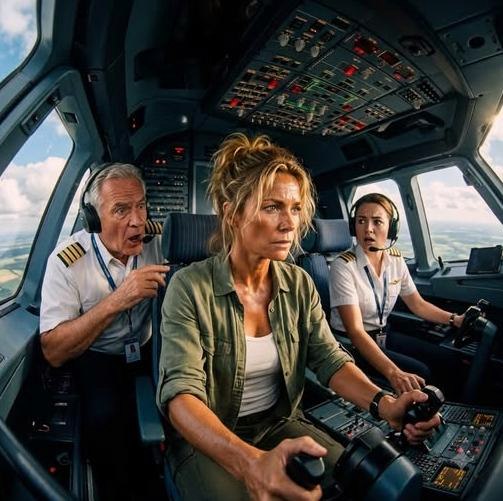
I handed the throttles to Jennifer and pointed at the horizon.
“Hold the nose there. Keep the right engine at seventy percent. If we drift left, give me a short burst of right thrust.”
Jennifer nodded. “And you?”
“I’m taking the landing.”
Reed unbuckled and moved behind us. “Tell me what to do.”
“Watch the airspeed. If it falls below one hundred and thirty, call it.”
“You’re flying by engine power alone.”
“No. I’m flying by what the aircraft still has.”
The runway rushed toward us.
The left wing shuddered as fuel sprayed somewhere inside the damaged line. A thin mist flashed silver in the sunlight. I reduced the left engine further and used the right engine to hold our heading.
“Air speed one forty,” Reed called.
“Gear down.”
“Gear is down.”
“Flaps?” Jennifer asked.
“Dead.”
The three of us understood what that meant. The aircraft would touch down fast and heavy. There would be no easy second attempt.
I lowered the nose by a fraction.
The tires struck the runway.
The impact slammed my chest against the harness. A shower of sparks erupted beneath the left wing. Passengers screamed behind us as the aircraft bounced once, then settled.
“Reverse thrust!” I yelled.
Jennifer pulled the right engine back. Reed engaged the remaining braking system, which responded unevenly but enough.
The jet veered toward the edge.
“Right thrust!”
Jennifer corrected. The nose swung away from the wheat and back onto the broken pavement.
A tire burst.
The aircraft lurched so violently that my head struck the instrument panel. Warm blood slid down my eyebrow.
The runway ended ahead.
I pushed the right engine forward for two seconds, not to accelerate, but to straighten the aircraft. Then I cut it.
The plane stopped with its nose hanging three feet beyond the pavement and its left wing smoking above the grass.
For a moment, nobody moved.
Then the cabin erupted.
People cried, laughed, shouted names. A man near the cockpit kept saying, “I’m alive,” as if he had to convince himself.
Captain Reed looked at me. “You saved us.”
“Jennifer did the engine work.”
“She followed your instructions,” he said.
“Then thank both of us later. Get everyone out.”
We evacuated through the forward doors. The air smelled of scorched rubber and wheat. I stepped onto the runway and saw Gus on his knees beside the utility truck.
The black car had hit the truck and stopped crookedly across the grass.
Two men climbed out.
Marta emerged from the hangar carrying a fire extinguisher. She was seventy-one, small, white-haired, and moving with furious purpose.
“Put it down!” she shouted.
One of the men raised a hand toward Gus.
Captain Reed caught his arm from behind and twisted it down. Jennifer grabbed the other man before he reached the case.
I ran to Gus.
Blood darkened his shirt below the ribs.
“Gus.”
He looked up and managed a crooked smile. “You always did make an entrance.”
“Who did this?”
“Voss’s security people.”
“You knew they were coming?”
“I knew Voss would panic when the plane failed.”
“You sent me into a trap.”
His smile disappeared. “No. I tried to keep you out of one.”
He pushed the metal case toward me.
Inside were folders, invoices, a small ledger, and a stack of photographs. On top lay a yellowed form bearing my signature.
I recognized it immediately. My original test report from the Wraith flight.
But beneath my signature, in a different ink, someone had added a sentence: Pilot declined recommended hydraulic inspection.
“That isn’t mine,” I said.
“I know.”
Marta came closer. “It was added after you were sedated. Voss had access to the medical archive.”
The world seemed to tilt again, though the aircraft was motionless behind me.
For thirty-four years, I had believed the lie began with a bad decision in the air. It had begun in a hospital room, while I was unconscious and my hands were wrapped in fire dressings.
Gus touched my sleeve.
“I found the nurse who saw them alter it,” he said. “Her name is Evelyn Price. She is in Seattle.”
“Why didn’t you tell me?”
“Because she was afraid. I needed proof before I brought her into this.”
I looked at the folders. “And Emily?”
“She knows the truth about the report. She doesn’t know how much of it was buried.”
My phone rang.
The screen showed Emily’s name.
I answered with hands that still smelled of jet fuel.
“Mom?” she said. “Are you safe?”
“I’m alive.”
“I heard there was an emergency landing. I’m coming to the airfield.”
“Emily, listen to me. There is something you need to see.”
A pause.
“Is it about the Wraith?”
“Yes.”
“Then I’m already on my way.”
Behind me, Daniel Voss stepped out of the black car.
He was older than I remembered, but his posture was unchanged: immaculate suit, polished shoes, one hand resting on the roof as though the wrecked aircraft belonged to him.
He looked past me at the passengers.
“You have no idea what you’re carrying,” he said.
“I know exactly what it is.”
“It will destroy Pacific Crest. It will destroy Helix. It will destroy people who had nothing to do with your old grievance.”
“This is not a grievance.”
He glanced at my burned hands. “You were unstable after the crash. Everyone knew it.”
Marta stepped beside me. “I wrote the rejection report.”
Voss’s face tightened.
“You signed a confidentiality agreement.”
“I signed it under threat.”
“You signed it.”
Gus coughed from the grass. “And you signed the payment ledger.”
Voss turned toward him.
That movement was enough.
Captain Reed took the ledger from the case and held it above his head so the passengers could see.
“This man tried to erase the cause of what happened,” he said. “He nearly killed everyone on my aircraft.”
Voss pointed at him. “You’ll lose your license.”
Reed looked at the smoking wing. “Maybe. But I won’t lose my name.”
Sirens approached from the county road. Fire crews and federal aviation officials had finally reached the strip. The two security men were held away from the aircraft while investigators photographed the damaged components.
Voss kept speaking, louder now, trying to turn the passengers against me.
“She was never cleared to fly that aircraft.”
“No,” I said. “I was a passenger.”
“You interfered with the crew.”
“I kept the crew alive.”
“You have no authority.”
I held up the altered report.
“Neither did you.”
Emily arrived twenty minutes later in a silver rental car. She ran across the grass in a cream-colored dress, stopped when she saw my bloody forehead, and wrapped both arms around me.
For a moment, neither of us spoke.
Then she pulled back and looked at the case.
“Show me.”
We sat on the step of the hangar while Marta laid the documents between us. She explained every signature, every transfer, every missing page. Gus described the nurse in Seattle. Captain Reed added his written statement. Jennifer photographed the component numbers and gave the images to the aviation officials.
Emily read the false sentence beneath my signature twice.
“They made me believe you caused the deaths,” she said.
“I believed it too, some days.”
She pressed her fingertips against the paper.
“I was fifteen when I stopped talking to you.”
“I remember.”
“I thought silence was punishment.”
“It was.”
Her eyes filled. “I’m sorry.”
I reached for her hand, but stopped halfway.
She closed the distance herself.
“You were supposed to come to my wedding as a guest,” she whispered. “Now you’re coming as my mother.”
“I don’t own a dress that survived a plane crash.”
She laughed through her tears. It was the first time I had heard that laugh directed at me in fifteen years.
Across the field, Voss watched the investigators remove the hydraulic pumps from the aircraft. One of them held up a corroded housing and read the lot number aloud.
HX-4417.
The same number that had burned into my memory beside the Wraith’s wreckage.
Voss’s empire did not collapse in one dramatic instant. It came apart in visible pieces: contracts suspended, executives resigning, maintenance records seized, insurers refusing coverage. Pacific Crest grounded every aircraft carrying the disputed components. Helix lost the government contracts Voss had spent thirty-four years protecting.
The aviation board restored my rank and cleared my name, but the ceremony was not what I expected. No medals could return the years Emily had spent believing I was dangerous. No certificate could give back the two people who died beneath the Wraith.
Marta testified publicly. Evelyn Price, the nurse, came to Seattle with the original hospital log. Gus survived surgery and refused to attend the ceremony unless someone smuggled him in wearing his grease-stained work shirt.
I brought him myself.
Before Emily’s wedding, she asked me to help her pin a small brass aircraft-wrench onto the inside of her bouquet ribbon. It was the pin Gus had given me in 1992. The scratches on its back were almost worn smooth.
“Check everything twice,” she read.
“Your grandfather’s sort of blessing,” I said.
“Gus is not my grandfather.”
“He is family.”
She looked at me carefully.
“So are you.”
The wedding took place beside the Seattle harbor, under a roof of glass and steel. When the music began, Emily did not walk toward a perfect mother restored by paperwork. She walked toward the scarred woman who had spent thirty-four years carrying a machine’s failure as if it were a personal sin.
At the end of the ceremony, she leaned close.
“Mom,” she whispered, “when you stood up on that plane, were you afraid?”
“Yes.”
“You didn’t look afraid.”
“I had passengers watching.”
She smiled. “You had me waiting.”
Outside, the wedding guests released small paper aircraft into the harbor wind. Emily’s was folded from a copy of the corrected report, the false sentence crossed out in red.
It flew badly, dipped toward the water, and then caught a rising current.
Gus stood beside me with one arm pressed against his healing ribs.
“Still think you’re retired, Phoenix?” he asked.
I watched Emily run after the paper aircraft along the pier, laughing as it climbed above the water.
“No,” I said. “I think I’m finally done being grounded.”
Missed the beginning?






