PART 4
Nora held the envelope between both hands.
It was not gray or sealed with wax. It was a cream-colored bank envelope, softened at the corners from being handled too often. A tiny red stamp marked it as belonging to the company archives.
My mother stared at it as though it were a lit match.
“Don’t open that,” she said.
I turned toward her. “Why?”
“Because your grandmother was sick. She wasn’t thinking clearly.”
Nora’s expression tightened. “She was thinking clearly enough to make me sign for it.”
Malcolm took out his reading glasses. “Aiden, the instructions are addressed to you.”
I broke the seal.
Inside was a single page and a photocopy of a deposit slip. Grandma’s handwriting filled the page in narrow lines.
She had known about the missing money for almost a year. She had also known that my mother would try to use the estate to cover it. But there was something I had not expected: Grandpa had not left the company shares to me because he favored me over his children. He had left them to me because I was the only family member who had never signed a document on behalf of someone else.
Grandma wrote that she had watched me pay their utility bills without being asked, return borrowed tools, and keep every receipt in a little metal tin. She trusted my habits more than anyone’s promises.
The final paragraph changed everything.
The $184,600 had not vanished.
Two weeks before Grandpa died, he had transferred an equal amount from a private reserve into an account held by an independent accountant. It was intended to restore the company’s operating funds if Elaine ever attempted to take control. The account could be released only by the trustee named in Grandpa’s private instructions.
That trustee was Nora.
My mother pushed away from the table.
“She stole that money,” Elaine said. “She hid it from me.”
Nora looked directly at her. “I protected it from you.”
Brent stood. “Mom, what did you do with the money you took?”
Elaine’s face collapsed inward. She sat down again and pressed both hands against her forehead.
“I paid the restaurant debts,” she whispered. “The equipment was repossessed. Brent was going to sleep in his car.”
“I had no idea,” Brent said.
“You would have let him fail.”
“No,” I said. “Grandpa would have helped him honestly. He just wouldn’t let you turn help into ownership.”
The room went quiet except for the wall clock.
Malcolm spread the papers across the table. The trust, the rejected share transfer, the ledger, Grandma’s letter, and the reserve account instructions formed a chain that could not be wished away. The company was still solvent, but the lender needed proof before Monday. Nora could release the protected funds, and the trust could challenge the false pledge. It would be expensive, humiliating, and public.
My mother looked at me.
“If you do this, everyone will know.”
“Everyone already knows something happened. You arrived with a truck to take the house before the records were checked.”
“I was scared.”
“I believe you.”
That surprised her.
I believed she had been terrified of losing the family’s image. I believed she had convinced herself that taking money was temporary, that moving into the house was practical, that a lie told to save Brent was kinder than the truth. But fear did not turn forged papers into permission.
Brent walked to the window and rubbed his thumb over the ink smear on Nora’s archive box.
“I’m returning the restaurant equipment,” he said.
My mother looked up sharply. “You can’t.”
“I can sell it. I can repay part of what you took.”
“You’ll have nothing.”
“I already had nothing. You just made me believe I had been rescued.”
That was the blow she could not argue with.
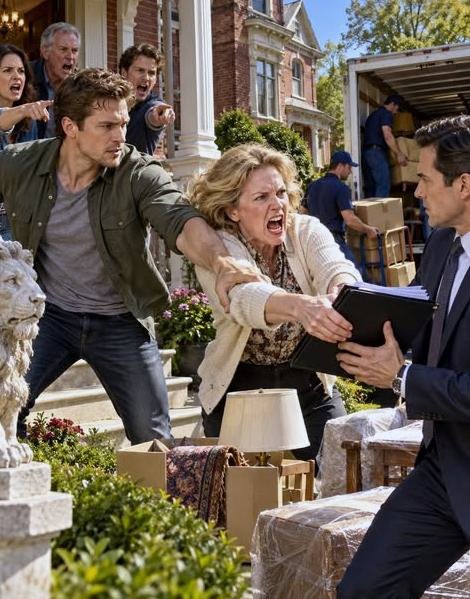
By noon, the moving truck was gone from the driveway. The labels had been peeled from the furniture and gathered into a crumpled pile on the porch. I carried Grandma’s reading chair back to its place beside the bookcase, then locked the study records in a fireproof cabinet Malcolm had brought from his office.
At 1:30, Nora and I went to the bank. She released the reserve under the instructions Grandpa had written, and the lender accepted the documentation before the factory’s credit line could be called. The shares remained inside the trust. Elaine had no authority over them, and neither did I alone. Any future company decision required Nora, Malcolm, and me to sign together.
My mother did not lose the house because she had never owned it. She lost the role she had built for herself—the person who could speak for everyone, rearrange everyone’s lives, and call the rearrangement love.
The family met at the Victorian that evening because I insisted that the inventory happen in the room where the argument had begun. Every missing item was listed. The green ledger was found in the bottom drawer of my mother’s desk at home. She had taken it after the funeral and hidden it beneath old tax folders.
When she placed it on the table, she did not ask me to forgive her.
That mattered.
“I can repay the company,” she said. “Not quickly. But I can sell the SUV, the cabin, anything that is mine.”
“You also need to sign a statement explaining what you did.”
She closed her eyes. “And if I refuse?”
“Then the records go forward without your explanation.”
She looked at the red-brick wall, at the photographs of her parents, at the chair she had tried to claim for someone else.
“I’ll sign.”
I did not hug her. She did not ask me to.
Instead, I put three documents in front of her: the repayment agreement, the resignation from the company board, and the written acknowledgment that no family member could occupy the house without my consent. She read every page. Then she signed with a black fountain pen that left a dark bead of ink beside her name.
Brent kept the restaurant’s lease but sold the expensive equipment. He repaid the first installment himself and took a job managing another kitchen. He visited the factory every Friday to work off the debt, not because I demanded it, but because he wanted his name separated from hers.
Marlene returned the spare key.
She placed it in my palm and said, “I should have asked you.”
“Yes,” I answered. “You should have.”
A week later, Nora brought the green ledger back to the study. She set it beside Grandpa’s coffee tin, the one where he kept receipts and loose screws. I opened the ledger to the last page.
Beneath the final column of figures, Grandpa had written one sentence for himself: Protect the thing that cannot speak for itself.
I used to think he meant the company.
That night, I understood he had also meant the truth.
The next morning, I signed the first repayment receipt and placed it inside the ledger. Then I added a new line beneath my grandfather’s handwriting, carefully leaving room for the numbers that would follow.
Nora stood behind me.
“What will you call the trust?” she asked.
I looked at the chair, the ledger, and the untouched bedroom labels still lying in the trash basket.
“Something simple,” I said. “The Vale Record.”
She smiled faintly. “That sounds like your grandfather.”
“No,” I replied, closing the ledger. “It sounds like what he was trying to leave us.”
Outside, Brent’s van stopped beside the factory gate with the first repayment boxes stacked in the back. He climbed out carrying the company’s missing files against his chest.
This time, nobody pointed him toward a room.
He walked straight to the records office and placed the box beneath the sign that read: Every signature matters.
Missed the beginning?